With our Canadian friend, Rene, and a rental car in hand it was time to leave Ubud after two weeks. Our plan was to drive an hour or so to the east to a small village named Sidemen. Sidemen had never been on our radar until Heather decided to get her hair cut in a salon in Ubud the week before. She chatted with a German tourist in the next chair over. “Sidemen is what Ubud was like twenty years ago” he claimed. “Hmmm” she thought, “we were in Ubud twenty years ago and it was pretty cool then”. Upon returning to our guesthouse she started researching. Pictures showed rice terraces surrounded by jungle-clad peaks with Mt. Agung in the background. A smattering of guesthouses and warungs (family-run restaurants) dotted the valley. It was just so . . . tranquil. And very green. And turned out to be exactly like the photos.
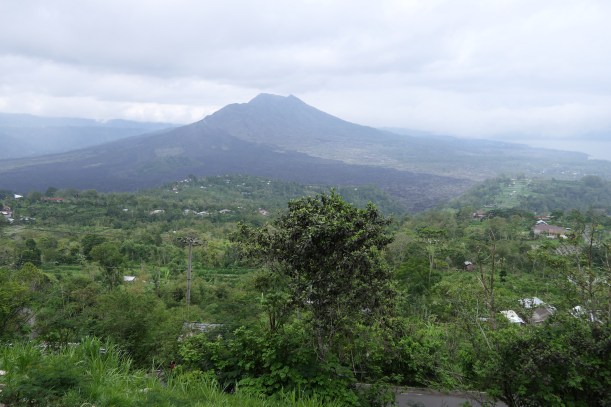
The Sidemen valley capped by the volcano – Agung.
The first afternoon was spent admiring the views from our guesthouse terrace. The next day, under threatening skies, we drove towards Mt. Agung, with the intention of driving up the flank of the volcano to see the temple that perched midway. The road climbed, and switch-backed, and narrowed as we ascended. There was no other traffic to be seen. We started to get almost incredulous stares from the locals as we passed by. Perhaps, we thought, not many folks make the drive up here. At times, the road was so steep our little Suzuki SUV would lose traction on the rain-slicked asphalt, only to grab hold and power us upward again. We eventually reached a ticket-seller just below the temple who waved for us to stop. “Fifty thousand rupiah (about $3.50) each person.” Then he carefully read off each of the items that the ticket covered, which were clearly printed, in English, on the face of the ticket: parking at the temple, entrance to the temple itself, a sari to cover our bare legs, access to the selfie spot (!) and the wooden platform (for views over the valley). We paid the fee and then asked if anyone else had visited this day. “Five other tourists. On motorbikes. Already gone.” We would have the temple to ourselves.
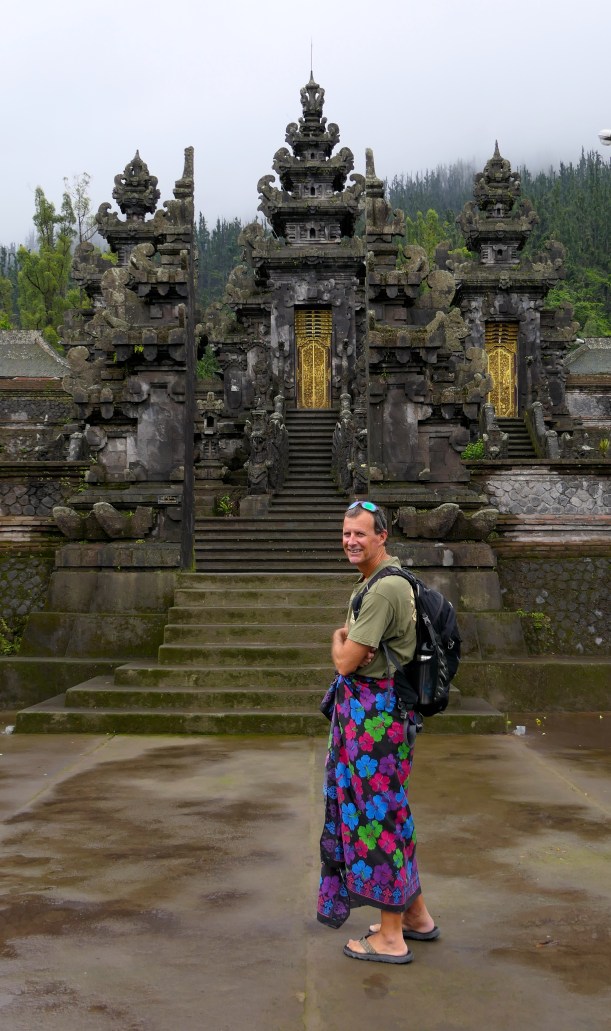
I paid for it – I’m gonna wear it. Pura Pasar Agung.
After descending the mountain, we returned to Sidemen for the afternoon. A drink was in order, so we ventured down one of the three roads in the valley until we found what looked like a promising warung, with a vine-covered bar adjacent. The bar overlooked a garden where a farmer tended to her chili plants. The eighteen-year-old bartender, who was incredibly passionate about his craft, proudly boasted of his drink menu. “We use only fresh fruit in season for our cocktails” he claimed. True to his word, we watched him step out from behind the bar to pick fresh passionfruit and mint leaves to craft our margaritas and mojitos. We chatted the entire afternoon, learning about the rice-growing process, his hopes to gain employment on a cruise ship some day, and the toll having a girlfriend took on his school studies.
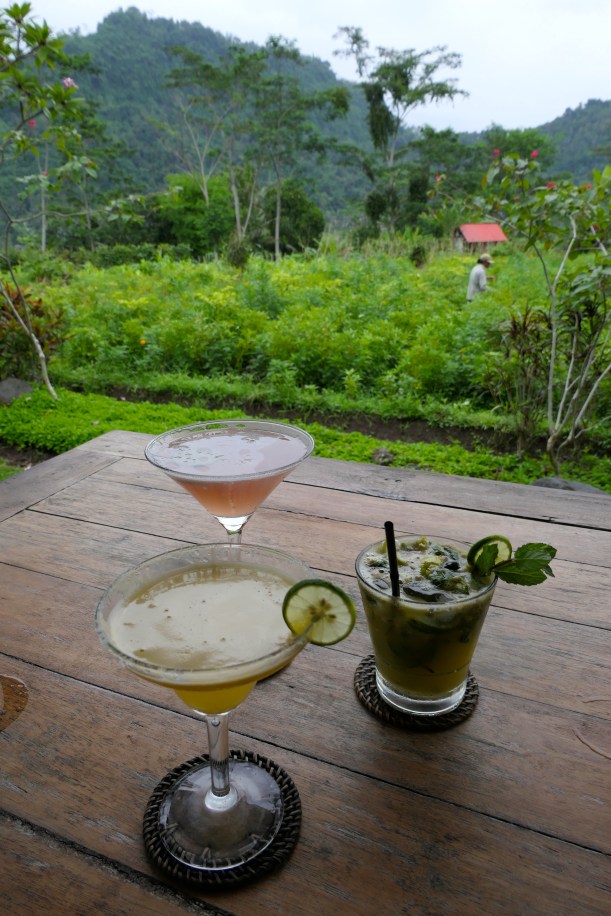
Cocktails, conversation and chili-harvesting.
The next day we drove more winding mountain roads, passing through rainforest-clad valleys, past coconut palms and banana trees, eventually bursting out of the dense jungle to reach the eastern shore at Candidasa. There were a number of temples to be seen in the area and the possibility of some snorkeling to be done. After checking in to our guesthouse, we opted out of the temple visits and settled for some time lounging by the pool and a little snorkeling in the bay after seeing several turtles come to the surface just off the beach. The snorkeling proved fruitless, however, as we couldn’t spot any turtles and a recent storm had left the water churned up, reducing visibility. We ventured out later for dinner and were rewarded with a stellar sunset (and the largest glasses of wine we’ve seen outside our own home).
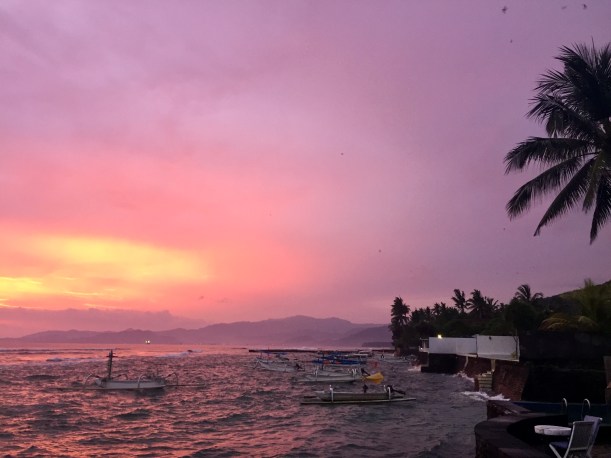
Candidasa sunset.
Finally, to complete our eastern Bali road trip, we drove down to Sanur, an old favorite stop of ours near Denpasar. Sanur is a strip of hotels, smaller guesthouses, warungs, hip restaurants (Soul On The Beach is our new favorite) all linked by a seaside promenade and also the speedboats that make the run out to Lembongan, Ceningan and Penida islands. In the past we’ve used Sanur as a base – to spend a week while extending our Indonesian visas, visiting a dentist for check-ups and cleanings or stocking up on supplies before heading out to Raja Ampat in the eastern part of the country. As in the rest of Bali, good value accommodation isn’t hard to find here. We wanted Rene to see the place in case she wanted to spend more time here after we split up in a few days. The next day we’d all be heading over to Penida for three days of exploring that large island and it’s many rugged beaches. But for now, we’d enjoy a pool, a long walk along the promenade and some really good food.

Can you say ‘Coco Loco’? Coconut water mojitos at Soul On The Beach, Sanur.
 The Rhum Line