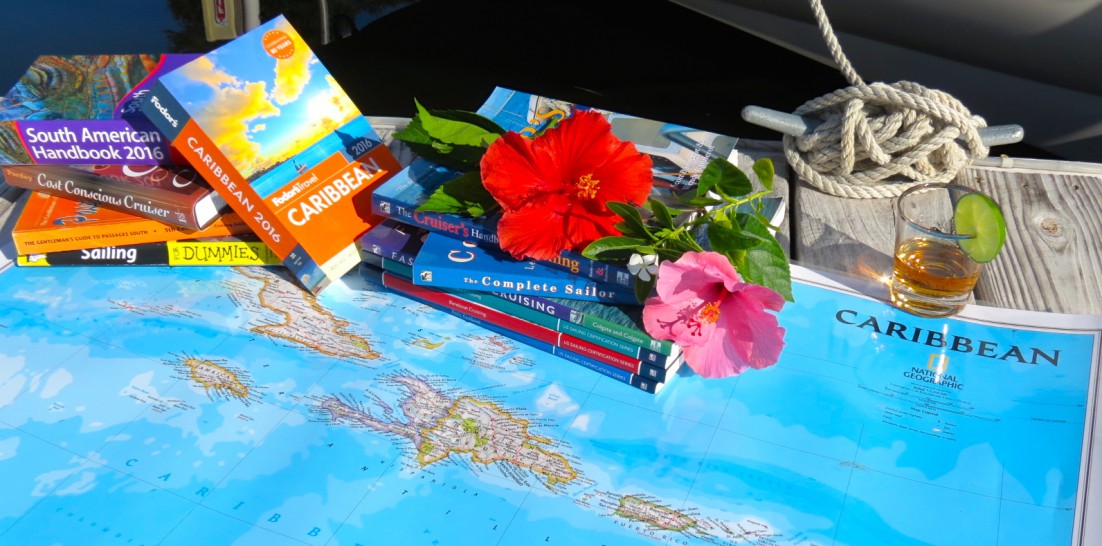
Spanish was coming at us from all sides. This was immediate and total immersion into the language. It had been five years since we had needed to speak (or attempt to speak) and understand it. But nothing had prepared us for being thrown into the middle of a crowd and trying to make heads or tails of the conversations surrounding us. Boy, we were in trouble! And we were still in the airport in Ft. Lauderdale, Florida . . .
Following the experience in our homeland, we had a smooth flight over the Caribbean Sea and across the northern stretches of the Andes into the valley that held Medellin, Colombia. We carried a bit of apprehension – we’re not city people and Medellin, Colombia’s second largest city after the capital, Bogota, has an unenviable past. It was, for a time in the 80’s and 90’s, the world’s most dangerous city and home to the notorious drug cartel leader, Pablo Escobar. But as we were to find out during our visit, Medellin is now one of the world’s most vibrant and innovative cities. Art and culture have given this city a level of excitement and energy unmatched by many others, and the paisas, the inhabitants of Antioquia province, of which Medellin is the capital, are justly proud of how they managed to bring themselves from the depths of drug violence to their present state.
On our first night, following the recommendation of our hotel clerk, we wandered a few blocks away to Mondongo, a restaurant specializing in the provincial cuisine. As tourists, we were alone amongst the locals – families, business-types and young couples. I had heard of the local specialty called bandeja paisa and was keen to give it a try. This plate consisted of a mound of rice, ground beef, a fried plantain, a slice of double-thick deep-fried bacon all topped by a fried egg along with a soup bowl full of beans. Heather opted for the more sensible ajioca, another regional dish consisting of a large bowl of broth brimming with shredded chicken, sliced potatoes and half a corn cob. Equally impressive to us were the procession of condiments and side dishes that the waiter proceeded to lay out on our table: arepas (corn meal cakes), limes, chopped cilantro, a plate of two different salsas and another plate containing segments of what surely must have been the world’s largest avocado as well as a couple of bananas. While most everything made sense in the context of the dishes, we never could figure how we were supposed to incorporate the bananas into our meals (like some others we elected to take them home for breakfast). The food was delicious. Having not had much to eat through our travels from the US to here, we gorged ourselves and were thoroughly stuffed. The following day I did a bit more research on the local dishes only to find that bandeja paisa is typically shared by two or more people. Could explain my slow start to our second day.
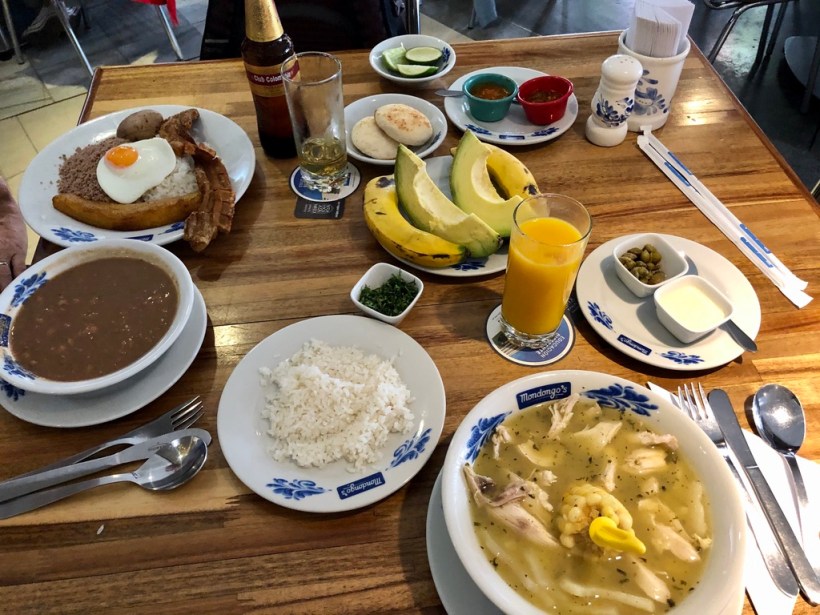
The Colombian trucker’s plate, bandeja paisa, on the left; ajiaco and the buffet of condiments on the right.
Our second and third days in Medellin took us to two extremes in the city – el centro, the heart of the city, and to Comuna 13, one of its poorest areas. El centro had the usual collection of government buildings, cathedrals and plazas. We were able to sample some street foods like empanadas (meat and potato-filled cornmeal pastries) and homemade frozen fruit pops. Also of interest was a wander through the ‘red light district’, centered around a small cathedral, where married men would absolve themselves of sin by offering a short prayer before taking up with the working girls just outside. Comuna 13, by comparison, is located on the edge of Medellin and climbs up the mountainside that borders the city. Once the most dangerous and violent of the barrios in Medellin, our guides insights to growing up during the turbulent times under the cartels left us speechless. But once the gangs were rooted out by the government, life here blossomed. The narrow alleyways of the comuna were covered in street art. People had painted their modest homes in bright colors. Vendors crowded the streets, offering ice cream, empanadas, fruit and drinks. Young men performed hip-hop moves, or sang or played guitars, hoping for a little change. It was as if life had been hibernating for two decades and now had burst forth and seen the light of day for the first time
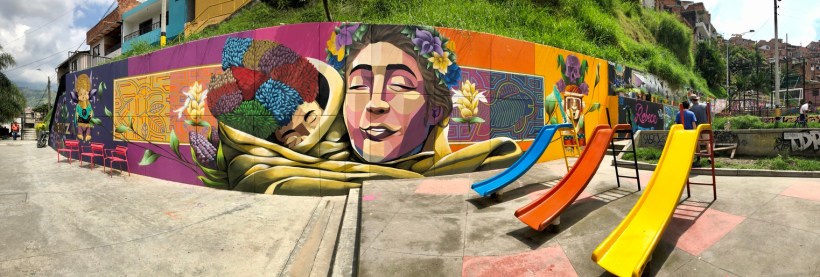
Street art in Comuna 13. Seems like anything that would hold color was a canvas.
.
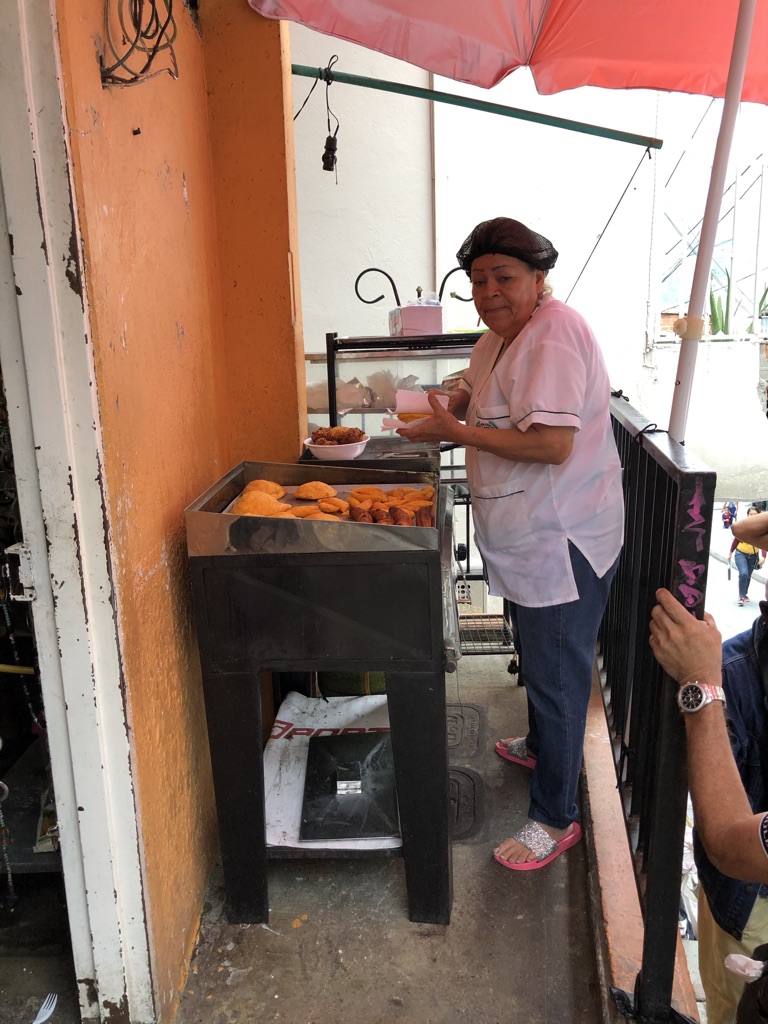
Still the best empanadas, in a country famous for them, that we ate. On the street in Comuna 13.
Leaving Medellin by bus, we traveled for two hours east across the mountains and into farm country (and not flat farm country). Pastures held cattle, hillsides were covered with fields of corn, strawberries and beans and small towns were filled with folks shopping. Still a half hour outside our destination of Guatape we caught our first glimpse of what brings hordes of tourists to the lake-side town – El Penol de la Piedra, simply known as ‘the rock’. Reaching a height of just over 7,000 feet in elevation, and accessed by 659 steps, ‘the rock’ towers over the lake-side and offers stunning views of the convoluted lake shore and the surrounding hills. While most folks visit Guatape as a day trip from Medellin, we opted for a two-night stay to enjoy the small-town vibe, colorful buildings lining the cobblestone streets and the fresh air, which was much appreciated after our time in the city. Besides visiting the rock, we wandered the streets, sipped cold beers in a cafe overlooking the main plaza and dined on trucha, the local farm-raised trout, for which the area is justly famous for.
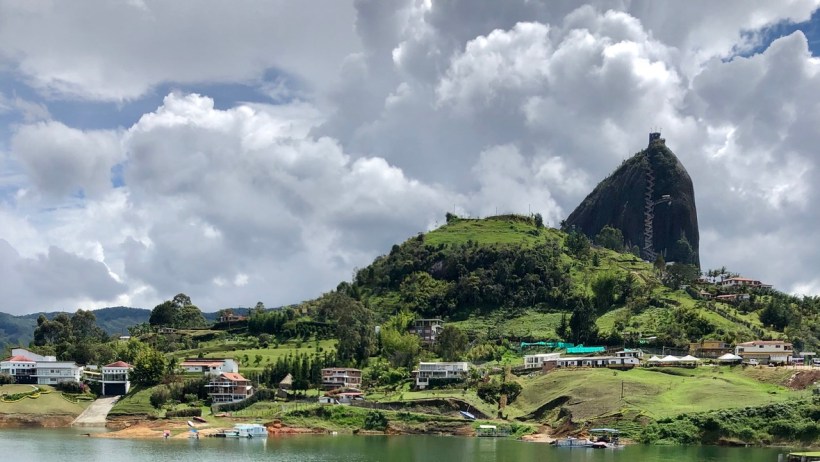
‘The rock’ from the bus to Guatape. Yes, those are the stairs straight up the side.
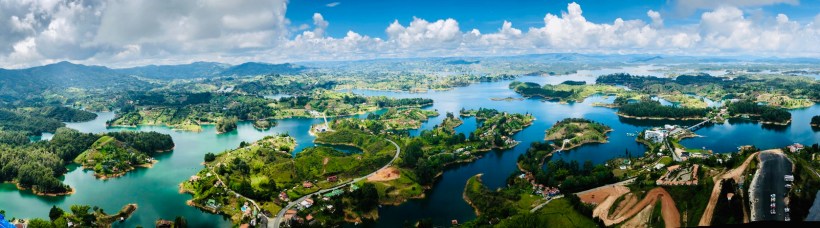
View from the top.
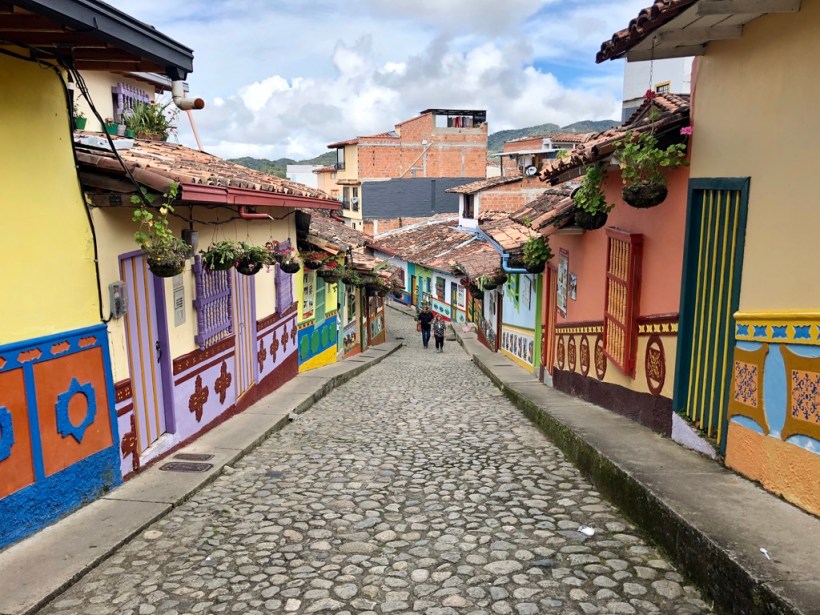
Colorful, clean, uncrowded Guatape. A wonderful respite from city life.
The title of this post indicated my intention to also cover our visit to Jardin, located about three hours, by bus, south of Medellin. But Jardin so impressed us, and we so enjoyed our stay that I thought it deserves it’s own post. So stay tuned . . .
 The Rhum Line