“Remember, we’re here to support the Cuban people” Heather whispered to me as we stood in adjoining lines at the immigration checkpoint in Havana’s airport after disembarking from our flight from Cancun, Mexico. American citizens are supposed to declare which of eleven categories of officially sanctioned visa categories they’re traveling on. “Thanks for reminding me” I whispered back, just as the female agent motioned me forward. As I stepped to her kiosk and placed my passport, which contained my Cuban visa card attained at the Cancun airport, on the counter, she yawned and stretched languidly, scooping up my passport as she brought her arms back down from above her head. She certainly didn’t seem overly concerned with the appearance of an American tourist, even though, as we were to find out during our travels through the country, my country has needlessly made life for the average Cuban citizen increasingly more difficult since 2016. Nevertheless, my visa card was stamped without question and I was free to enter the country. Soon after, Heather’s mom would arrive after her flight from Miami and join us for our ten day tour of the Communist country that lies just ninety miles south of Key West.
When we had announced our intention to visit Cuba, back in December, Mary Jane (my mother-in-law) had jumped at the chance to come along. She loves an adventure just as much as we do. In fact, a few years ago we celebrated her birthday by hiking to the Sun Gate above Machu Picchu, the year after that we were on safari in Kenya and Tanzania and the last two summers she’s visited us in Steamboat Springs she was the one to suggest we take road trips to visit Yellowstone, Mesa Verde and Taos, New Mexico. No ordinary vacations for this gal. So we set about identifying the various points of interest to see – the classic cars, Cuban folk music and Earnest Hemingway’s old haunts in Havana for Mary Jane, the beaches of Trinidad and Varadero for Heather and the mountains and tobacco fields surrounding the western town of Vinales for me. Heather, following a recommendation from a friend who visited a couple years ago, contacted a tour guide who would make the arrangements for our accommodation and transportation, and personally show us around the capital city on our first two days. After our arrival at the airport Reynold met us outside and ushered us to the parked ’56 Chevy which would carry us in comfort around the city for the next two days. Having thought the classic American cars were a rare exception amongst Cuba’s vehicle, I was pleasantly surprised to see that they were in fact the rule as they far outnumbered the newer imports from Korea, or even the older Ladas, which had come from the former Soviet Union. What was even more surprising was the number of horse carts that traveled along the shoulder of the roads throughout the country. We passed a number of billboards that glorified the 1959 revolution and reminded folks to uphold the ideals of the revolutionary leaders and continue along the path of Socialism. Once inside the city it was plain to see Socialism had been no friend to the Cuban people. Many of the once-grand buildings were crumbling. Those that still stood were in dire need of a coat of paint. The roads were full of pot-holes. We walked several streets that had sewage running in the gutters. Long lines formed outside the small shops that offered the barest of subsidized products, such as cooking oil, rice, beans and sugar. Similar lines were outside pharmacies, which a quick look through the window had revealed mostly empty shelves and cabinets. Reynold repeatedly mentioned that people couldn’t even get soap or toilet paper, let alone medicines and fuel for their automobiles. It was apparent that life for the average Cuban was not easy. Reynold revealed that the average wage for a Cuban middle-class worker was about $40 – per month. In the countryside we witnessed more long lines as people waited by the roadside for busses, sometimes for hours as the busses often didn’t run on schedule due to mechanical issues or the shortage of diesel fuel. A number of times we spotted doctors, part of that middle class, in their white medical coats, waiting in those lines.
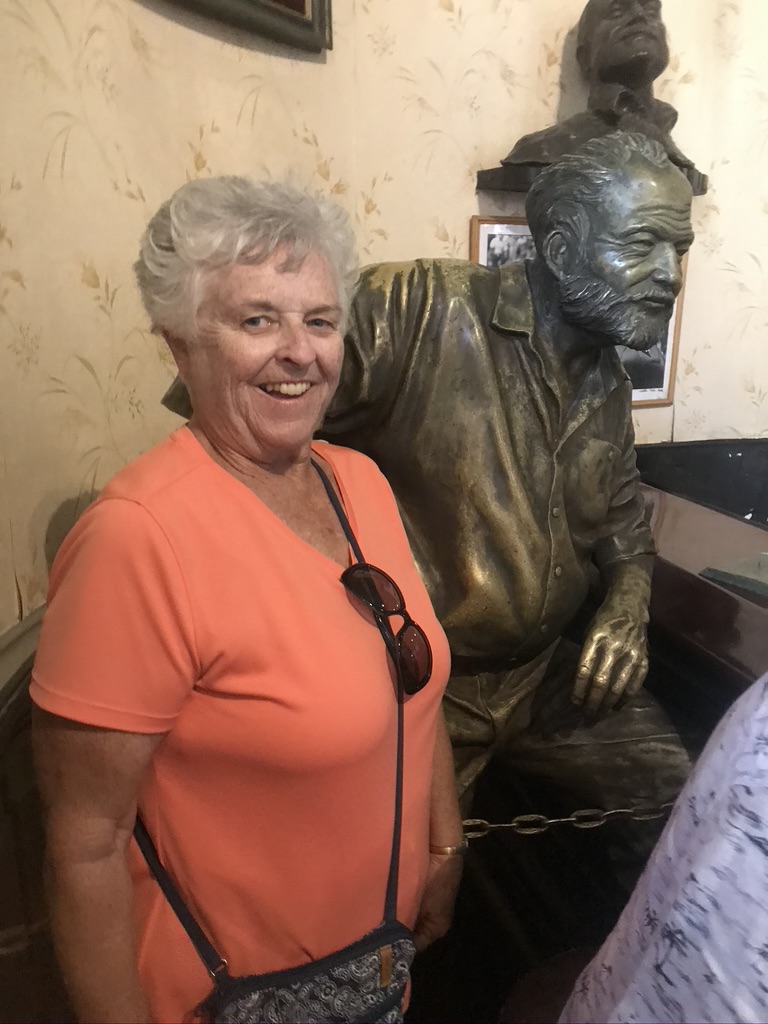
My mother-in-law and some writer . . .
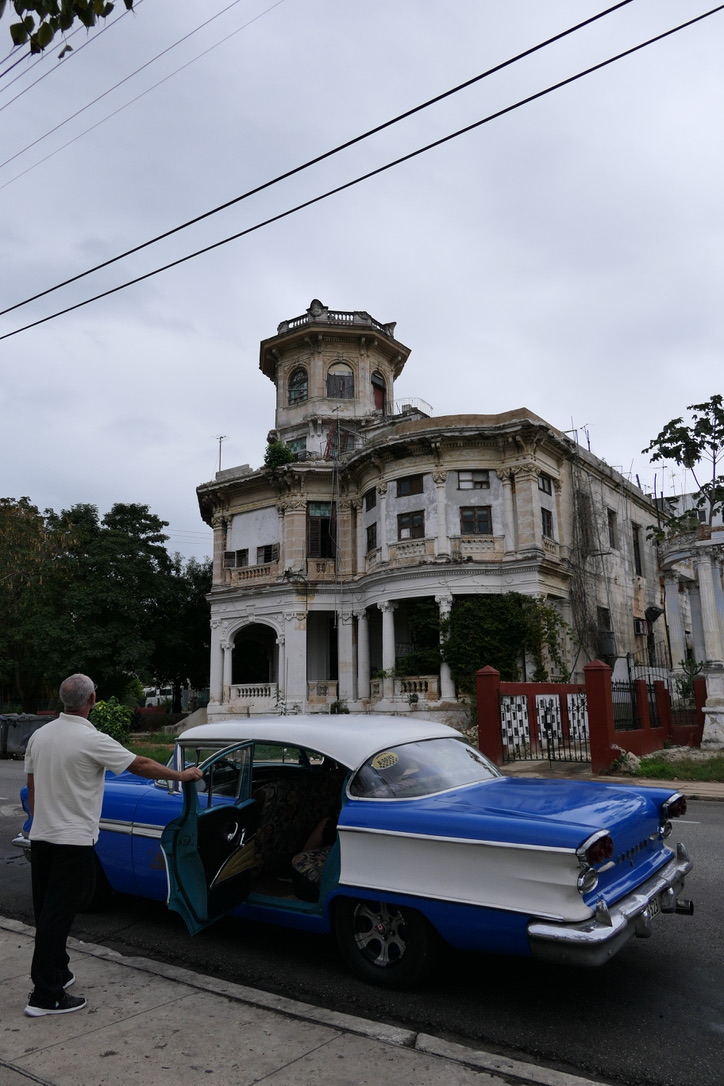
Touring Havana in style.
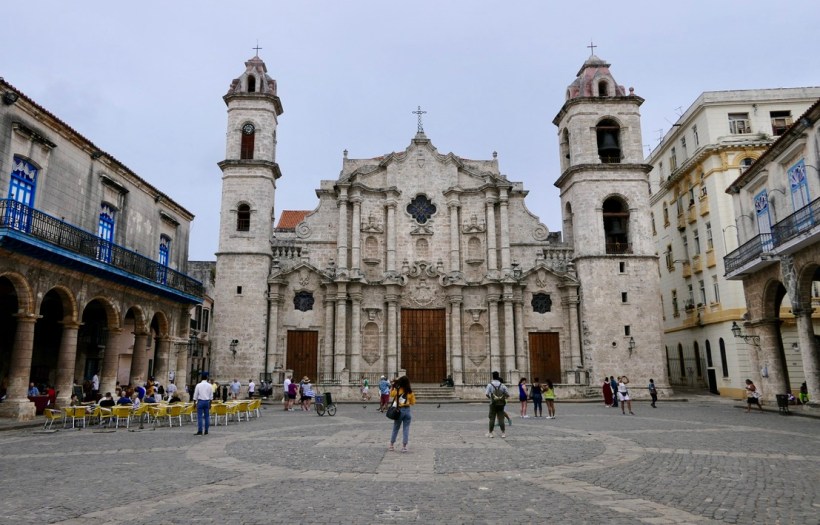
One of the many plazas in old Havana.

Mojitos at La Bodeguita del Medio.
There is no doubt that Havana’s old city is strikingly beautiful. It’s filled with leafy plazas ( which the locals use for accessing the country’s limited wifi hotspots), historic cathedrals, statues and cobblestoned streets. Tourists gathered at La Bodeguita Del Medio and La Floridita, bars made famous by the accounts of Hemingway holding court over mojitos and daiquiris, or in the ritzy hotel cafes and verandas overlooking the main plazas. Music filled the air, spilling out of bars and restaurants, or played by sidewalk musicians. Horse and buggies, with their tourist cargo, clip-clopped along the cobbled streets. Locals hurried along carrying a loaf of bread, or a shopping bag half-filled with vegetables. Parents with uniformed children in hand hurried on their way to or from school. With its Spanish colonial architecture, I couldn’t help but be reminded of Cartagena, Colombia.
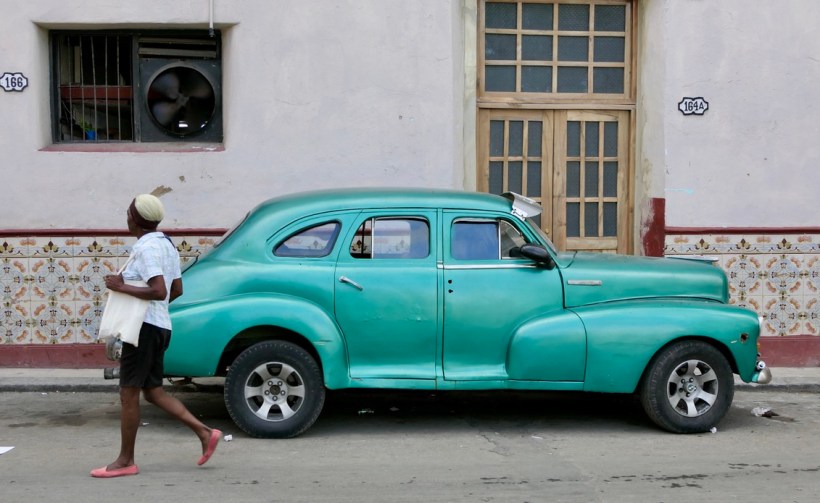
Classic cars are the rule in Havana.
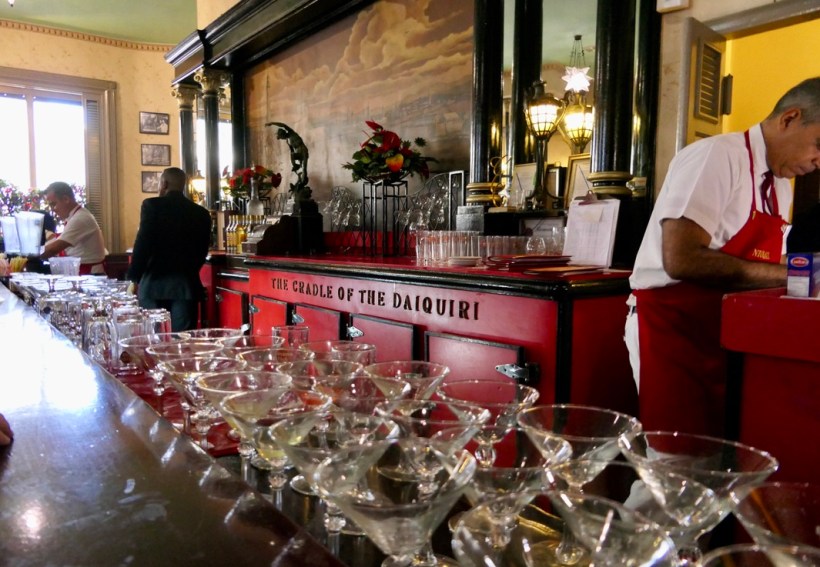
Serving up the original daiquiri at La Floridita.
After two days in the capital we made the two hour trip west to Vinales in a ’51 Chevy. I’m not quite sure in which decade since then the suspension system had failed, but to say we had a bouncy and swaying ride along the pot-holed highway there and back would be an understatement. Mary Jane, who always carries her FitBit in order to record her days activity level, could barely contain her laughter as she reported, on our return to Havana that evening, that the bouncing ride had recorded the equivalent of over twenty thousand steps. When we arrived to the area we were greeted with a panoramic view of the limestone mountains, palm trees and tobacco fields for which the area is justly famous. At one of those fields we toured the drying house, saw plants being harvested in the field, and watched a demonstration of one of the workers rolling cigars, while we sipped rum infused with guava fruit and tasted local honey, both of which were produced on the farm. After a short tour of a cave and underwater river in one area of the limestone mountains, we were dropped off for lunch. While we were plenty hungry, we were unprepared for the feast which would be laid out before us. Plates mounded with two kinds of rice, bowls of chicken stewed in tomato sauce, steaming plates of pumpkin and yucca and platters of sliced tomatoes, cucumbers and cabbage covered every inch of our table that could seat six people, though only the three of us occupied it. Stuffed, while hardly making a dent in the mountain of food, we piled back into the car for the return trip to Havana.
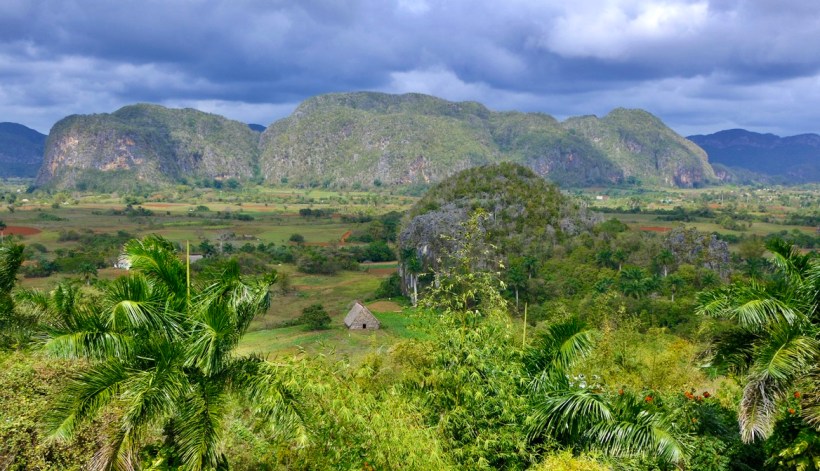
The valley surrounding Vinales.
Our next stop was the small southern city of Trinidad. Our comfortable guesthouse was located just blocks from the Plaza Mayor, the main square which held several museums around its perimeter and was crowned by it’s beautiful cathedral. Music was on offer in several of the bars around town, as well as on the giant set of stairs to the side of the cathedral, which made for a perfect place to sit at one of the outdoor tables, watch the sun set over the Caribbean in the distance and listen to the band while sipping mojitos (fortunately for us there were no shortages of mint or rum). We also visited Playa Ancon, located just five miles outside town, with it’s white-sand beach, waterfront restaurants teeming with Cubanos enjoying the weekend and a couple large resorts filled with Canadian and European tourists. We ordered lunch plates of grilled fish and prawns, rice and salad, all washed down with more mojitos and ice-cold Carib beers. Another day we toured the Valle de Ingeniros, just outside of town, to view one of the islands premier sugar-producing regions. At one of the valleys former estancias, or sugar plantations, we climbed a seven-story bell tower for expansive views, Mary Jane bargained for a beautiful embroidered table runner and we had lunch on the veranda of the former plantation house. Back in town that afternoon we wandered through the outdoor market stalls where some of the vendors asked if we could spare any extra soap or clothes for their families.
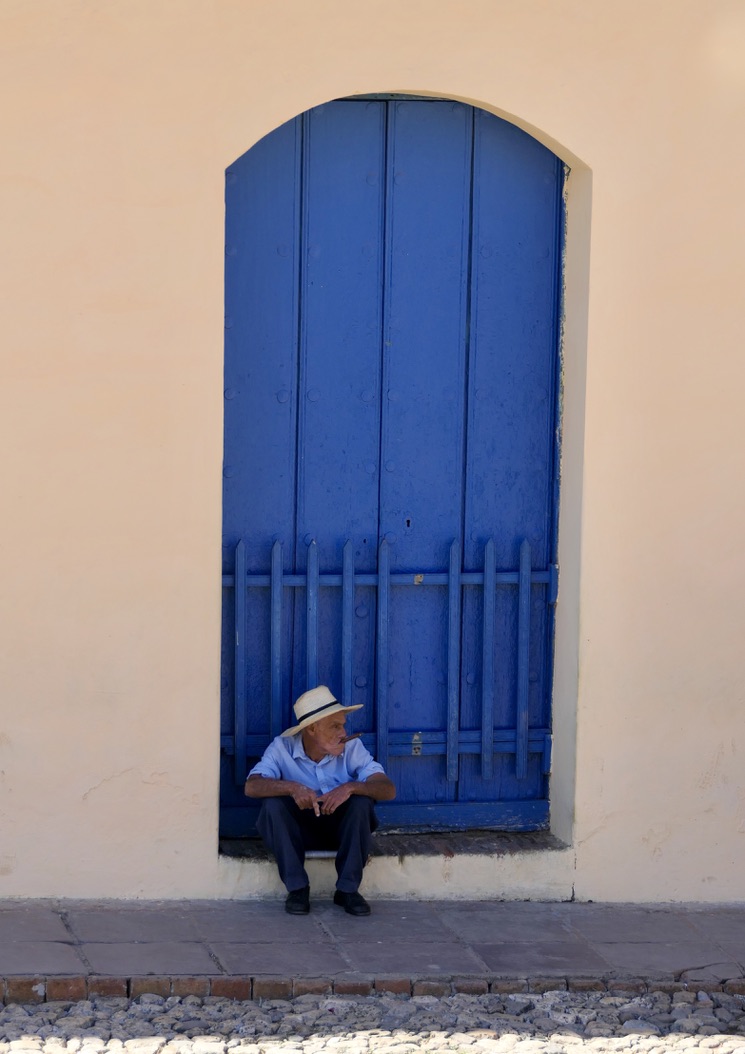
Taking it easy in Trinidad.
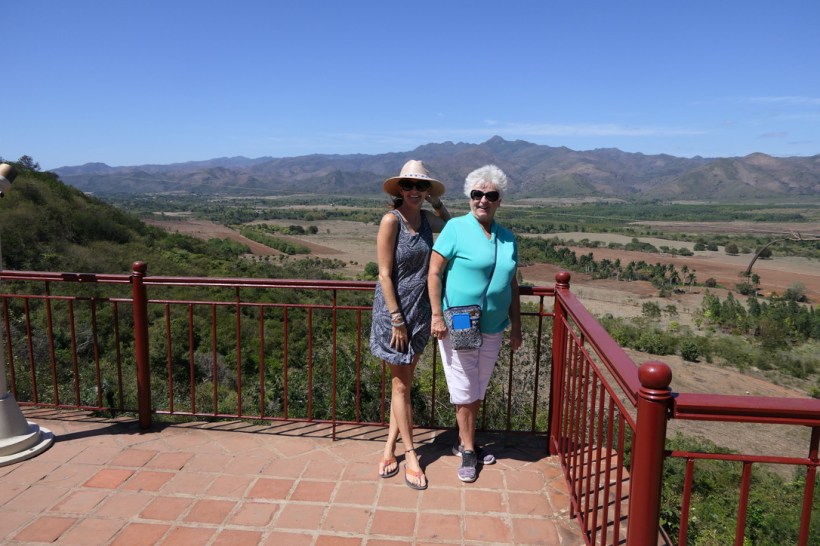
Overlook at the Valle de Ingeniros.
Our final stop would be Matanzas, the country’s second largest city, located on the northern coast. The appeal of the city was its proximity to the stunning beach of Varadero, whose blindingly white sands stretched for nearly twelve miles and were lapped by some of the clearest blue water we’ve ever seen. Grabbing lounge chairs under a thatched palapa, we spent the afternoon swimming, enjoying a grilled fish lunch and sipping pina coladas and beer. The girls opted for massages at a tent just back from the beach, shaded in the sea grape trees. Our two nights in Matanzas were at the home of Ana and Antonio, perhaps the sweetest guesthouse hosts we’ve encountered anywhere. On our first night they prepared a sumptuous spread for dinner – vegetable noodle soup, toasted baguette slices, roast chicken, rice and salad, followed by cake and ice cream. In the mornings we were offered Antonio’s omelettes, heaping plates of fresh fruits (including fresh guava picked from their backyard tree), salad and toast. Over the meals we learned their story as they related how they had quit their jobs (as an engineer and a doctor) to stay home in order to care for Ana’s mother, who suffered from dementia. They had started their casa particulare in order to pay their bills. Antonio pointed out the condiments on the breakfast table that he had acquired on the black market, as they weren’t available in the state-run stores. The black market, he explained, was supplied from the workers at hotels and resorts, who had to steal goods from their employers to supplement their meager wages. He also lamented the fact that simple products, like soap, were unattainable at times. Our Matanzas guide, David, a university student, related stories of his friends, that had the means and the money, who had left the country for opportunities in the US or Europe. We also heard from a waiter in Trinidad who complained that he had to salvage parts from boat engines in order to keep his Harley-Davidson running due to the lack of spare parts as a result of the American embargo. On our last day, Mary Jane presented our Havana host, Yai, with a bag of Vitamin C lozenges, Tylenol and Ibuprofen. She was overjoyed to receive such a gracious gift of much sought after medicines (even these products are only available by prescription in Cuba).
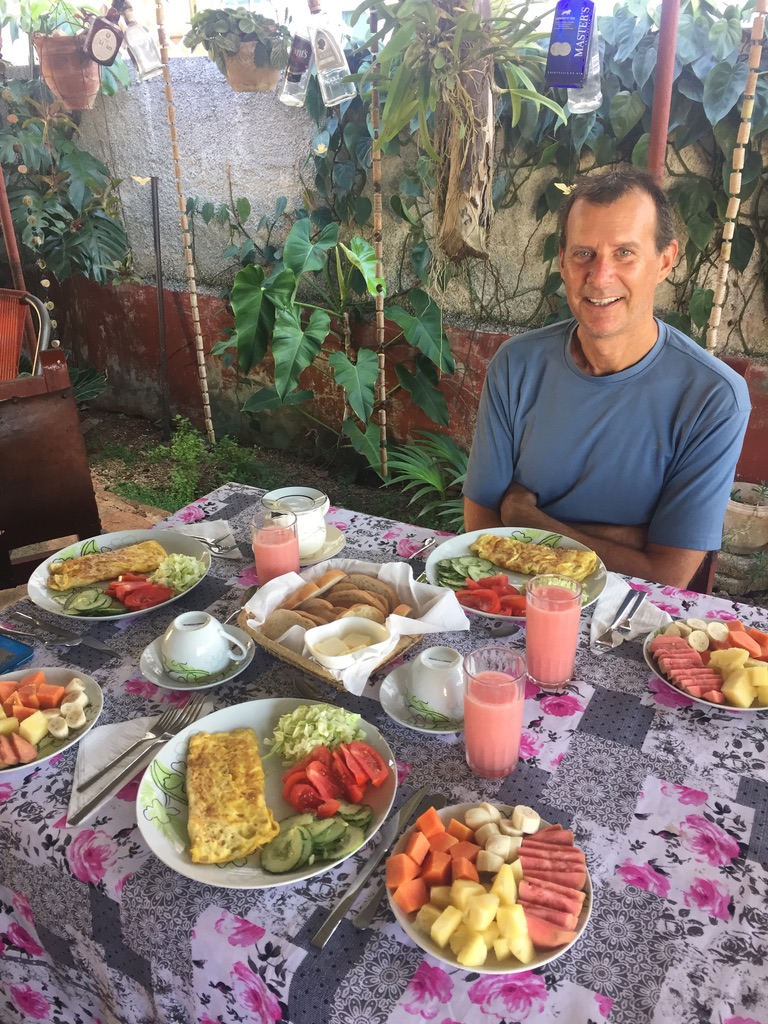
Breakfast, compliments of Ana and Antonio.
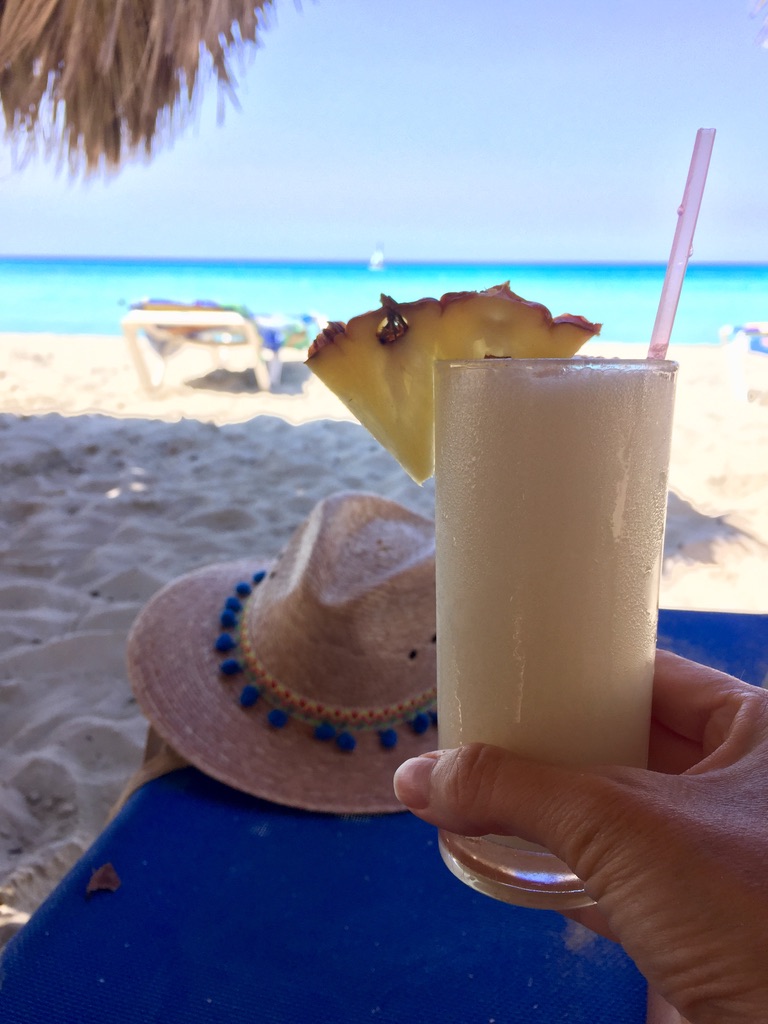
Pina Colada, white sand, blue water – Playa Varadero.
On our way to the airport (in a ’55 Chevy Bel-Air), we reflected on how Cuba had changed us in a way that visits to other countries hadn’t. What few preconceived notions we carried into the land had evaporated. We would not find any anti-American sentiment from the people we encountered. Rather, we were warmly embraced (and one time, quite literally embraced by a resident of Trinidad who rushed out of his modest home upon hearing we were Americans and hugged us, each one in turn, while crying out “Welcome, welcome, welcome!”, followed by the obligatory plea for soap) by folks who astutely realized that policies, even those that oppressed them, were created by governments and not by the people under them. When one is experiencing empty store shelves, empty gas tanks and even empty bellies, one doesn’t particularly care about politics. The land here is beautiful and the beaches are stunning. Home-cooked Cuban food as we experienced it at our casa particulares was outstanding. So, do yourself a huge favor and make the short hop across the Florida Straits to visit our neighbor. And bring some extra soap.
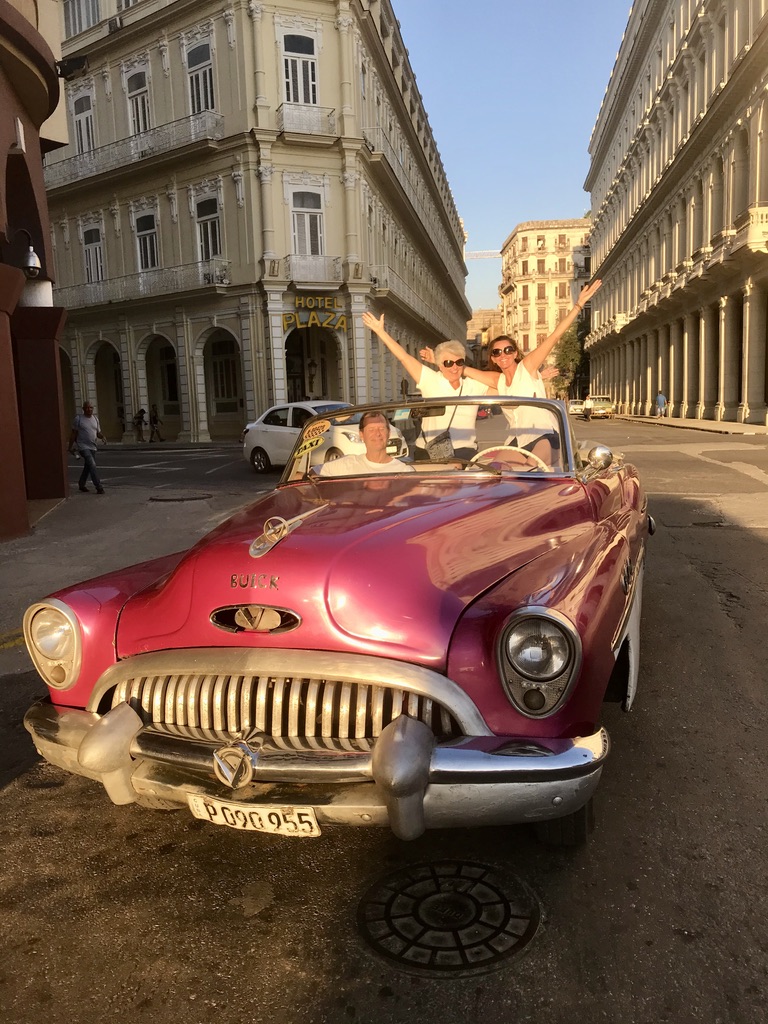
Beinvenidos a Cuba!
 The Rhum Line
March 7, 2020 at 1:55 pm
It was such a great pleasure to meet you guys and to have the chance to show you around and to help you get through the daily struggle of the cubans as you faced several times while here. Thank you so much for your kindness your support and your understanding of the whole situation. I surely hope we meet again soon, probably with Jen 😉 thank you also for picking Cuba as one of your destinations and for including me in your memories of this trip! 🥰❤🇨🇺🇺🇸
LikeLike