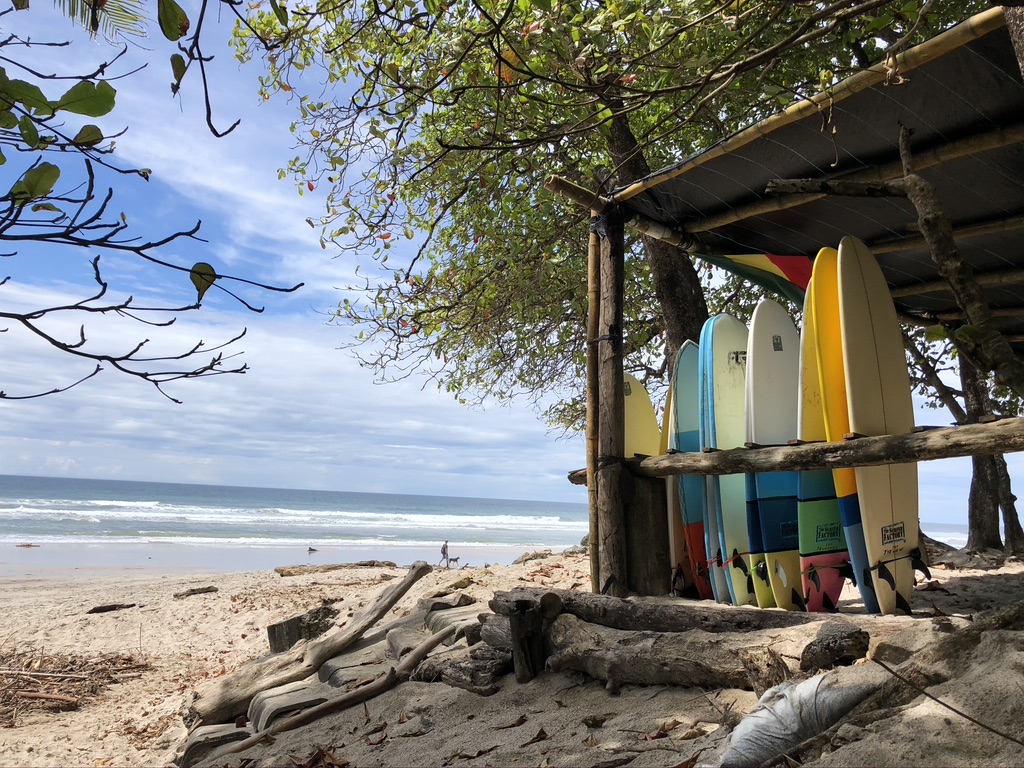
The roads in Costa Rica aren’t bad, as far as roads in Central America go – if you stay on the paved ones. However, a lot of the interesting sights, and certainly most of the best beaches, are located at the end of unpaved roads. And they can be pretty rough at the best of times. The end of rainy season is not the best of times. The roads of the southern Nicoya peninsula are described as the worst in all of Costa Rica. Naturally, we were headed to the southern Nicoya next.
Santa Theresa, for some reason, is a backpackers beach dream. Ask any traveler who’s been and they’ll tell you the beach is one of the most beautiful in the country, the surfing is top-notch and town has a chill, laid-back vibe perfect for relaxing. The beach is beautiful, but Costa Rica has a bevy of really beautiful beaches; the surfing is very good (I’ll have to trust them on this one), but for beginners and those looking for lessons I think there are certainly better places to learn; and town certainly is laid back, with folks wandering the dirt road through town barefoot, enjoying the hip vegan cafes and exploring the back roads on quad- and motor-bikes. On closer inspection, however, I realized that folks were wandering barefoot because after a rain the dirt road became a flip-flop sucking mud bog; the quad-bikes, which apparently all lack any kind of muffler system, would tear up the muddy street, or, if and when it dried out, would raise clouds of dust which would settle on everything within a hundred feet of the road, including the foliage, parked vehicles, buildings and my vegan chocolate cake (to tell the truth I couldn’t tell what was cake and what was dust). It’s quite possible that the road through Santa Theresa is the worst road in all the southern Nicoya, which now you know is pretty bad. We did find one outstanding aspect to our visit there – the food (I’m not considering vegan chocolate cake to be food). From the simple rotisserie chicken and sides at Chicken Joe’s, to the delicious tacos and craft beer (passion fruit ale!) at the Eat Street outdoor food court and the incredible wood-fire grilled mahi-mahi at the Argentinian-inspired El Facon, this was some of the most consistently good food we had enjoyed anywhere.
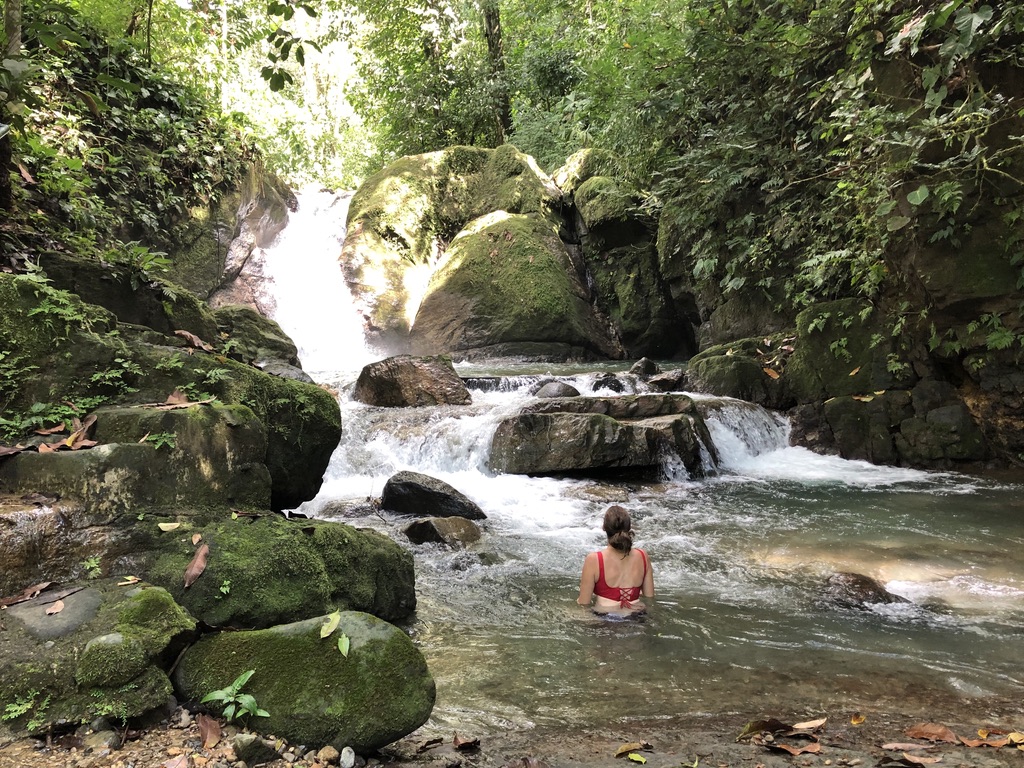
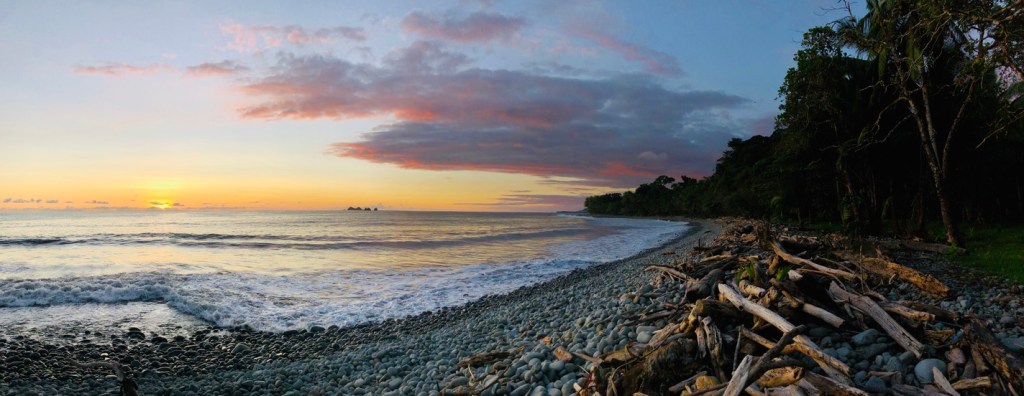
Not to be outdone, our next destination following Santa Theresa was the small town of Ojochal – dubbed the “food capital of Costa Rica”. North American and European ex-pats had gravitated to this quiet hamlet set between the black-sand beaches of the southern coast and the jungle-clad mountains of the interior, with many of them opening acclaimed restaurants. So, with high expectations of indulging ourselves in various international cuisines during our three-day stay, we rolled into town just as the sun set. We wound up the main road through the jungle, following the course of the Rio Balso to our lodge – El Mono Feliz (The Happy Monkey). Without a doubt, any monkey would be happy, if not ecstatic, to be staying here. The property is covered with lush, colorful foliage, offers an inviting pool at its center, is a haven for all kinds of birdlife and the wooden platform, at the rear of the grounds along the river, has hammocks for relaxation and contemplation. While I don’t think Ojochal lived up to it’s nickname (in no small part to the abundance of closed restaurants due to the pandemic), especially coming on the heels of our ‘foodie’ experience in Santa Theresa, our accommodation was certainly enjoyable. We did visit a couple beaches for strolling and sunsets, and spent the better part of one day relaxing in the Cascada Ojochal (waterfall). We don’t usually make an effort to visit waterfalls, finding them to be crowded and noisy (especially on a weekend) and not particularly relaxing. But the cascada was close to town so we gave it a shot. A short drive to the base of the mountains behind town we came upon the sign marking the entrance through a private residence. A young man greeted us, took a nominal entrance fee and directed us down the trail behind the family home, which was lined with cacao and banana trees and flowering shrubs. We descended a short ways into the canyon to find a two-tiered waterfall, several shallow pools for swimming, moss- and lichen-covered boulder walls leading up to a thick canopy overhead. Not another soul around – on a Sunday! While it took a couple minutes to work up the courage to plunge into the cool water, once in it was a delight to move between pools, float with the current and soak away the afternoon. When we finally dragged ourselves out of the water, we relaxed on some smooth rocks, the only sound being the crash of the falls. Overhead we caught sight of a toucan perched in the canopy. It was a great way to spend part of the day, which would precede a fine lunch at a local soda (cafe serving typical fare) before heading to a quiet beach for sunset. Not a bad way to spend the day on the Pacific coast.

With our fill of creature comforts (good food and comfy accommodation) it’s time to head to the wild and rustic Osa peninsula!
 The Rhum Line
December 12, 2020 at 12:04 am
I drove as far south of Samara as I could, but at one point I gave up. My feeling is that it is voluntary to filter the tourist tide 🙂
LikeLike
December 12, 2020 at 7:30 pm
Ha! Yes, those roads are tough, but a lot of folks seem willing to put themselves through that to reach some of those beaches.
LikeLiked by 1 person