The Rhum Line

The aimless and sometimes muddled route of a traveling couple looking for their next great adventure


Leave a comment

Yucatan Road Trip – The Costa Maya

‘Yes, you can make it here with two-wheel drive. In just two hours from Tulum you will be in paradise!’

I could feel the enthusiasm in Juan’s email. The owner, with his wife Marta, of Hotel Las Palapas had assured us our rental car would handle the dirt road that travels through the Sian Ka’an Biosphere Reserve between Tulum and Punta Allen. In person, Juan was just as enthusiastic as I pictured him. He was also funny, friendly, and, as it turned out, wildly optimistic. Two hours seemed like more than enough time to drive the thirty-five mile stretch. But one does not drive this road in a singular direction – due to the profusion of potholes, we had to zig and zag it’s entire length – and only arrived at Juan and Marta’s place after three hours of painfully slow driving.

Punta Allen has that end-of-the-earth feeling, perhaps because it fits the description as well as anywhere else we’ve been. Located at the southern end of the finger of land that sits between the Biosphere Reserve and the Caribbean Sea, Punta Allen has a grid of clay and limestone lanes (as pot-holed as the access road) covering about three square blocks, a handful of restaurants looking over the water, about as many guesthouses and fishing lodges . . . and not much else. Some folks come as a day trip from Tulum, stay a night, take a boat tour of the lagoons and the offshore reef in the morning, then head back to ‘civilization’ (if foul-smelling, over-developed and crumbling Tulum can be called that). We chose to spend three full days here, hoping we could fill our time paddling, snorkeling and swimming. The constant wind took paddling off the table. The profusion of sargassum (a problem all along the Caribbean coast of the Yucatan this time of year) kept us from snorkeling and swimming off the beach. We did make the three-and-a-half mile roundtrip walk out to the lighthouse on the point (punta), found some palm trees to hang our hammocks a couple afternoons, and dined in most of the restaurants. On our final day we had Juan organize a boat trip for us. We were taken to the community dock on the bay, met our captain and headed out onto the water. It was a stunning day (other than the stiff breeze) – the sun shone brightly, large puffy cumulus clouds dotted the horizon and the water offered a palate of blue colors. If we’re lucky, our captain said, we might see manatees, dolphins and turtles during our trip. He patrolled the bay for several minutes and then circled around just as a manatee surfaced for a breath. ‘Manatee. Check!’ Heather said to him with a huge smile on her face. Then we left the bay and headed into the open sea. Soon Heather was able to turn to him again – ‘Dolphins. Check!’ Minutes later we spotted the first of three turtles as it swam just below the surface – ‘Turtle. Check!’ With that we had fulfilled the tours promise, but we still had a snorkeling stop out on the reef to fill out the morning. While the reef didn’t offer much in the way of colorful coral or large numbers of fish, the appearance of a couple manatees certainly made the snorkeling fun. After returning to the boat, we motored into shallower water for another swim before returning to the dock. It was an epic trip, topped off with another delicious fish dinner at one of the waterfront restaurants back in town.
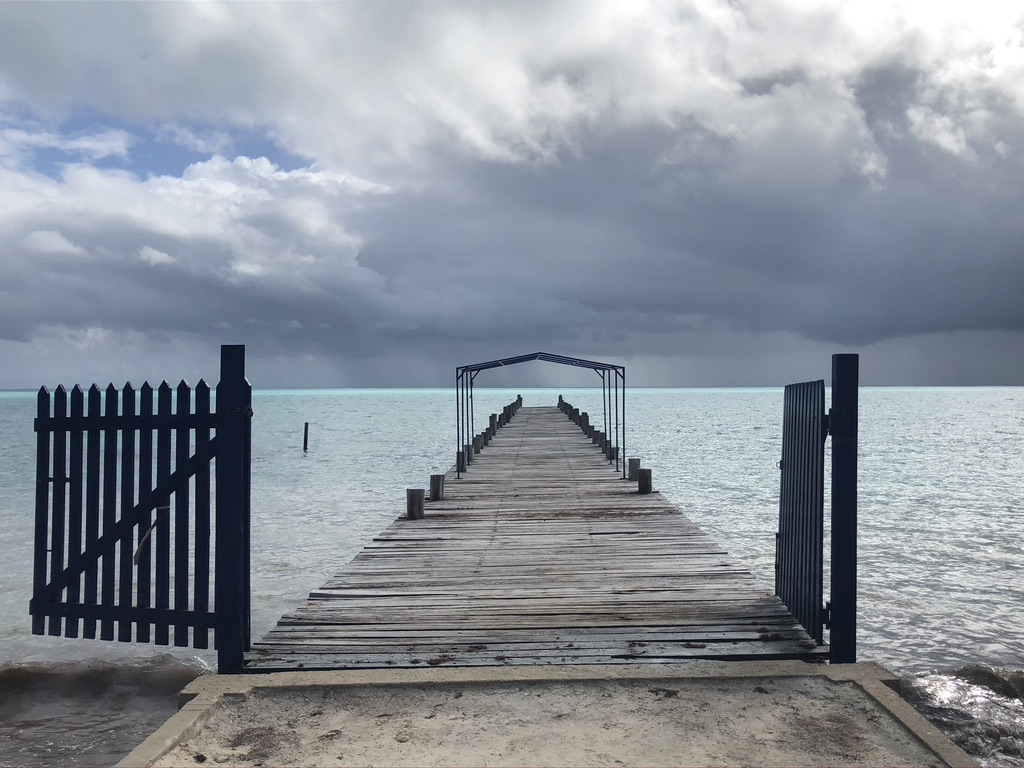
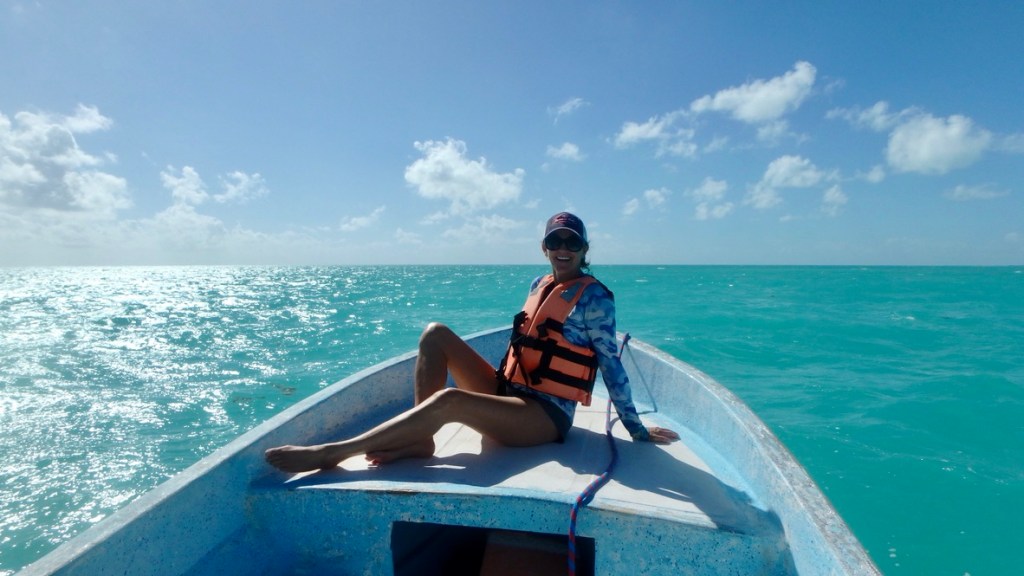
The end of the world – Punta Allen
Try to look like your enjoying yourself! Dolphin spotting off Punta Allan
Post boat trip dinner – with a view

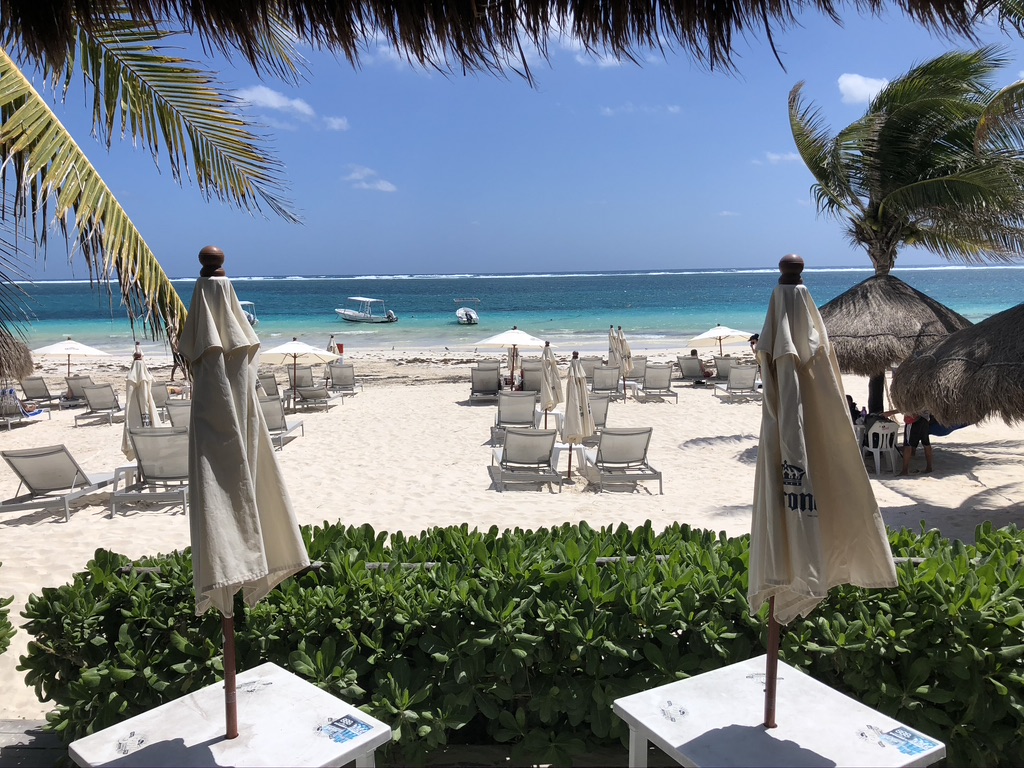
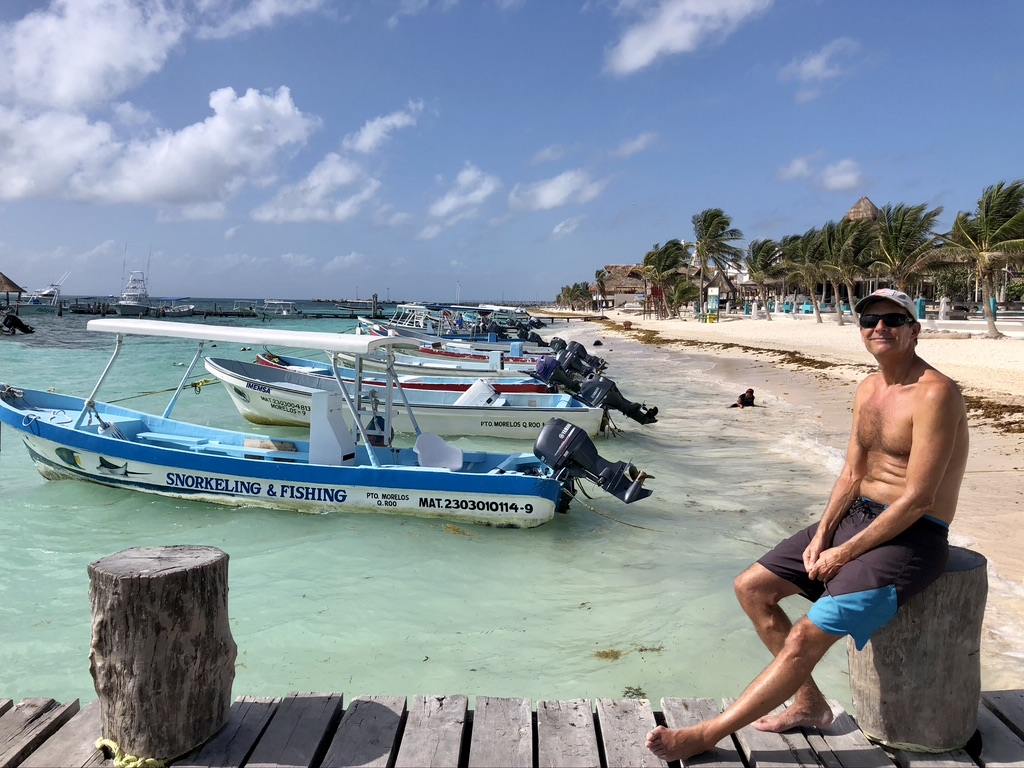
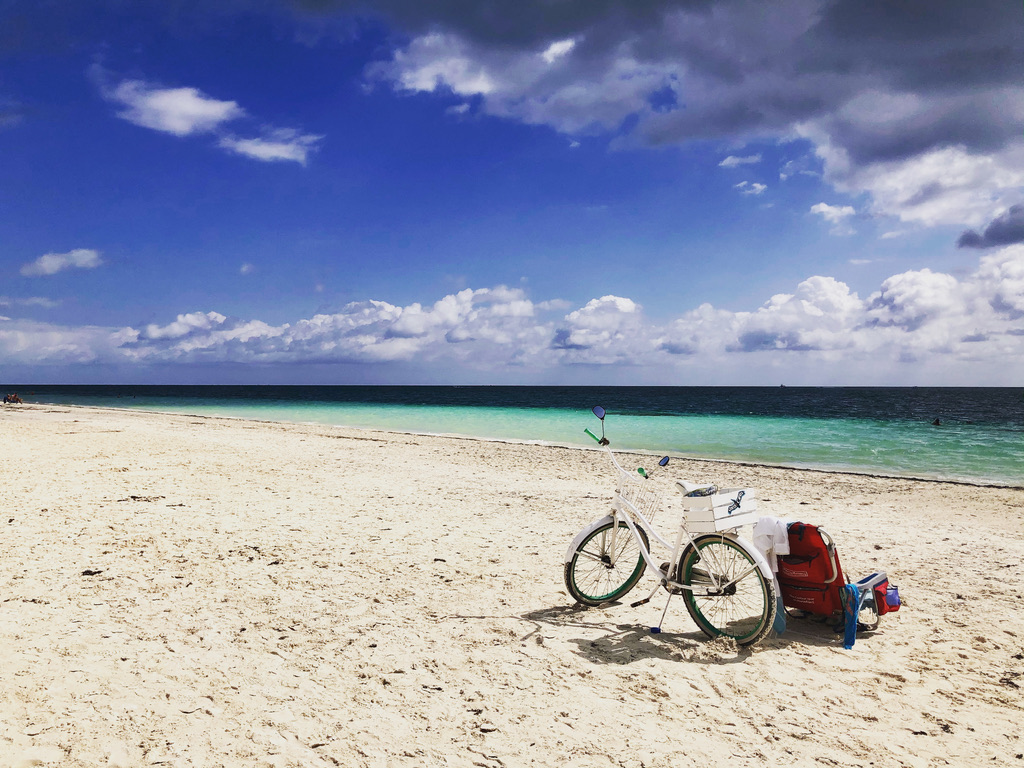
Continuing our trip down the Costa Maya, we arrived in the small town of Mahahual, where we had planned on a three-day stay. The town runs about five blocks along the shore, fronted by a paved malecon (promenade) lined with small gift shops, dive operators and restaurants, whose tables spill out onto the white-sand beach right down to the clear waters of the sea. A reef just offshore keeps the waters calm for swimming and offers a chance for snorkeling. To the north and south of town a packed-dirt road runs for thirty miles in both directions, with nothing but an occasional house to break up long stretches of deserted beach, palms, sea grape and mangroves. Back in town there’s a cruise ship port, which has been idle for the past year. Many businesses are doing okay, dependent on the increased visitation by Mexican tourists. But we noticed a lot of empty stalls where vendors would normally have been hawking all the kitsch, t-shirts and shell necklaces to the cruise shippers.

We were happy to spend our days snorkeling, strolling the promenade, driving the deserted roads along the coastline and feasting on the creative tacos and tostados offered by our favorite Mahahual restaurant – La Chilangoloense. Night after night we returned here for the tasty margaritas, impressive variety of seafood tacos and tostados, the friendly service of the staff and the toes-in-the-sand setting on the beach. Outside of the weekends Mahahual gives one the sense of what this former fishing village might have been like years ago – by nightfall at 7 pm the streets were empty, the vendors had all gone home and most restaurants along the beach were closed for the night.
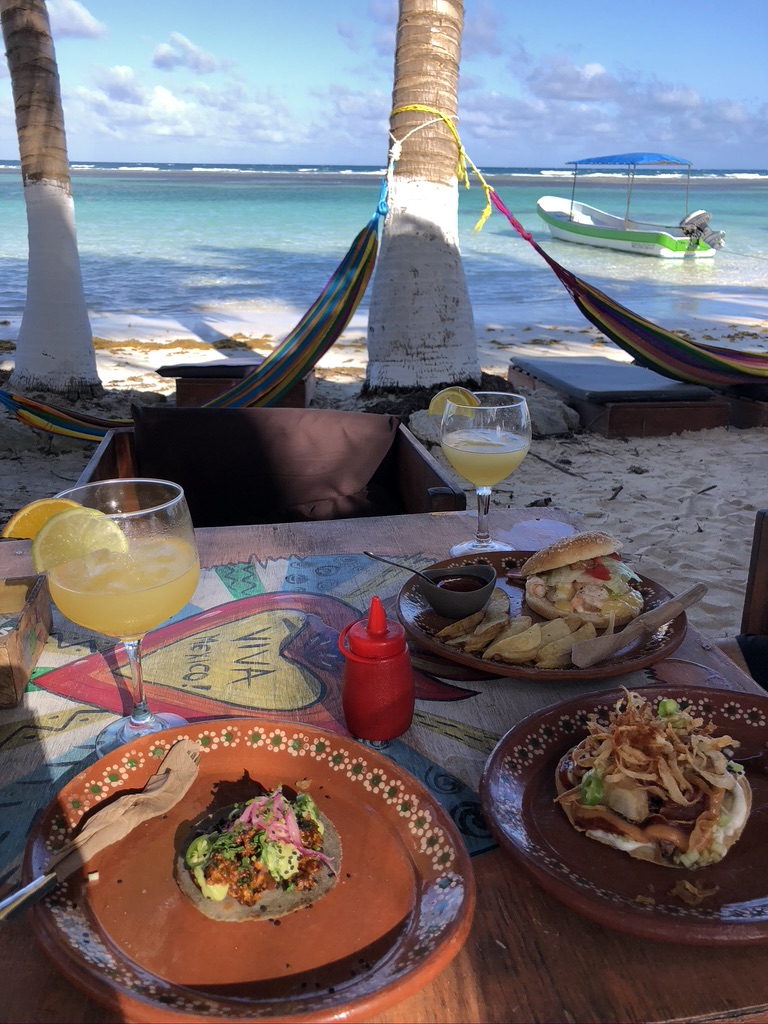
Some of the tasty tacos – and a shrimp burger – at La Chilangoloense
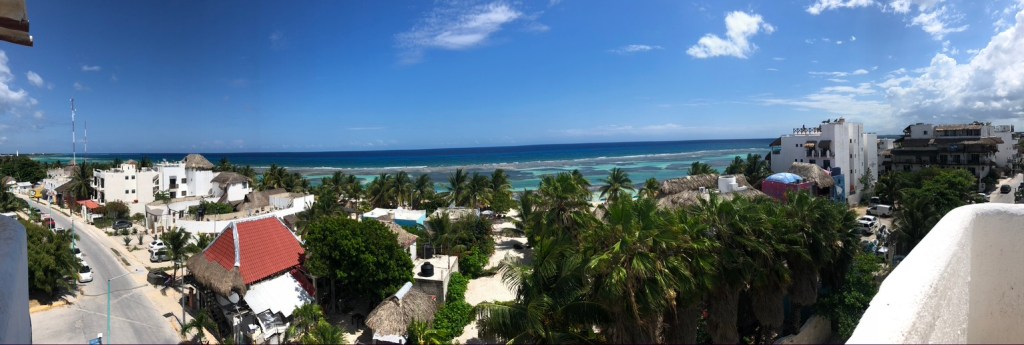
All of Mahahual from our terrace
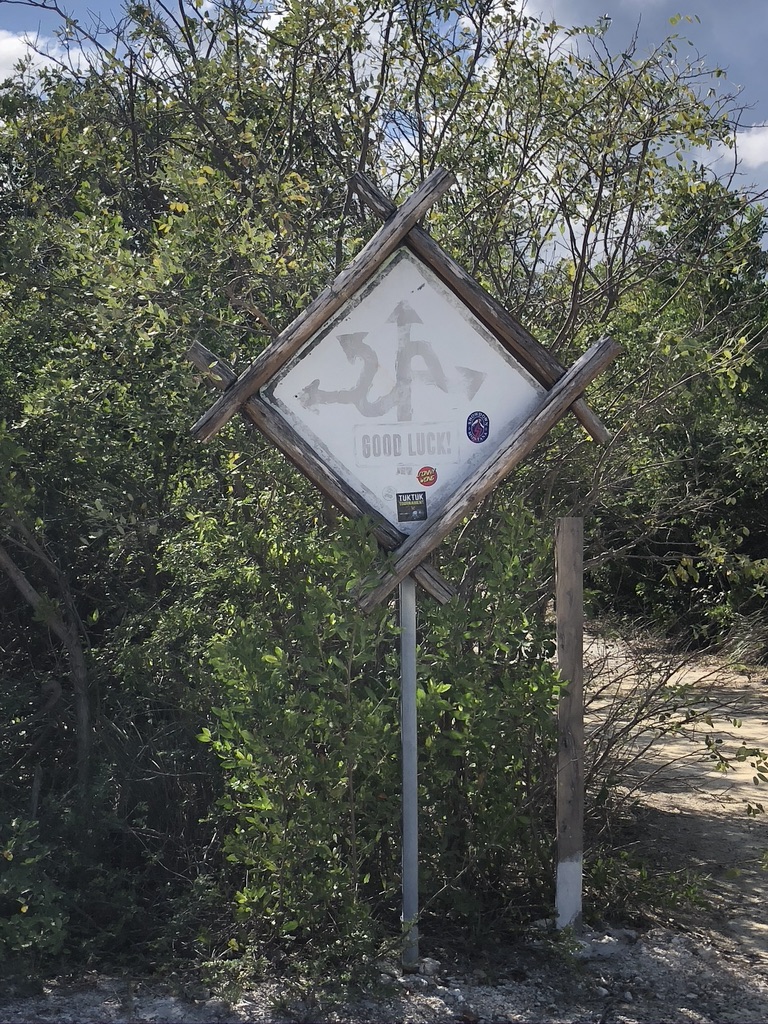
Someone’s sense of humor along the beach road outside Mahahual

After a week in Mahahual, it’s time to leave the coast and head inland and across the Yucatan peninsula. Ahead over the next couple weeks lies the lake and cenotes of Bacalar, the Mayan ruins at Calakmul in the jungle of the interior and the colonial city of Campeche, overlooking the Gulf of Mexico.
4 Comments

Yucatan Road Trip – Stop One

‘Todo bien!’

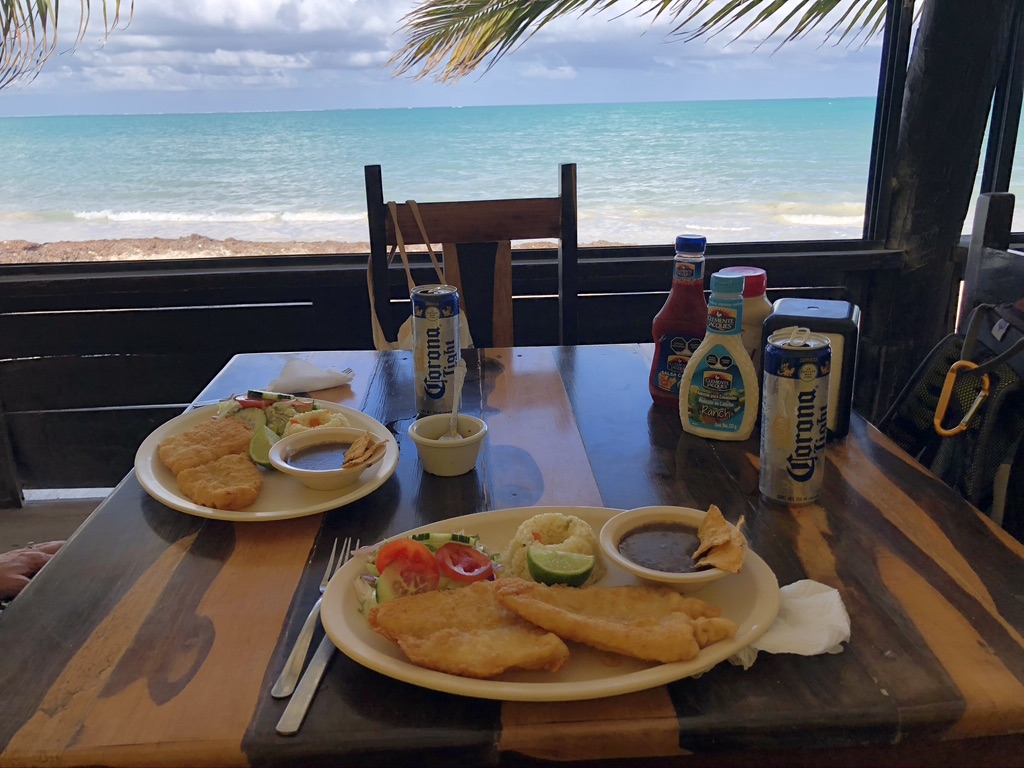
Heather enthusiastically answered our servers query as to her satisfaction with the mojito he had just set in front of her. Along with the bowl of shrimp ceviche, a plate of fish tacos and my bottle of craft beer, I couldn’t agree more that things were ‘all good’. We were sitting at an open-air restaurant overlooking the beach in Puerto Morelos, with a view across the white sand beach to the clear blue Caribbean Sea. After the previous day’s long trip from Costa Rica, including a three-hour drive to San Jose, the inevitable long wait at the airport, two and a half hour flight, an evening arrival into the airport in Cancun, picking up our rental car and making the thirty minute drive here in the dark, the delicious food and cold drinks, not to mention the perfect view, was the perfect start to our month-long Yucatan road trip.

‘Todo bien’

We chose Puerto Morelos as our starting point mainly for it’s proximity to the Cancun airport, knowing we’d be arriving late and not wanting to travel far at night. We had heard stories of this former fishing village, now well-known by European and North American travelers, and it’s beautiful beach and calm waters. It’s turned out to be everything we hoped for. Not often do you arrive somewhere in the dark, tired after a day of travel, yet still have such a positive feeling about a place that you immediately begin thinking about staying longer. Yet that’s exactly how we felt here. After breakfast at our guesthouse we inquired with the owner if our room was available beyond our original four-day reservation, and to our delight, learned that it was. So we booked in for another couple days . . then after another day, booked an additional week. We spent the first few days wandering the beach, swimming, exploring town, feasting on way too many tacos and enjoying the warm ocean breezes. When those breezes died down, we inflated our paddle boards and ventured out onto the calm waters of the Caribbean, gliding over the clear waters inside of the reef that runs just offshore. There are no shortage of travelers here – Puerto Morelos has been discovered. But it’s a far cry from the maskless crowds that throng Cancun or Playa Del Carmen (we know – we had to visit both while running errands). It’s remains a Mexican town filled with gringos – just hang around the beach after four pm and you’ll see all the local families come out for a couple hours of swimming and relaxing after a work day.

Fishing boats line a section of beach in front of Puerto Morelos’ town center.
Discovered but still not crowded.

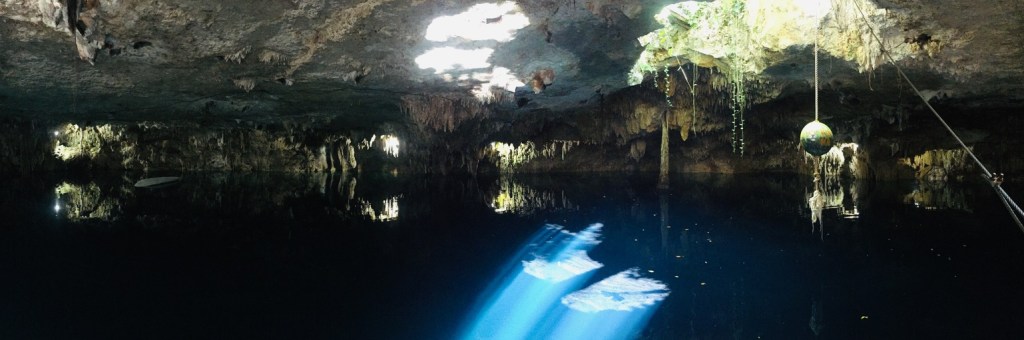
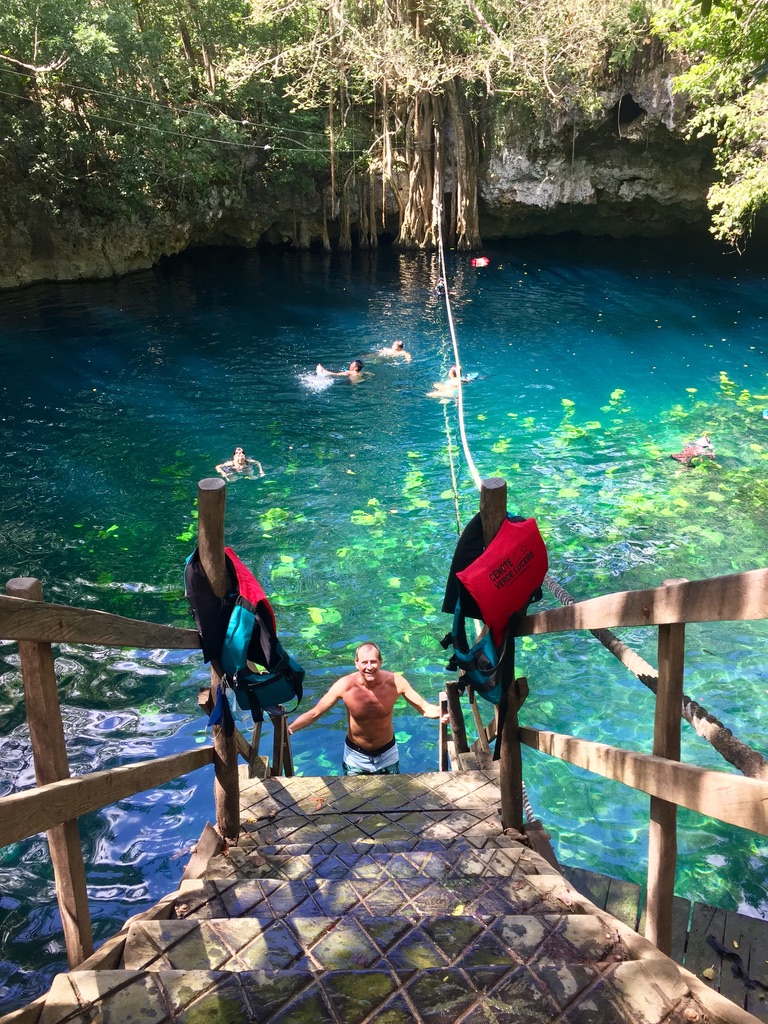
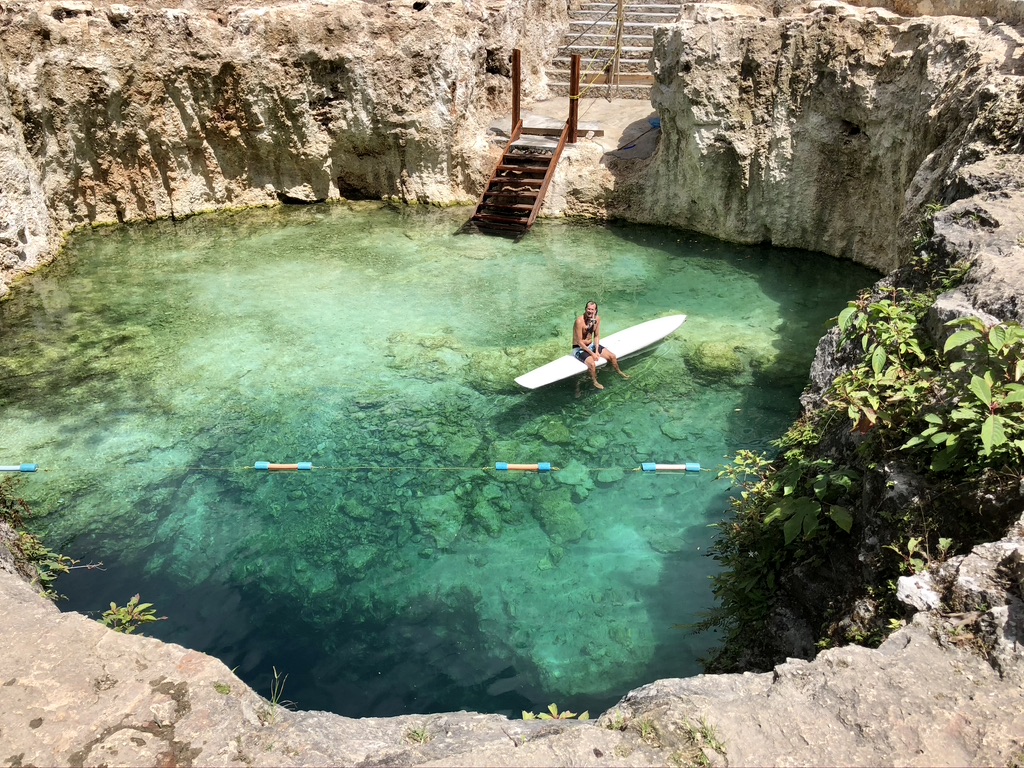
Another attraction to Puerto Morelos lies a few miles inland. Las Rutas de Cenotes runs from Puerto Morelos to the inland town of Leona Vicario, a straight stretch of highway covering just over twenty miles. The cenotes – fresh water-filled limestone sinkholes – that line the ruta range from small open-air pits (maybe featuring a rope swing) to enclosed caverns with a narrow opening and even one with a series of connected caverns each having it’s own small access. Over the course of two mornings we visited three different cenotes and found total enjoyment in each kind. Our first day we were lucky to be the only visitors at the Kin-Ha cenote, an enclosed cavern with one narrow opening providing access and light. Afterwards we drove to the Verde Lucero cenote and joined a handful of others floating in the cool waters of the open-air cavern under a sunny sky. On our second trip to the ruta, we spent the better part of a day (with new friends from our guesthouse) exploring the interconnected caverns of the Siete Bocas (Seven Mouths) cenote, then relaxing under one of their palapas, sipping beers and watching others jump into the deep pool of an open section.

The enclosed cavern of the Kin-Ha cenote.
Entrance to the Verde Lucero cenote.
Taking a break at the open pool of the Siete Bocas.

We couldn’t have picked a better starting point for our Yucatan road trip. Puerto Morelos offers everything we look for in a Mexican beach town – white sand beach, clear water, great food and a relaxed atmosphere. We’ve already decided to extend our road trip for another month – which will give us plenty of time to get back to Puerto Morelos for another visit.


Leave a comment

Costa Rica – That’s A Wrap!

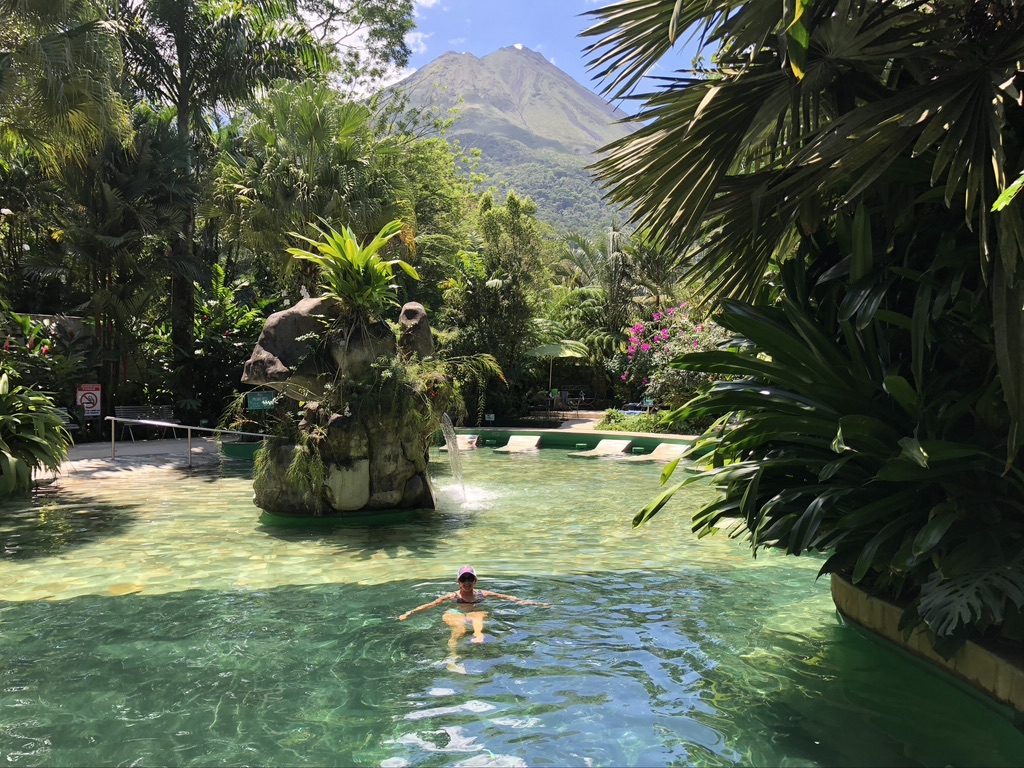
Our visit to Costa Rica has come to an end. We left the Caribbean coast a week ago and headed inland to Lake Arenal, famous for its namesake volcano, adventure tours and hot springs. We unpacked our bags in an out-of-the-way lodge perched on a hillside overlooking the lake’s northern shore, in the town of Nuevo Arenal (the original Arenal now sits at the bottom of the lake, created by the building of the dam in 1972). We had hoped to also unpack our paddle boards and launch them onto the lake for a couple days of paddling, but the incessant wind dashed those plans. We consoled ourselves by visiting one of the areas many hot springs on our first day. It seems most folks visit the well-known hot spring resorts and we wanted to avoid the crowds at those. Fortunately, Cindy, the owner of our lodge, suggested one that would offer a more intimate and quiet experience. Her recommendation was spot on. When we visited Paradise Hot Springs we shared the seven pools (the water heated by the thermal activity of the Arenal Volcano – which could be seen from the pools) with only three other visitors. The resort (there are rooms available here) offered a luxurious experience – in-pool loungers, lush foliage (think beautiful moss and vine-covered palms sprouting orchids in a rainbow of colors), flowering bougainvilleas, soft music from hidden speakers, a swim-up bar and those awesome views of the volcano. It certainly was paradise.

Heather in Paradise!

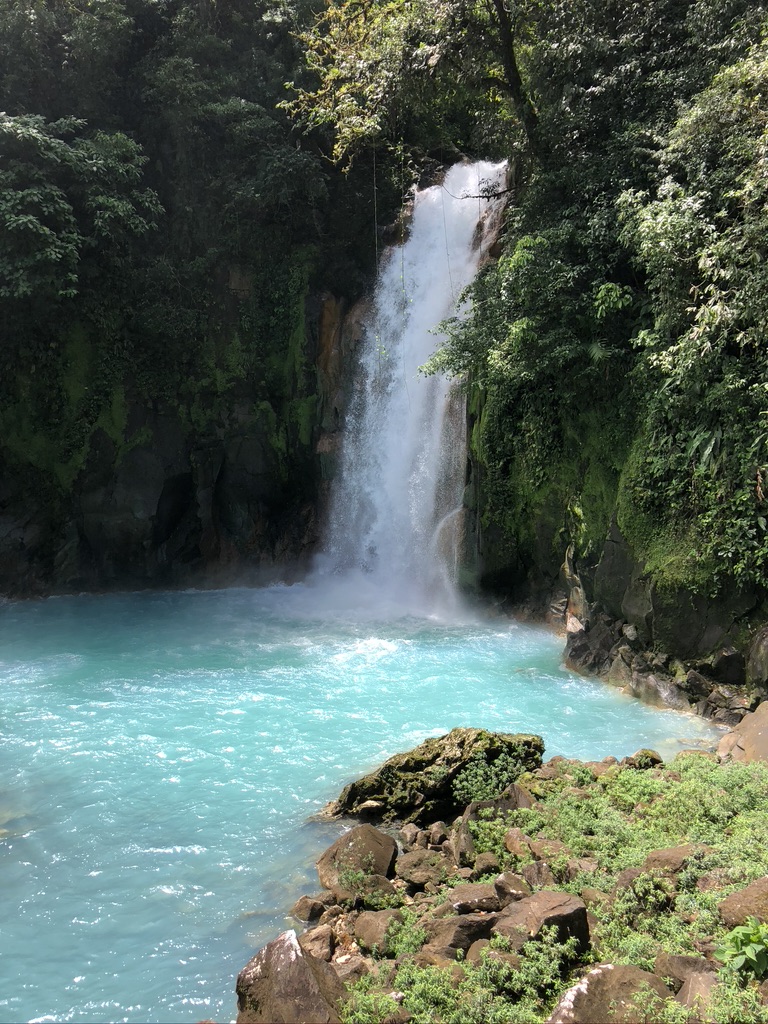
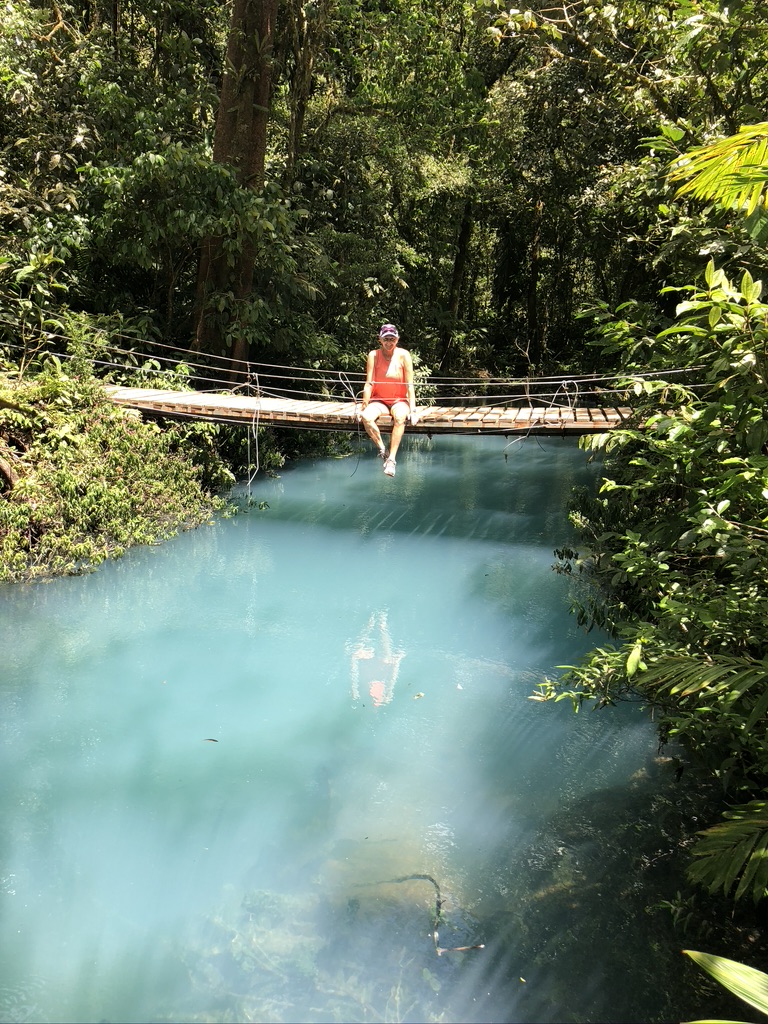
Our second day we opted to drive an hour north to Tenorio Volcano National Park. The highlight of the park (the volcanic peak remained shrouded in clouds throughout our visit) was a hike along the Rio Celeste (Heavenly River). The name comes from the unusual color of the water. The turquoise hue is formed when suspended minerals (aluminum and silicon) of one river mix with the highly acidic water of another and refract sunlight into the blue color. The trail passes a spectacular waterfall, a small lagoon, a section that features a bubbling sulphur spring and ends where the two smaller rivers converge and the coloration begins. The roundtrip hike took about two and a half hours and we returned to Lake Arenal by an alternative route that took us through hilly pastureland, past long rows of wind turbines and beneath the shadow of yet another volcanic peak.

The waterfall at Rio Celeste
Taking a break on the Rio Celeste hike.

Our final day at the lake we returned to Paradise Hot Springs for another ‘soak session’. As with the previous two days, we capped off the day by dining at the superb restaurant attached to our lodge. The open-air restaurant had a perfect view of the setting sun, offered a selection of tasty Costa Rican craft beers, delicious ceviche, fresh fish and a damn fine Black Angus burger. The staff was wonderful, the food was incredible (we never did save room for their chocolate cake over three nights) and the walk home (about ten steps) was manageable.

Sunset over Lake Arenal from our lodge’s restaurant.

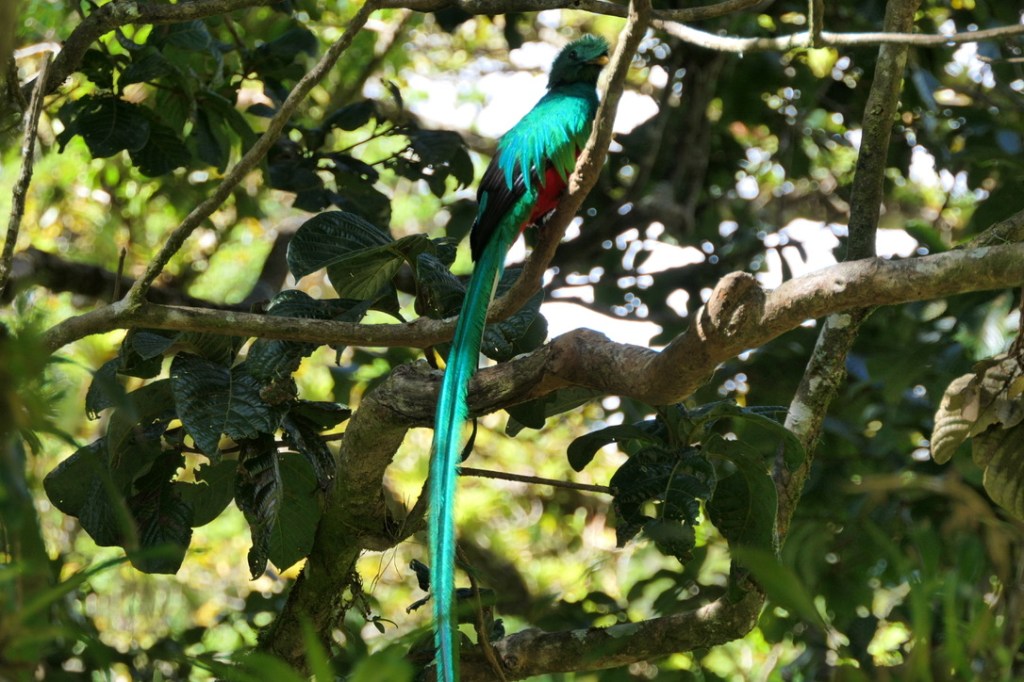
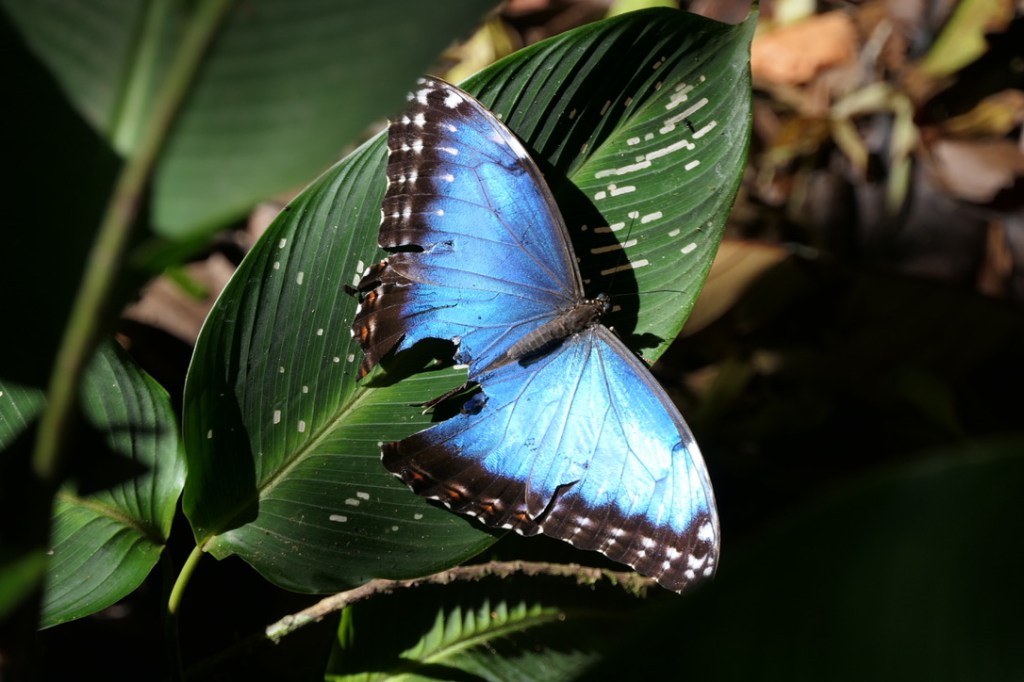
Our final stop would be the mountain town of Santa Elena – base for exploring the nature reserve of Curi Cancha and the cloudforest reserves of Monteverde and Santa Elena. We had visited all three parks last year and were eager to revisit Curi Cancha, where we had been able to view the Resplendent Quetzal, one of the world’s most beautifully colored birds. As in Lake Arenal, the wind would alter our plans – wind-driven rain would force us to pass on a visit to the cloudforest reserves (both at higher altitudes than the nature reserve). We visited Curi Cancha and once again were lucky enough to see a pair of quetzals, some white-faced capuchin monkeys, a large blue morpho butterfly and enjoy the entire park (all 200+ acres) while seeing only five other visitors.

A Resplendent Quetzal at Curi Cancha Reserve.
Blue Morpho in Curi Cancha Reserve.
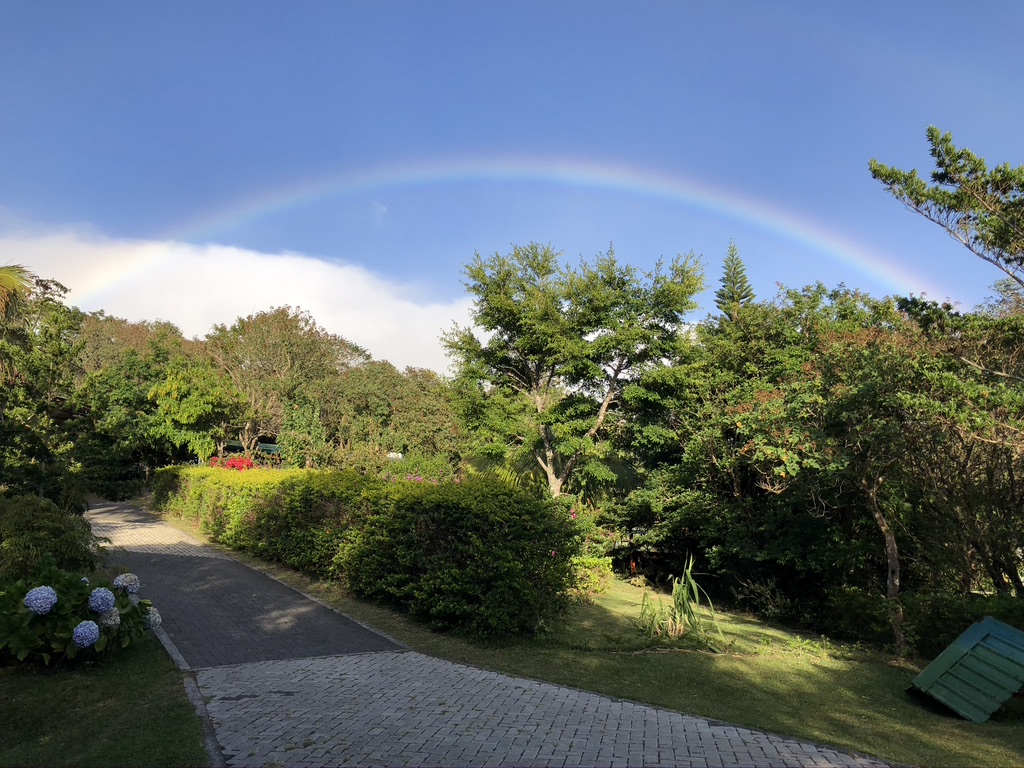
Rainbow outside our cabin near Santa Elena, our last stop in Costa Rica.

On our last night in Costa Rica we sat on a bench outside of our cabin. We watched the sunset paint the sky in varying pastel shades. We reflected on our visit – in four months we had traveled over 2,700 miles in our rental car, stayed in sixteen different guesthouses and visited thirty-nine different beaches on two coasts. And broken one bone. Not often can you travel abroad, break your foot, have surgery, spend six weeks recovering and rate the trip a huge success! As we leave we won’t say ‘adios’ (goodbye), but rather ‘hasta luego’ (see you later), to Costa Rica and it’s ‘pura vida’ lifestyle . . . and tomorrow say ‘hola’ to Mexico!