The Rhum Line

The aimless and sometimes muddled route of a traveling couple looking for their next great adventure


Leave a comment

Yucatan Road Trip – Part Four

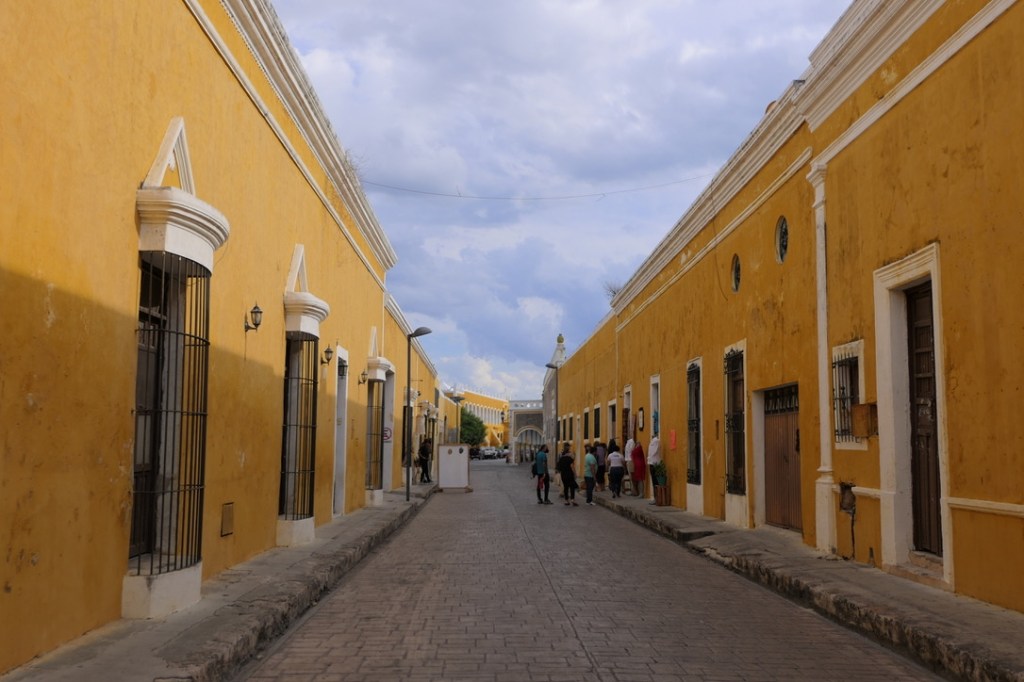
Mariachi music drifted from the car speakers. The air conditioner struggled to keep us cool in the mid-90’s heat of the day. Outside, the landscape rolled past – tinder-dry grassland, stunted trees and dry-stone walls partitioning off parcels of empty pasture. The road was straight and narrow, the bleak scenery only broken occasionally when we passed through small towns with names like Tekal, Temax and Tzimin. We were on our way to the coast, which we hoped would provide some relief from the oppressive heat of the interior of the northern Yucatan. We had just left one of the more unique little towns along our route. Izamal is called ‘The Yellow City’, and it’s easy to see where it had gotten its name – every building in the town is painted the same shade of mustard yellow. It’s a pretty town, spreading out along narrow streets and small plazas from the Convent of San Antonio de Padua, which sits on a small hill at its center. Most visitors come on a day trip from Merida, just ninety minutes away, and we had thought to do the same until Heather had found a beautiful restored hacienda just outside town that offered accommodation and looked too unique to pass up. We arrived at the hacienda around one and spent a couple hours at it’s refreshing pool, waiting for the heat of the day to dissipate, before venturing into town to have a look around and find a spot for dinner. We parked on one of the plazas below the convent and set out to explore. Beyond the obvious monochromatic color scheme, and the imposing walls of the convent looming over town, the third thing we noticed upon exiting our car were the horse-drawn carriages making rounds of the plaza. The carriages were gaily decorated with bright colors and plastic flowers, while the horses were . . . wearing matching sombreros! Chalk it up to ‘just when you think you’ve seen everything’.
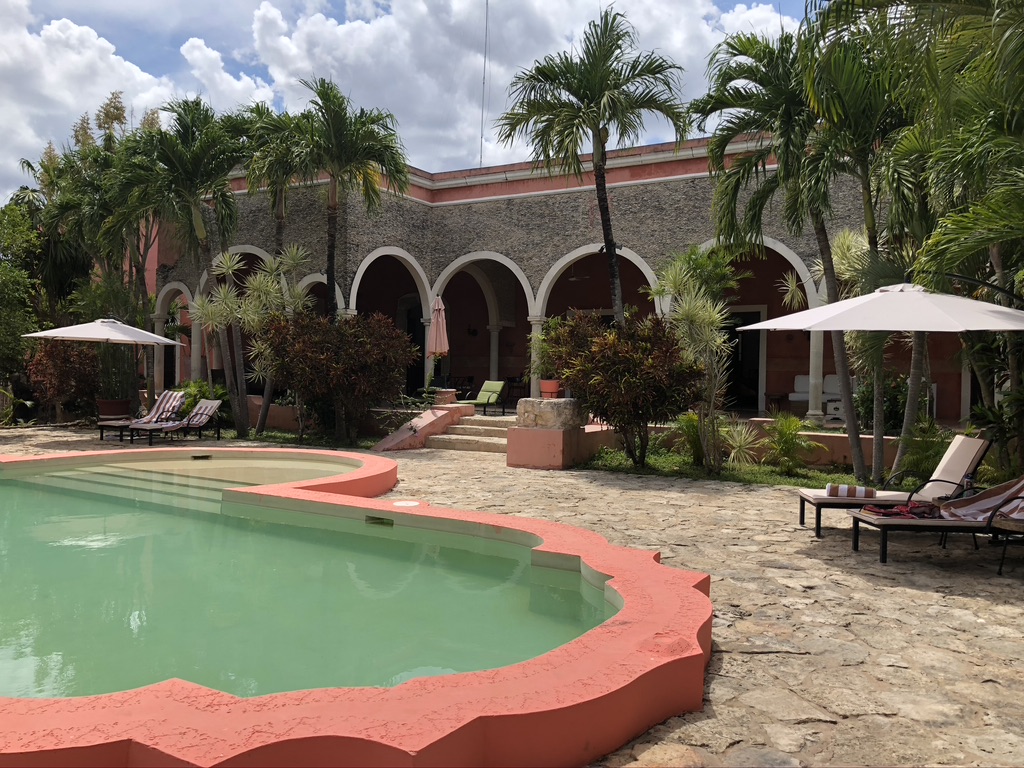
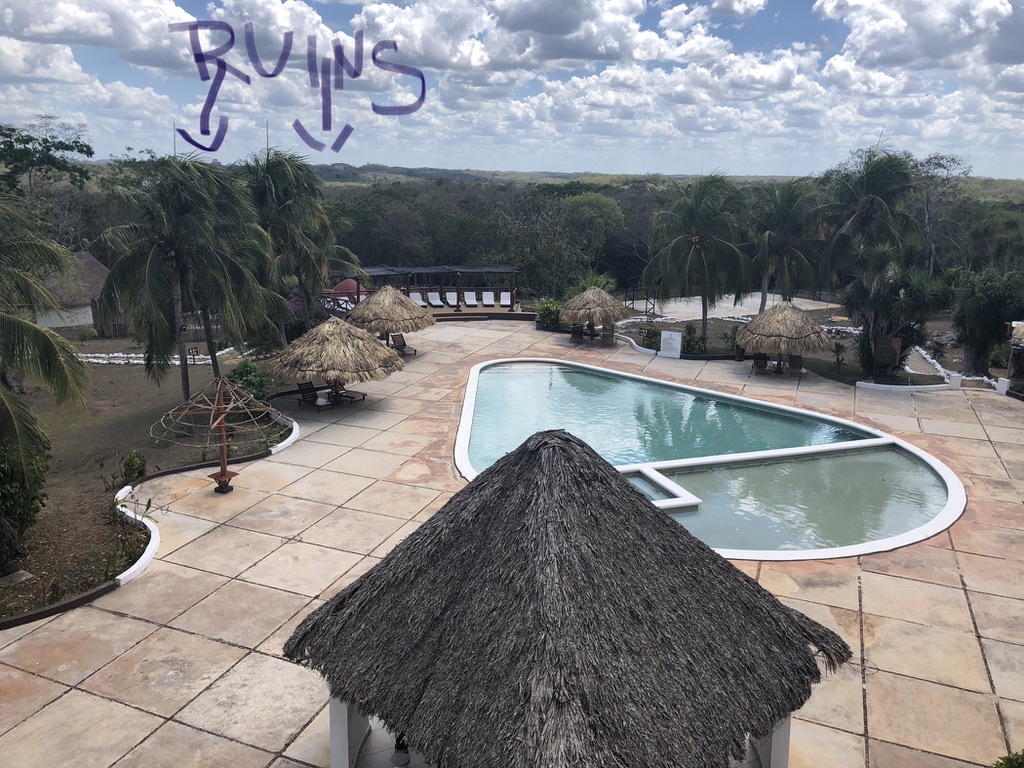
Hacienda Sac Nichte, just outside Izamal
Quiet, clean and . . . yellow – Izamal
Cute carriage, matching sombrero . . . and sleeping cabbie

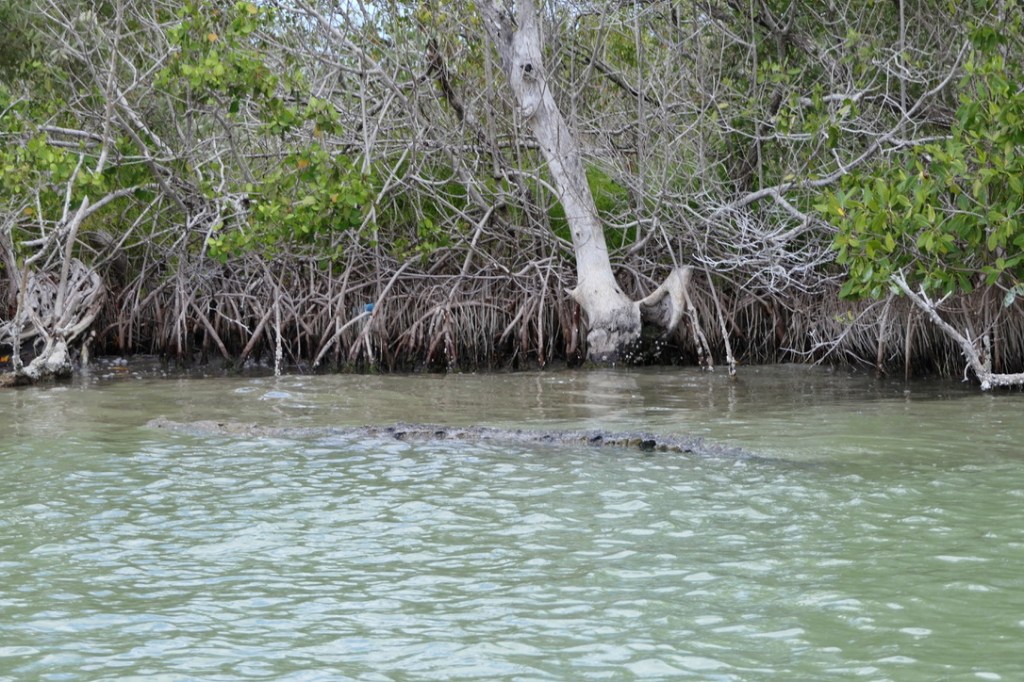
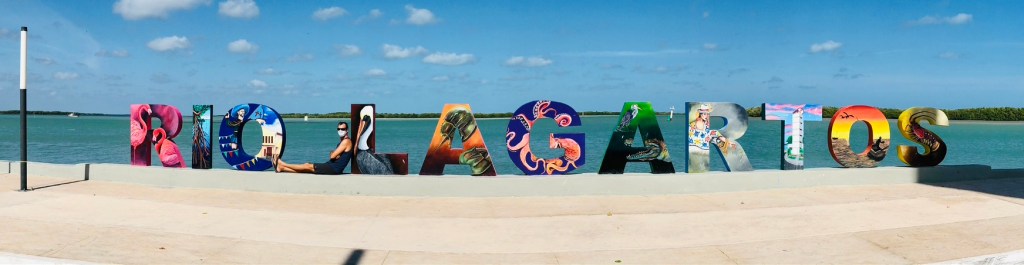
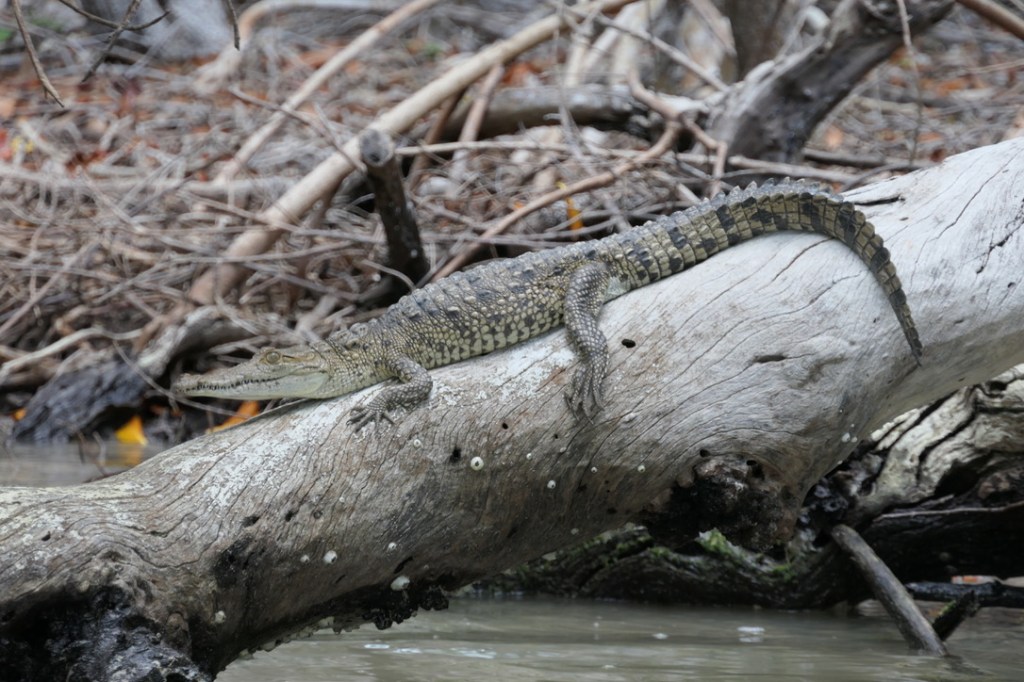
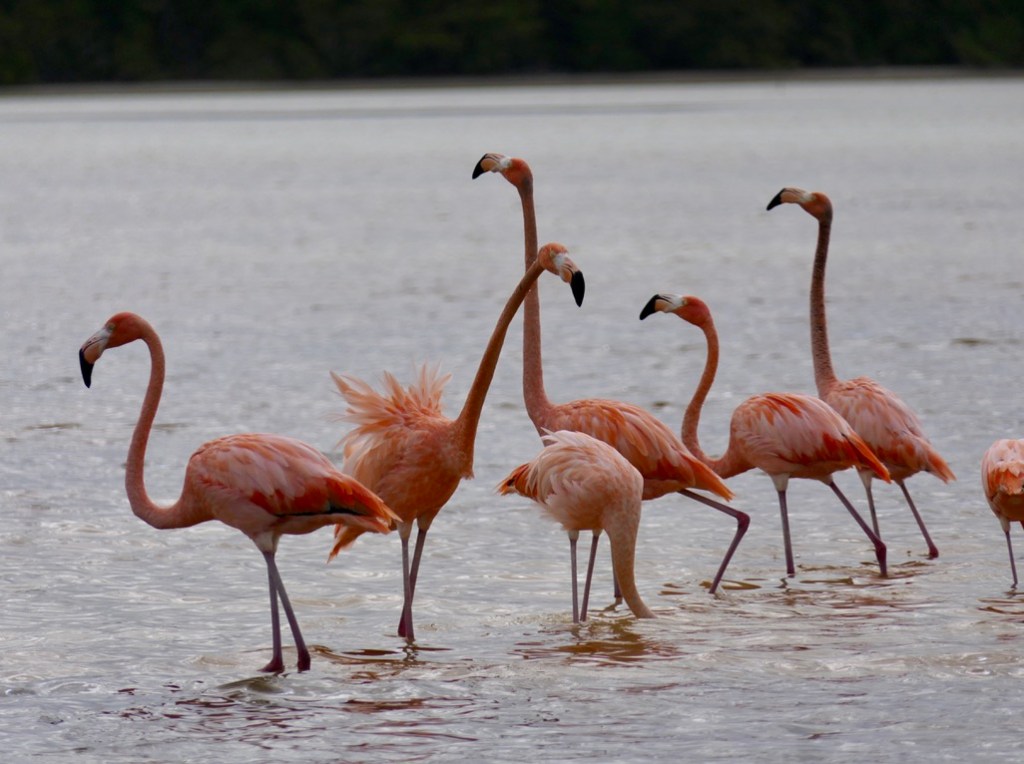
Moving on from Izamal, we hit the coast at the town of Rio Lagarto (Alligator River). The name is misleading – there are no alligators here (there are crocodiles), and the water that borders town is an estuary, not a river. The estuary and surrounding mangrove swamps are part of the Ria Lagarto Biosphere Reserve (Ria acknowledges the estuary) which is home to many species of waterfowl, including flamingoes, as well as salt ponds. An area very similar to that around Celestun, the ‘ramshackle gritty beach town’ I highlighted in the previous post that we visited a week ago. However, the town of Rio Lagarto was charming, the waterfront was busy (mostly with day-trippers taking tours of the estuary), there were several restaurants located just off the malecon, which ran the length of town, and our hotel room looked out over all the action. I chatted with one boatman and got the particulars of his estuary tour and we made arrangements for a trip the following morning. After breakfast at our hotel we met Jose at the dock and boarded his lancha for the two-hour trip. He carefully explained his plan for the morning – motor up the estuary to spot the different birds, then further on to see the flocks of flamingoes, returning to visit Las Colorados, the ‘red lakes’ where the salt mining operation was conducted, a stop at the ‘Mayan baths’ where we could cover ourselves with mineral-rich muds that would make us ‘feel ten years younger’, then ending at a white-sand beach to rinse off the mud before returning to town. And that’s exactly how it went. As we motored away from town we viewed cormorants, anhingas, eagles, pelicans and gulls, spotted a baby crocodile sunning on a log, all the while Jose providing a running commentary of interesting information about the birds, waterway and mangroves. After an hour we came upon the flamingoes in a shallow lagoon within the estuary. The numbers didn’t approach what we had seen previously in Celestun, but the birds were still beautiful to see nonetheless. As we started the return journey, we stopped to view the salt ponds and the large commercial salt extraction operation, noticing that the ‘red lakes’ were more orange-hued (similar to Celestun). Then Jose offered us the ‘Mayan bath’ – he invited us to slather on the age-reducing mud from the shoreline, which he said was full of ‘salt, minerals and flamingo poo’. Encrusted in drying mud, we flew back towards town, stopping briefly to observe a swimming six-foot crocodile, before making our final stop at the beach for a cleansing swim.
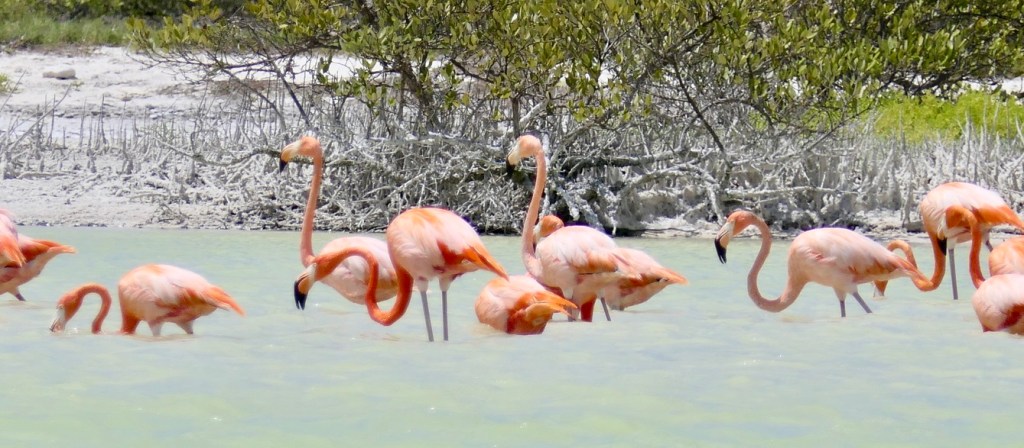
Ria Lagarto flamingoes
There was this little croc . . .
. . . and one a bit bigger
Mayan spa treatment
On the Rio Lagartos waterfront

On our way out of town we visited the village of Las Colorados, which we had viewed from a distance on our boat tour. Here we found an actual ‘red’ lake, which was in fact pink, just next to the giant salt mining operation, and which couldn’t be seen from the estuary. As we approached the salt pond, ‘guides’ rushed up to our car from the side of the road, insisting that the pink pond was on private property and only ‘official’ guides could accompany us to the ponds edge where we could take photographs. Or, we could stop the car, get out and take a photo from the road, which offered a fairly unobstructed view. So that’s what we did, then turned around and headed back out of town to our next destination.
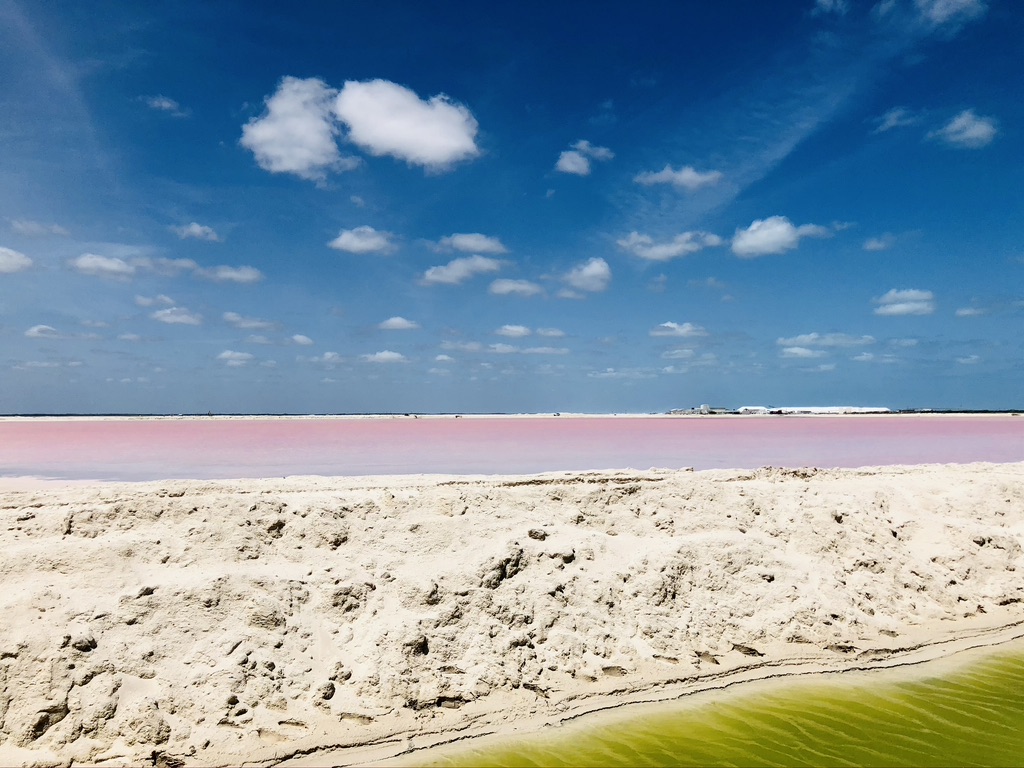
The pink lake really exists!

Valladolid would be our final inland stop before returning to the coast for the remainder of our Yucatan road trip. It would be one more small colonial city, with a main plaza and a three-century old cathedral, and more of that mid-90’s blistering heat. We opted for a single nights stay, waited out the heat in our air-conditioned room until just before sunset, then ventured out to stroll it’s cute lanes through the historic center. We found a restaurant with outside seating on the plaza and spent the evening sipping drinks and snacking on chips and guacamole, watching the weekend crowd.

After our pleasant evening in Valladolid, we hit the road to make our way back to Puerto Morelos, closing the loop of our road trip back to our first stop over a month ago.
Leave a comment

Yucatan Road Trip – Part Three

‘Quaint former fishing village’ and ‘picturesque little beach town’ are lines often used to describe many of the smaller beach destinations along the coast of the Yucatan, but will never be used when talking about Celestun. This ramshackle gritty village, located on the Gulf of Mexico just an hour and a half drive (less if you drive like a Mexican hell-bent on getting to the beach for the weekend) west of Merida is as unpretentious as they come. It doesn’t have any hip vegan cafes, boutique hotels or a craft brewery. It does have a long stretch of white sand fronting the beautiful blue water of the Gulf and it also has flamingoes. During the season, which we visited during the tail end of, thousands of American flamingoes make their winter home in the estuary of the Ria Celestun Biosphere Reserve, just at the edge of town. This is what brought us here for a couple of days.

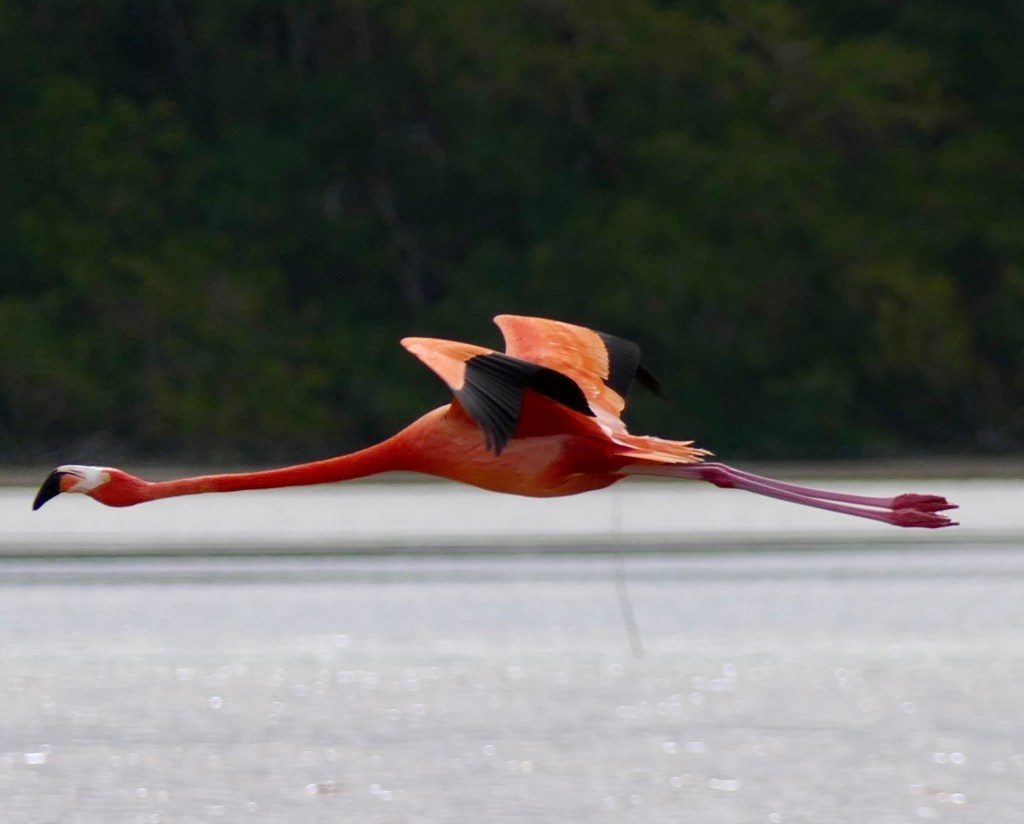
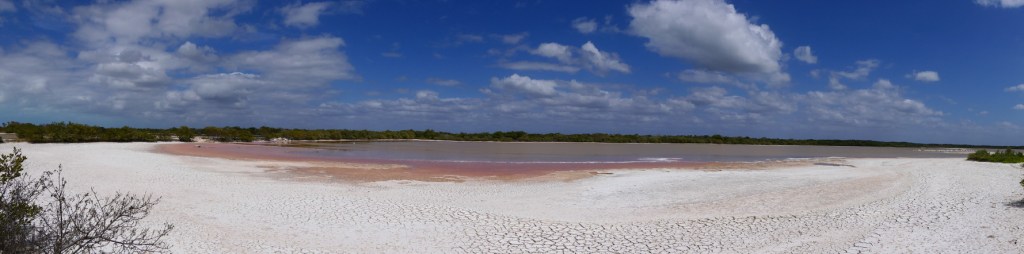
Being close to Merida, the largest city on the Yucatan, means Celestun is packed with beachgoers on most weekends. We happened to pick the busiest of all weekends, Easter, to visit. To beat the crowds, we elected to make an early start to our flamingo-spotting tour. We drove out to the edge of town just after 8 am and arrived at the official tour office and dock – before the office had even opened. Fortunately a few boatmen were around and we were able to strike a deal directly with one and were quickly on our way. The only other activity on the water that early were a handful of local crab fishermen who had already strung their nets along the mangrove-lined shore or dropped their traps into the river (blue crabs are the catch here – we sampled their meat packed into crispy empanadas at a seafood restaurant on the beach the previous evening). We motored about ten minutes downriver before we caught sight of a pink line on the water. Then we were amongst them – hundreds of flamingoes in various flocks, stalking the shallows, honking and hooting while feeding on the shrimp larvae that produces the pink coloring of their feathers. With the engine off we drifted silently past as the birds stuck their long necks into the water to feed, strolled through the river on their spindly legs and occasionally took flight by first running on the waters surface before getting airborne. When we had our fill of pink birds, we motored over to a small islet to see dozens of roosting cormorants, frigates and albatross. Our last stop would be to a small freshwater spring which bubbled to the surface to create a crystal-clear pool amongst the mangroves. Back on land, we explored a bit more of the Biosphere Reserve by car, driving dirt paths through mangrove swamps that led us to salt ponds holding mineral-laden waters with orange and pink hues.

These are funny-looking birds
A flamingo in flight
A salt pond in the Biosphere Reserve – we did see evidence of small-scale salt harvesting in places

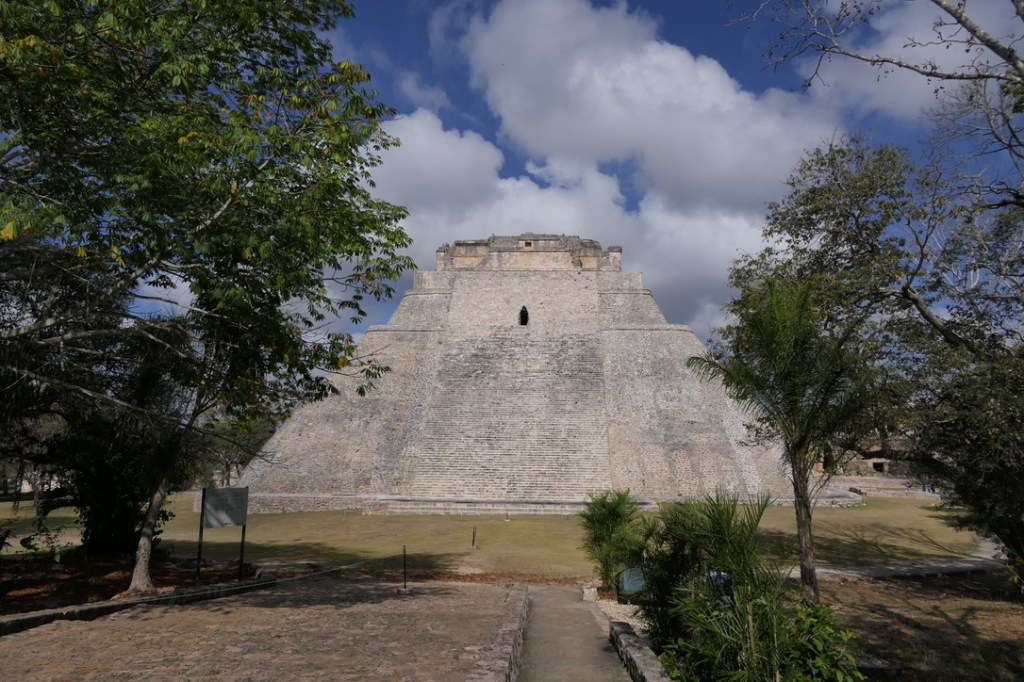
Prior to our visit to Celestun, we drove from Campeche inland to see the Mayan ruins at Uxmal. Situated along the Ruta Puuc, which contains several other Mayan sites, Uxmal is one of the only archeological sites still open to visitors in this area (the others have mostly closed during the last year – COVID casualties). Most visitors come to Uxmal on a day trip from Merida or Campeche, but we couldn’t resist the chance to stay at the Hotel Uxmal Maya Resort, which was located within walking distance to the ruins, had a large swimming pool (perfect for cooling off after a day in 90 degree heat) and rooms that looked out over the surrounding jungle with views of the tallest structures of the archeological site. We made our visit in the morning and were able to beat the day-tripper crowds, who were just arriving as we left around mid-day. Uxmal’s most impressive structure, the Pyramid of the Magician, greets you immediately upon entering. Behind it lies a quadrangle of temples surrounding an expansive courtyard, the stone facades decorated with highly elaborate carvings of human faces, animals and other objects. Uxmal also features a fairly intact ball court, where a crude game of Mayan basketball was played in front of spectators, who got the added benefit of occasionally seeing the losing team suffer the indignity of having to buy the winners beer before being sacrificed. Okay . . . I’m joking about the beer part.

A room with a view – Uxmal
The Pyramid of the Magician
Heather enjoying Uxmal (but probably thinking of the pool back at the hotel)

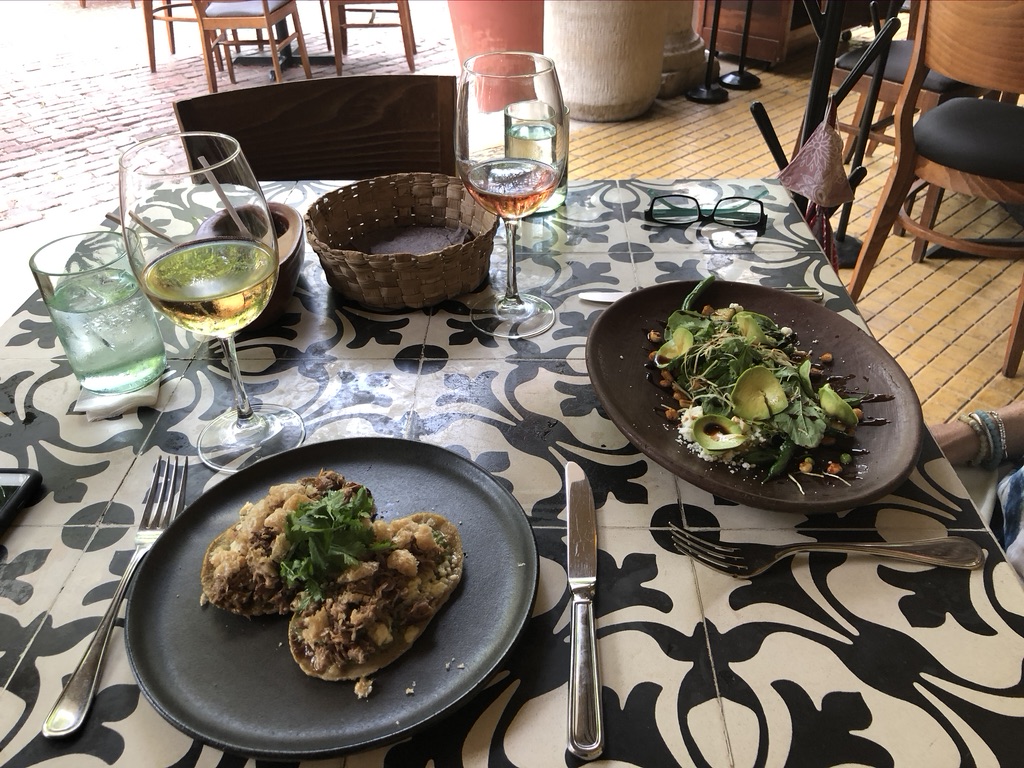
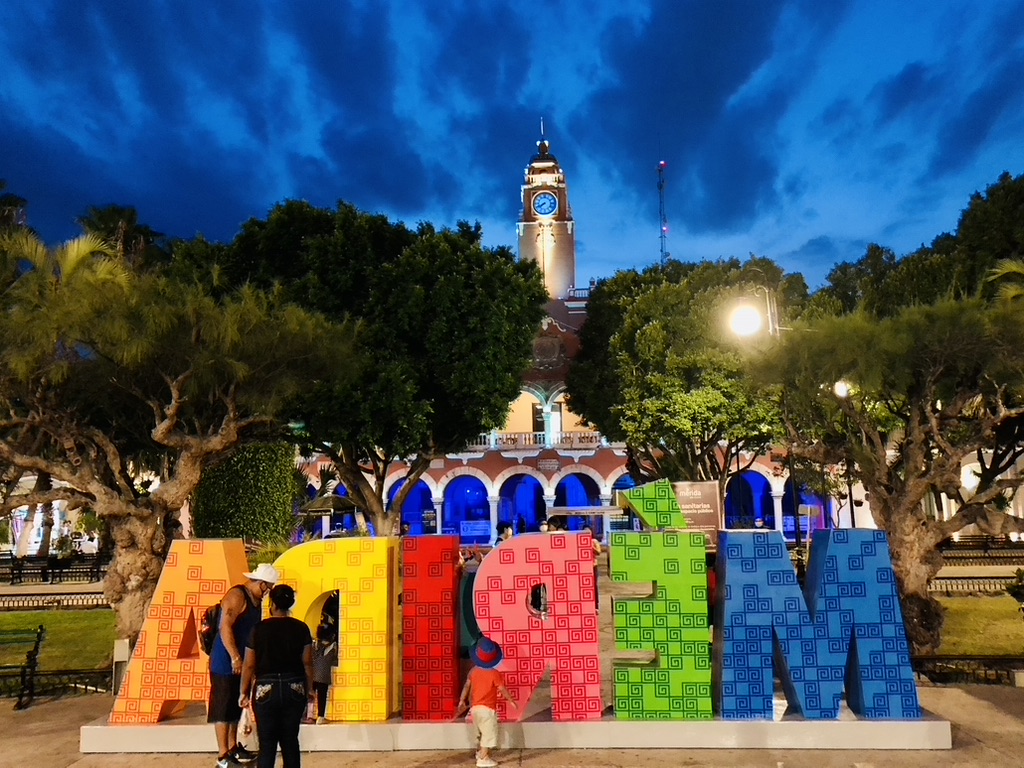
After our visits to Uxmal and Celestun, we made our way to Merida for a few days in the big city. Merida is one of those places that rubbed us the wrong way at first. The central plaza, while architecturally attractive, was crawling with numerous vendors offering the same stuff, so you couldn’t sit for a minute without being offered yet more shirts, necklaces and handbags. We found the recommended restaurant offering traditional Yucatecan cuisine to be overrated and disappointing. We had an underwhelming breakfast at our hotel. And it was hot – really hot (93). We were dispirited thinking we had another whole day to spend in town and we weren’t looking forward to it. But then something magical happened. Merida revealed its charms to us. We skipped the hotel breakfast and sought out a bakery cafe in the neighborhood where we enjoyed fresh flaky croissants followed by a quiche and fresh fruits with yogurt and granola. We strolled along the wide sidewalks of the Paseo de Montejo, admiring the beautiful architecture of the mansions that once were homes to Merida’s elite, now housing banks, museums, offices and cafes. In the evening we dined at Apoala, which is situated on a small plaza, where we feasted on Oaxacan-inspired dishes like shrimp ceviche with grilled avocado and roasted pumpkin; a fresh salad of greens, fava beans, green beans, toasted corn and tomato; and shredded roast suckling pig piled on housemade tortillas with Oaxacan cheese, cilantro, pickled onion and chicharrones. We lingered over craft cocktails and Spanish wine before strolling to the main plaza and ended the evening at the outdoor bar of an old classic hotel tucked into a small plaza, chatting with a new friend. Merida had won us over.

Food that won our hearts – dinner at Apoala in Merida
Looking across the Plaza Grande at sunset – Merida

Another week of our Yucatan road trip is in the books. Next, we’ll head inland from Merida to visit a very unique small town, another Biosphere Reserve on the northern coast (yep, more flamingoes) and one more small city before ending our trip at a couple of our favorite beach towns.


Leave a comment

Yucatan Road Trip – Inland and Across to the Gulf

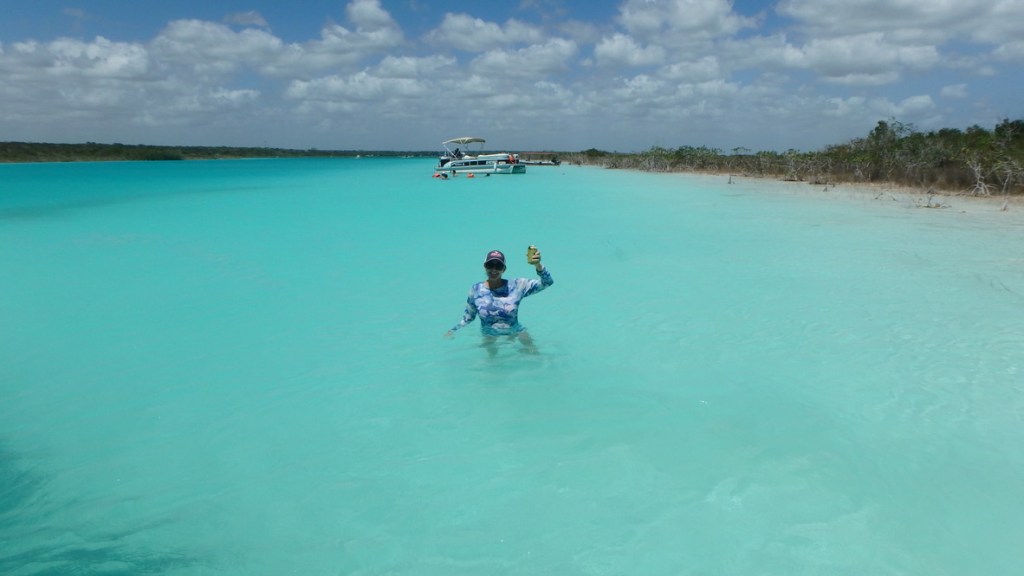
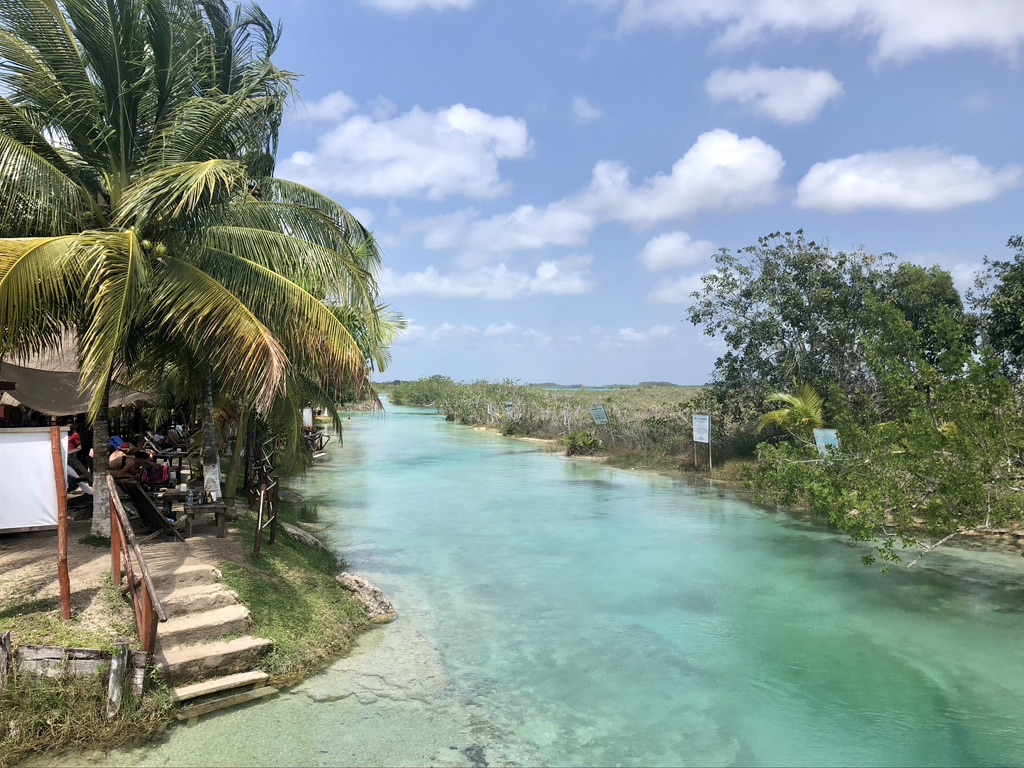
The Maya Riviera, the stretch of coastline along the Yucatan’s Caribbean side, contains most of the area’s well-known destinations for beach fun: Cancun, Playa Del Carmen, Cozumel and Tulum to name a few. Head inland from the coast and the scenery changes dramatically and the crowds thin considerably. We left the beaches behind at Mahahual and headed into the heart of Mayan country. The shimmering blue of the Caribbean Sea would be replaced by the . . . shimmering blue of an inland lagoon? Not just any old shimmering blue – Laguna Bacalar is also known as the Lagoon of Seven Colors (spoiler alert – the colors are all shades of blue). It’s hard to imagine an inland body of water that contains the lightest shade of blue where it lies over a shallow limestone bottom to the deepest blue of the nearly bottomless cenotes, of which there are four in or around the lagoon. The best way to experience the lagoon and the amazing colors of its water is by boat. Almost anywhere along the shore boats are available for hire, offering a fairly standard trip of a couple hours, allowing for plenty of swim time in the shallower sections. The boat captains are also more than happy to provide a cooler and ice if you decide to bring along some beer (spoiler alert – we did). If you prefer to stay on land while enjoying the water, there are two other options – Sac Ha offers access to a shallow bay (with that light blue water and limestone bottom) and a number of palapas for a shady spot to spend the afternoon; Los Rapidos is sited along a narrow channel where you can float the current, then sip margaritas and munch on chips and guacamole while watching others enjoying their float. When we’d had enough time on, and in, the water, we spent our evenings exploring the eateries in town. Our favorite meals ranged from the simple, traditional chicken roasted over charcoal, served with tortillas, rice and salsa at Pollo Asadero Sinaloa to the upscale offerings at Nixtamal, including wood-fire grilled tuna with coconut butter, passion-fruit aioli and a variety of grilled vegetables. The fiery salsa served with tortilla chips before our meals were washed down with mezcal – guava mojitos (so good I just had to mention them).

Enjoying some of the ‘blue’ in Laguna Bacalar

The end of the float at Los Rapidos – margarita time!

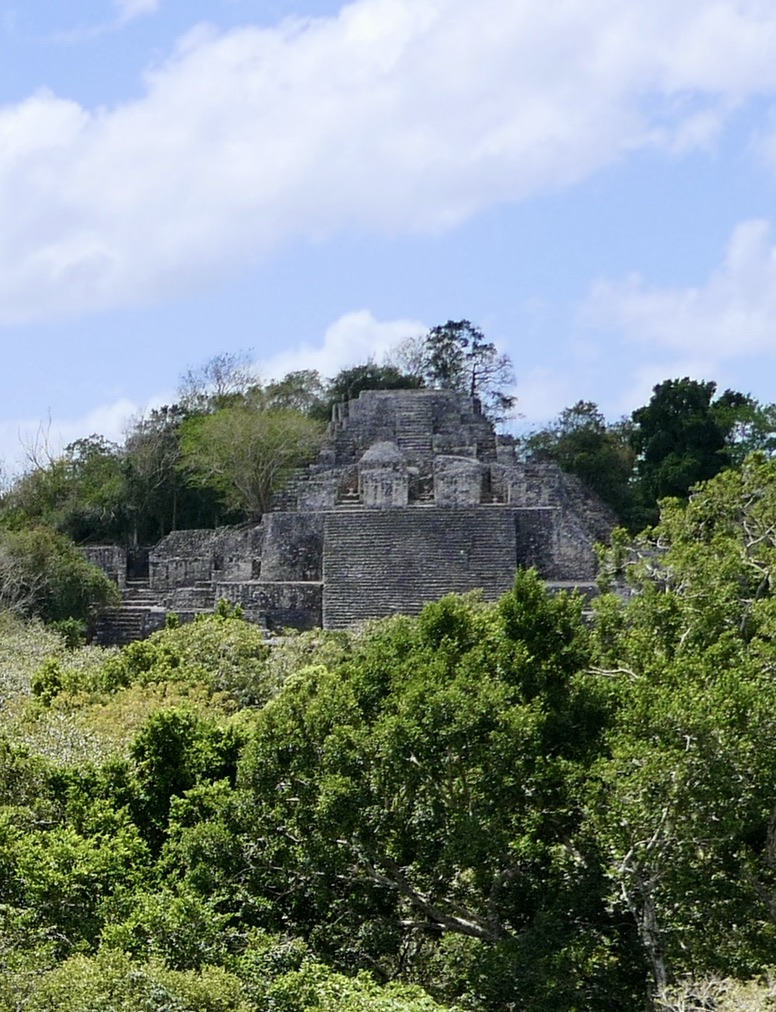
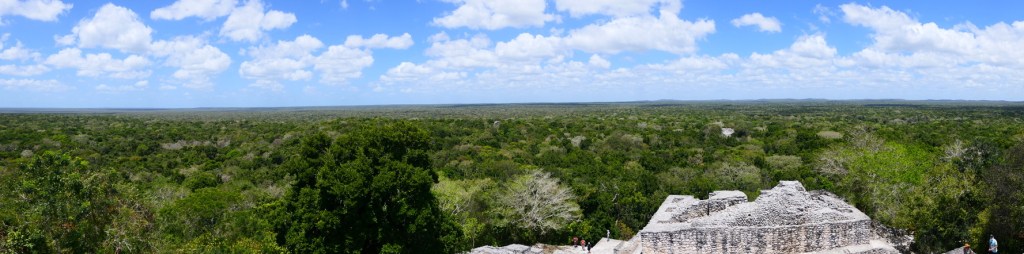
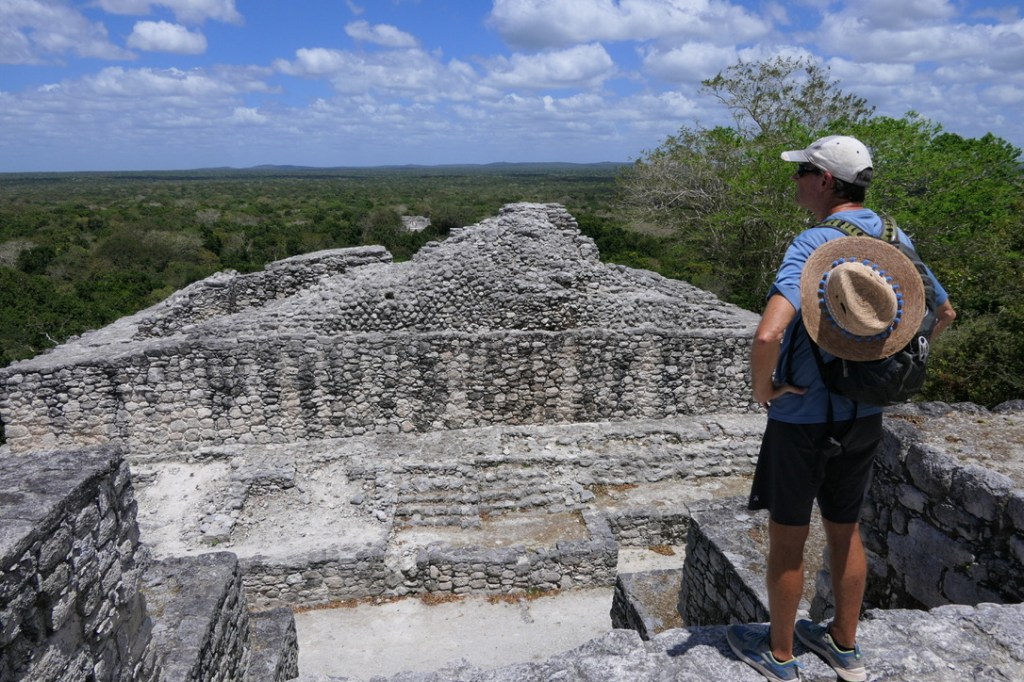
Acting on a tip from our host back in Puerto Morelos, we made a visit to the Mayan ruins at Calakmul our next stop. The ruins, located deep in the jungle amidst the Calakmul Biosphere Reserve just thirty miles from the Guatemalan border, required a two-night stay in the small market town of Ixpujil. To the tourist, Ixpujil doesn’t offer much, other than a place to sleep, and, as it turned out, decent pizza and cheap beer. But it still lies two hours away from the ruins, so we got an early start the next morning, fueled up on a delicious fruit, granola and yogurt breakfast, and made the drive to the ruins. The main attraction at Calakmul are the two towering pyramids which peak out of the jungle, offering panoramic views of the surrounding landscape, as well as the site below.

Rising from the jungle – Calakmul ruins
The flat landscape around Calakmul in the state of Campeche

I think I see Guatemala

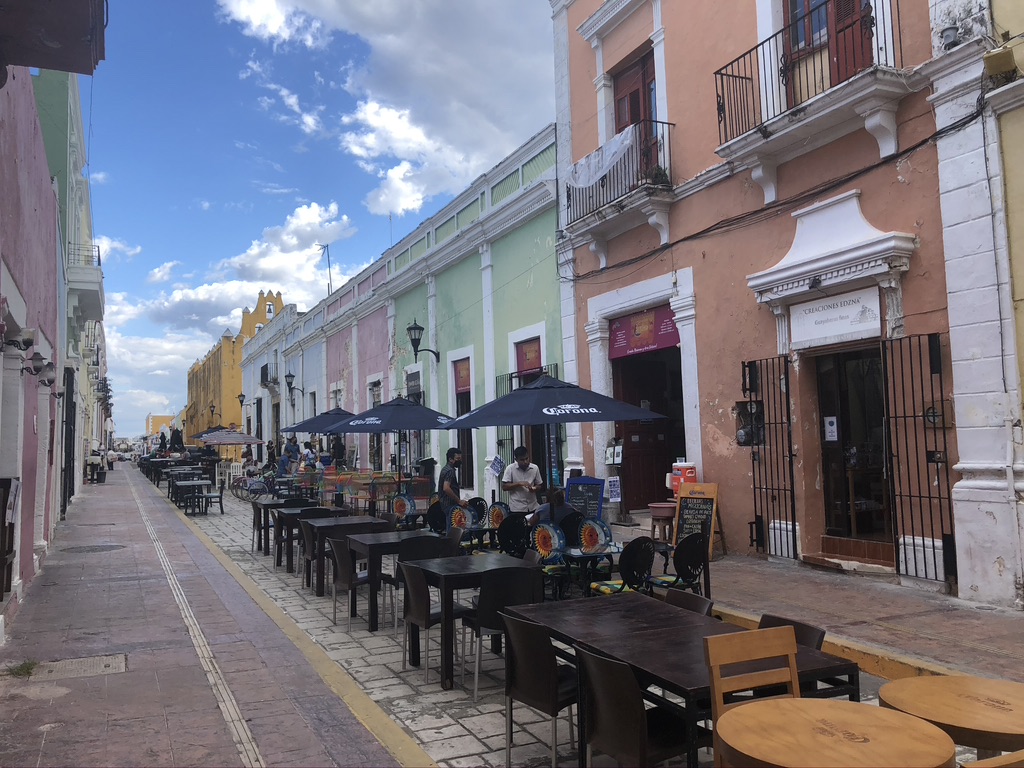
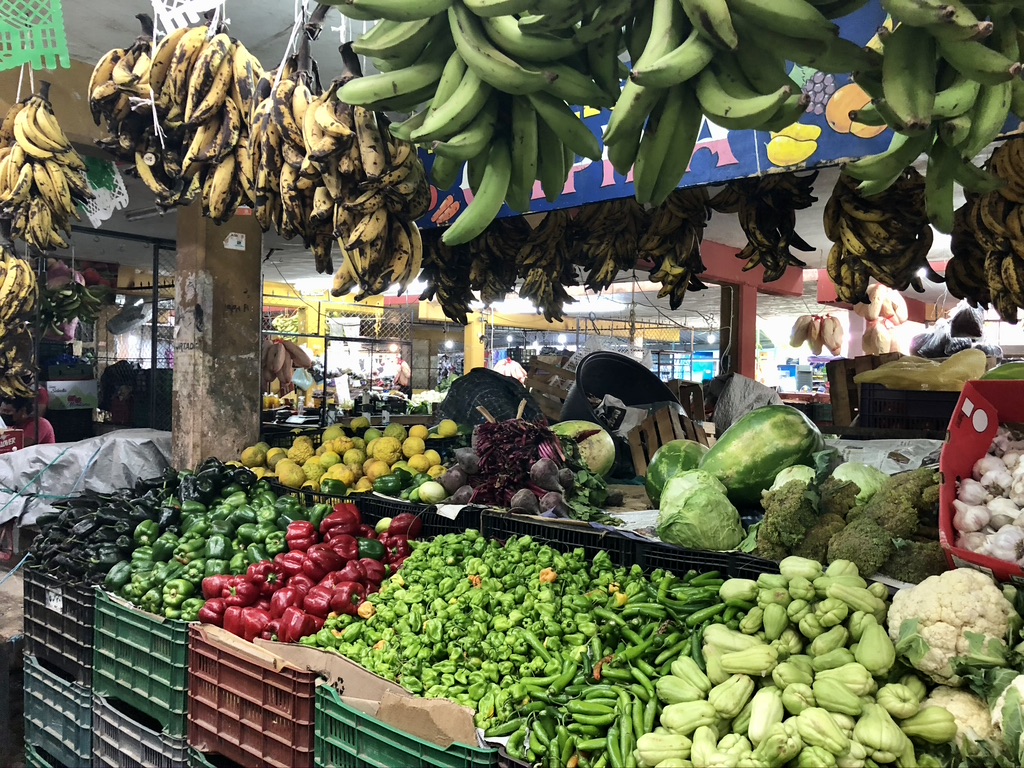
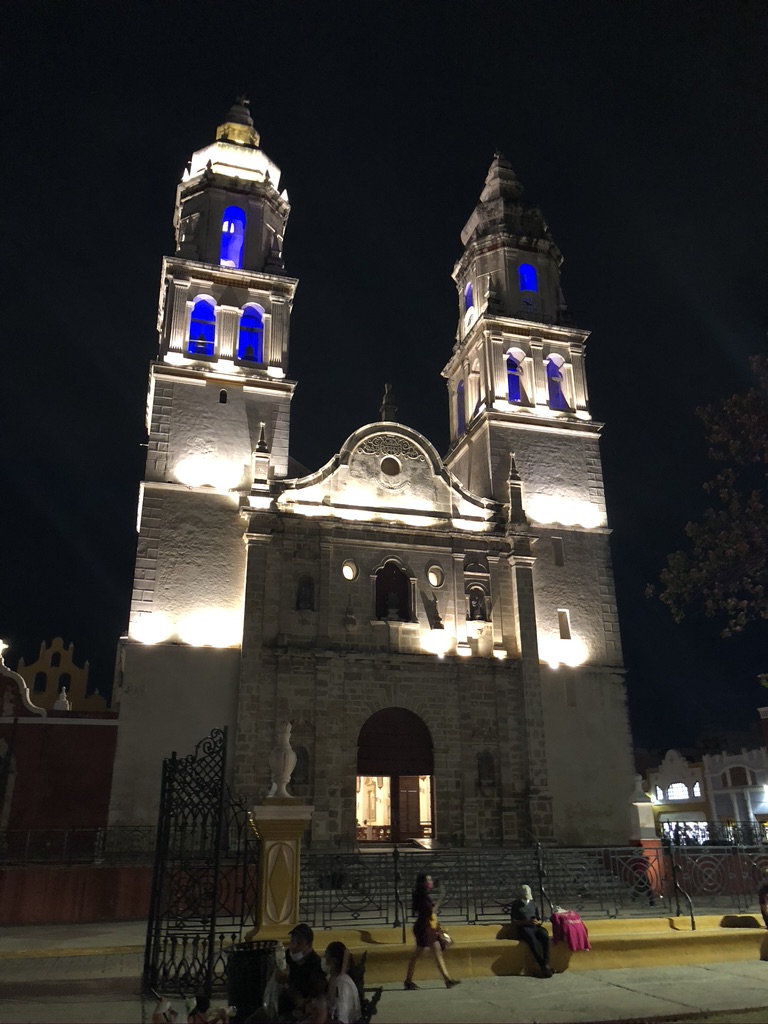
Following our jungle experience at Calakmul, we traveled four hours west to the Yucatan coast, this time on the Gulf of Mexico. We arrived in the small city of Campeche, capital of the state of the same name and second largest city (after Merida) on the peninsula. We were immediately taken by this little charmer – pastel-colored buildings, a lovely main plaza with a beautiful church and a seemingly never-ending malecon along the waterfront. We were most impressed by how clean this city was – not a scrap of trash to be seen on any of its streets. We wandered through the sprawling central market, a vast covered area with dozens of stalls offering every type of fresh fruit, vegetable, fish and meat, along with clothes, footwear and jewelry. The malecon was a great spot to watch the sunset before heading back into the historic town center for a meal and to view the plaza and cathedral lit up for the evening.
A popular pedestrian street in Campeche getting ready for the dinner hour

Some of the fresh produce on offer at the mercado
The cathedral on the main plaza, started in the 16th century

Eight days took us from coast to coast – from a lagoon to Mayan ruins deep in the jungle, to the beautiful colonial city of Campeche. The next week would see us venture back into another Biosphere Reserve for more Mayan ruins, back out to the Gulf coast for flamingo spotting and some time in the Yucatan’s largest city.


Leave a comment

Yucatan Road Trip – The Costa Maya

‘Yes, you can make it here with two-wheel drive. In just two hours from Tulum you will be in paradise!’

I could feel the enthusiasm in Juan’s email. The owner, with his wife Marta, of Hotel Las Palapas had assured us our rental car would handle the dirt road that travels through the Sian Ka’an Biosphere Reserve between Tulum and Punta Allen. In person, Juan was just as enthusiastic as I pictured him. He was also funny, friendly, and, as it turned out, wildly optimistic. Two hours seemed like more than enough time to drive the thirty-five mile stretch. But one does not drive this road in a singular direction – due to the profusion of potholes, we had to zig and zag it’s entire length – and only arrived at Juan and Marta’s place after three hours of painfully slow driving.

Punta Allen has that end-of-the-earth feeling, perhaps because it fits the description as well as anywhere else we’ve been. Located at the southern end of the finger of land that sits between the Biosphere Reserve and the Caribbean Sea, Punta Allen has a grid of clay and limestone lanes (as pot-holed as the access road) covering about three square blocks, a handful of restaurants looking over the water, about as many guesthouses and fishing lodges . . . and not much else. Some folks come as a day trip from Tulum, stay a night, take a boat tour of the lagoons and the offshore reef in the morning, then head back to ‘civilization’ (if foul-smelling, over-developed and crumbling Tulum can be called that). We chose to spend three full days here, hoping we could fill our time paddling, snorkeling and swimming. The constant wind took paddling off the table. The profusion of sargassum (a problem all along the Caribbean coast of the Yucatan this time of year) kept us from snorkeling and swimming off the beach. We did make the three-and-a-half mile roundtrip walk out to the lighthouse on the point (punta), found some palm trees to hang our hammocks a couple afternoons, and dined in most of the restaurants. On our final day we had Juan organize a boat trip for us. We were taken to the community dock on the bay, met our captain and headed out onto the water. It was a stunning day (other than the stiff breeze) – the sun shone brightly, large puffy cumulus clouds dotted the horizon and the water offered a palate of blue colors. If we’re lucky, our captain said, we might see manatees, dolphins and turtles during our trip. He patrolled the bay for several minutes and then circled around just as a manatee surfaced for a breath. ‘Manatee. Check!’ Heather said to him with a huge smile on her face. Then we left the bay and headed into the open sea. Soon Heather was able to turn to him again – ‘Dolphins. Check!’ Minutes later we spotted the first of three turtles as it swam just below the surface – ‘Turtle. Check!’ With that we had fulfilled the tours promise, but we still had a snorkeling stop out on the reef to fill out the morning. While the reef didn’t offer much in the way of colorful coral or large numbers of fish, the appearance of a couple manatees certainly made the snorkeling fun. After returning to the boat, we motored into shallower water for another swim before returning to the dock. It was an epic trip, topped off with another delicious fish dinner at one of the waterfront restaurants back in town.

The end of the world – Punta Allen
Try to look like your enjoying yourself! Dolphin spotting off Punta Allan
Post boat trip dinner – with a view

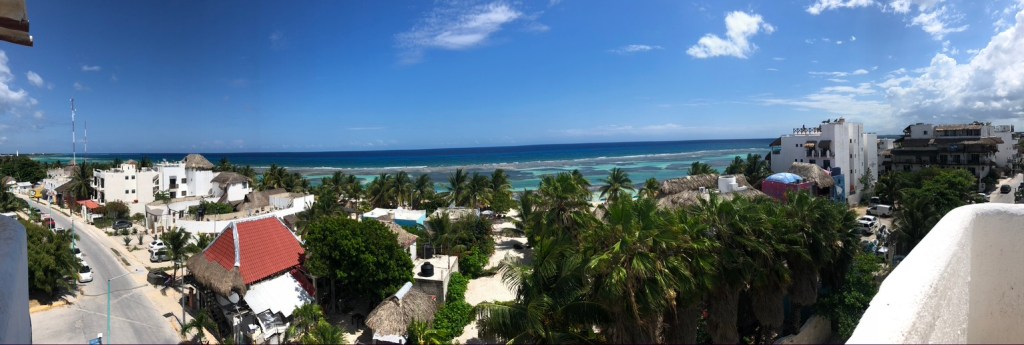
Continuing our trip down the Costa Maya, we arrived in the small town of Mahahual, where we had planned on a three-day stay. The town runs about five blocks along the shore, fronted by a paved malecon (promenade) lined with small gift shops, dive operators and restaurants, whose tables spill out onto the white-sand beach right down to the clear waters of the sea. A reef just offshore keeps the waters calm for swimming and offers a chance for snorkeling. To the north and south of town a packed-dirt road runs for thirty miles in both directions, with nothing but an occasional house to break up long stretches of deserted beach, palms, sea grape and mangroves. Back in town there’s a cruise ship port, which has been idle for the past year. Many businesses are doing okay, dependent on the increased visitation by Mexican tourists. But we noticed a lot of empty stalls where vendors would normally have been hawking all the kitsch, t-shirts and shell necklaces to the cruise shippers.

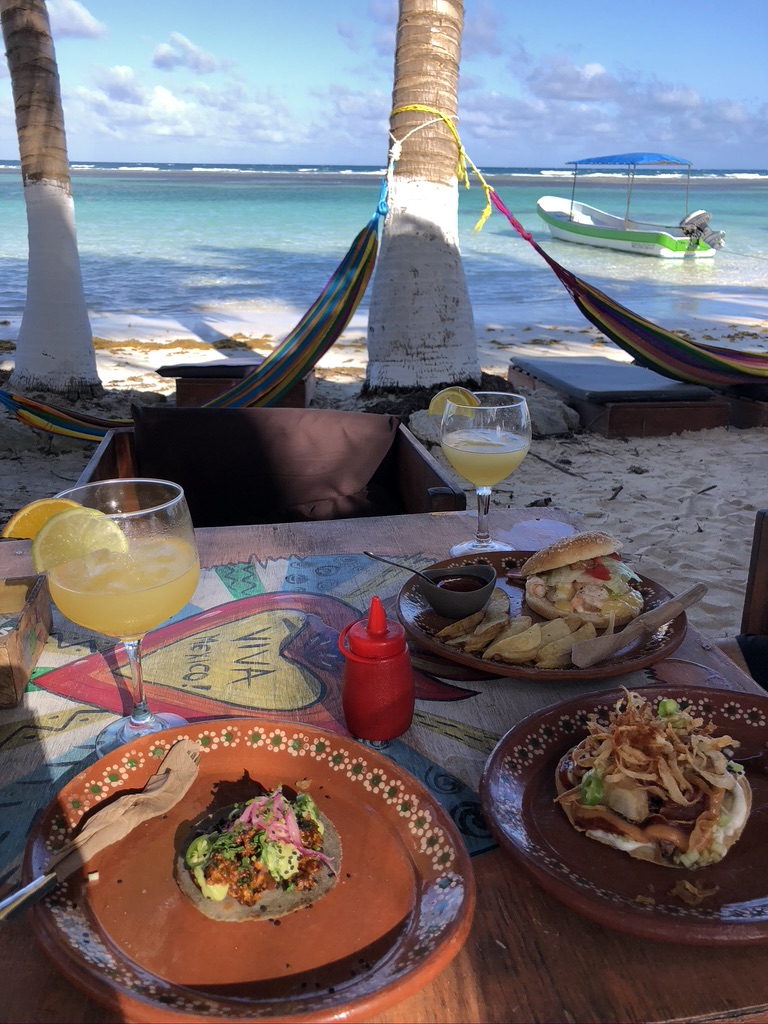
We were happy to spend our days snorkeling, strolling the promenade, driving the deserted roads along the coastline and feasting on the creative tacos and tostados offered by our favorite Mahahual restaurant – La Chilangoloense. Night after night we returned here for the tasty margaritas, impressive variety of seafood tacos and tostados, the friendly service of the staff and the toes-in-the-sand setting on the beach. Outside of the weekends Mahahual gives one the sense of what this former fishing village might have been like years ago – by nightfall at 7 pm the streets were empty, the vendors had all gone home and most restaurants along the beach were closed for the night.

Some of the tasty tacos – and a shrimp burger – at La Chilangoloense

All of Mahahual from our terrace
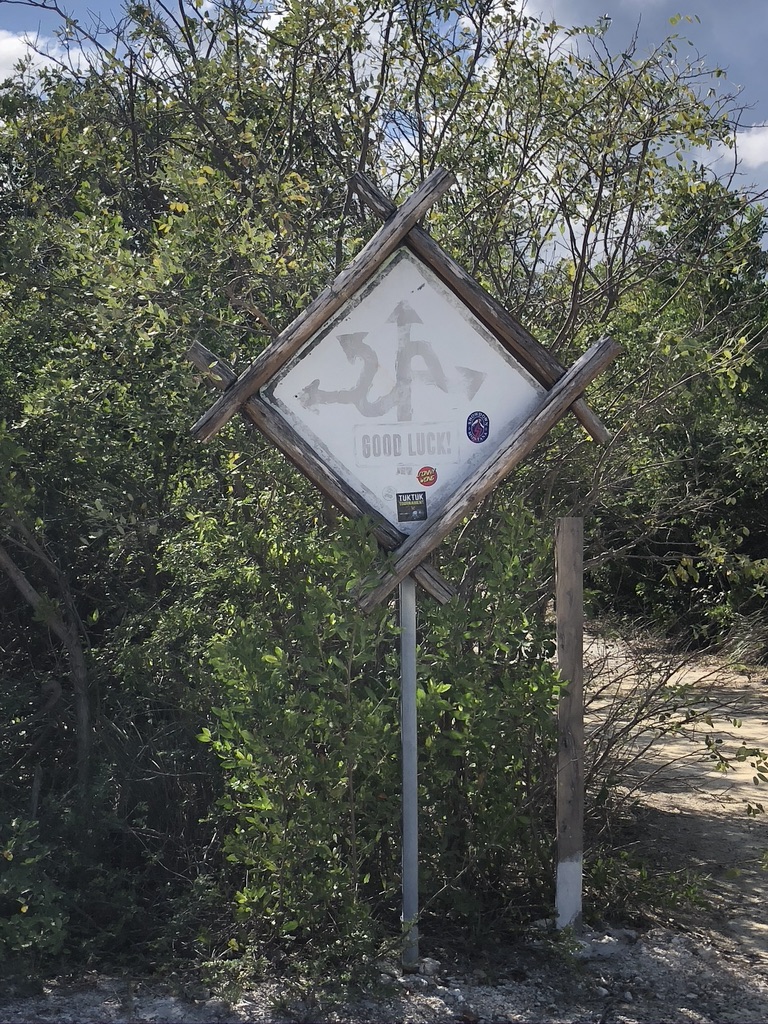
Someone’s sense of humor along the beach road outside Mahahual

After a week in Mahahual, it’s time to leave the coast and head inland and across the Yucatan peninsula. Ahead over the next couple weeks lies the lake and cenotes of Bacalar, the Mayan ruins at Calakmul in the jungle of the interior and the colonial city of Campeche, overlooking the Gulf of Mexico.


4 Comments

Yucatan Road Trip – Stop One

‘Todo bien!’

Heather enthusiastically answered our servers query as to her satisfaction with the mojito he had just set in front of her. Along with the bowl of shrimp ceviche, a plate of fish tacos and my bottle of craft beer, I couldn’t agree more that things were ‘all good’. We were sitting at an open-air restaurant overlooking the beach in Puerto Morelos, with a view across the white sand beach to the clear blue Caribbean Sea. After the previous day’s long trip from Costa Rica, including a three-hour drive to San Jose, the inevitable long wait at the airport, two and a half hour flight, an evening arrival into the airport in Cancun, picking up our rental car and making the thirty minute drive here in the dark, the delicious food and cold drinks, not to mention the perfect view, was the perfect start to our month-long Yucatan road trip.

‘Todo bien’

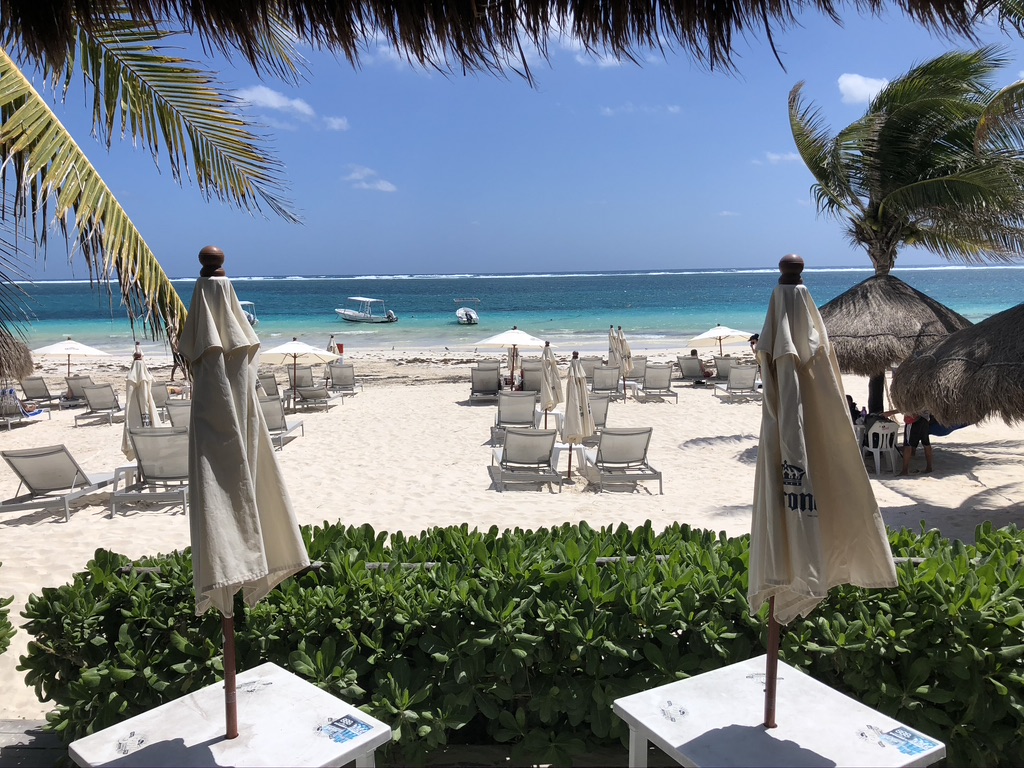
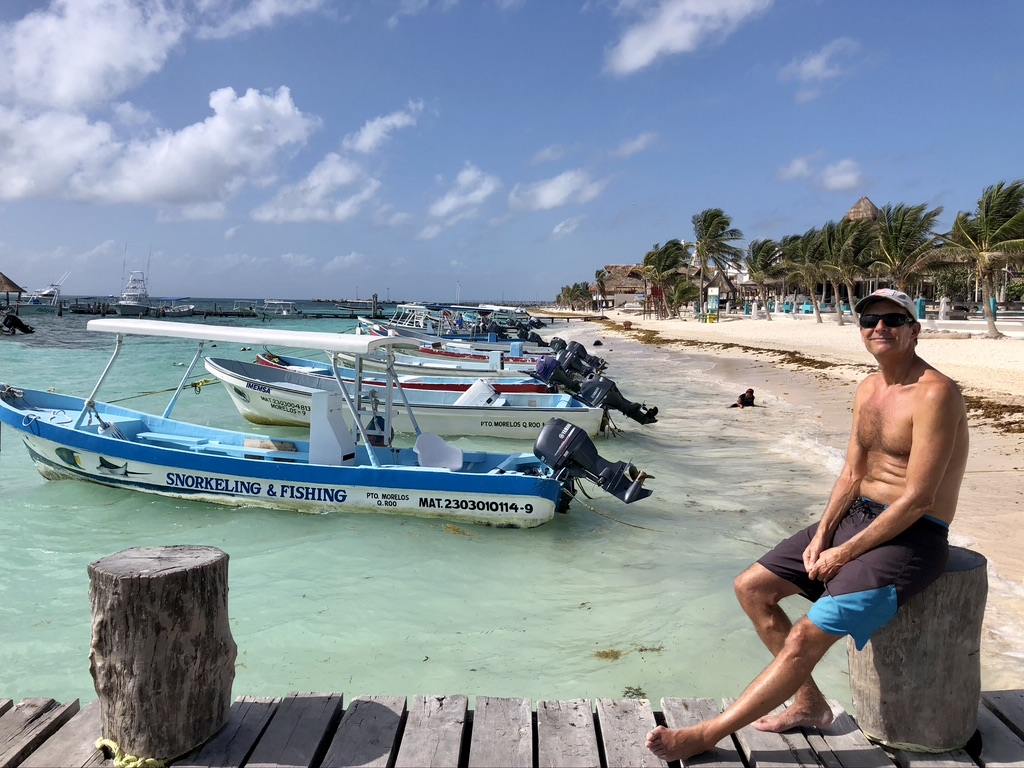
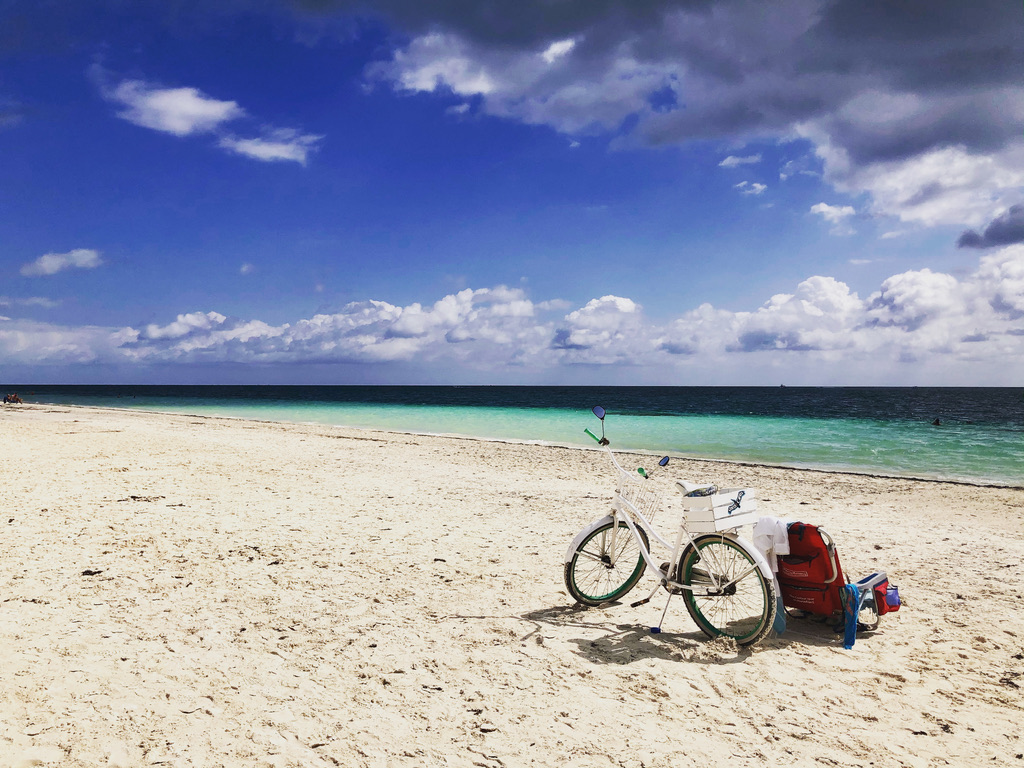
We chose Puerto Morelos as our starting point mainly for it’s proximity to the Cancun airport, knowing we’d be arriving late and not wanting to travel far at night. We had heard stories of this former fishing village, now well-known by European and North American travelers, and it’s beautiful beach and calm waters. It’s turned out to be everything we hoped for. Not often do you arrive somewhere in the dark, tired after a day of travel, yet still have such a positive feeling about a place that you immediately begin thinking about staying longer. Yet that’s exactly how we felt here. After breakfast at our guesthouse we inquired with the owner if our room was available beyond our original four-day reservation, and to our delight, learned that it was. So we booked in for another couple days . . then after another day, booked an additional week. We spent the first few days wandering the beach, swimming, exploring town, feasting on way too many tacos and enjoying the warm ocean breezes. When those breezes died down, we inflated our paddle boards and ventured out onto the calm waters of the Caribbean, gliding over the clear waters inside of the reef that runs just offshore. There are no shortage of travelers here – Puerto Morelos has been discovered. But it’s a far cry from the maskless crowds that throng Cancun or Playa Del Carmen (we know – we had to visit both while running errands). It’s remains a Mexican town filled with gringos – just hang around the beach after four pm and you’ll see all the local families come out for a couple hours of swimming and relaxing after a work day.

Fishing boats line a section of beach in front of Puerto Morelos’ town center.
Discovered but still not crowded.

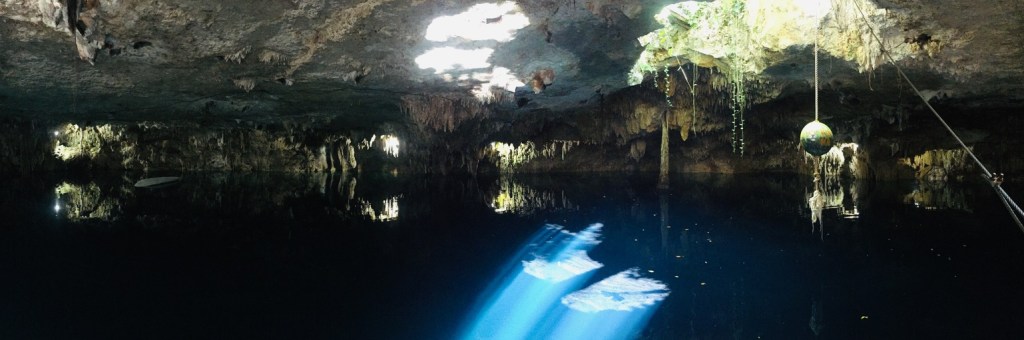
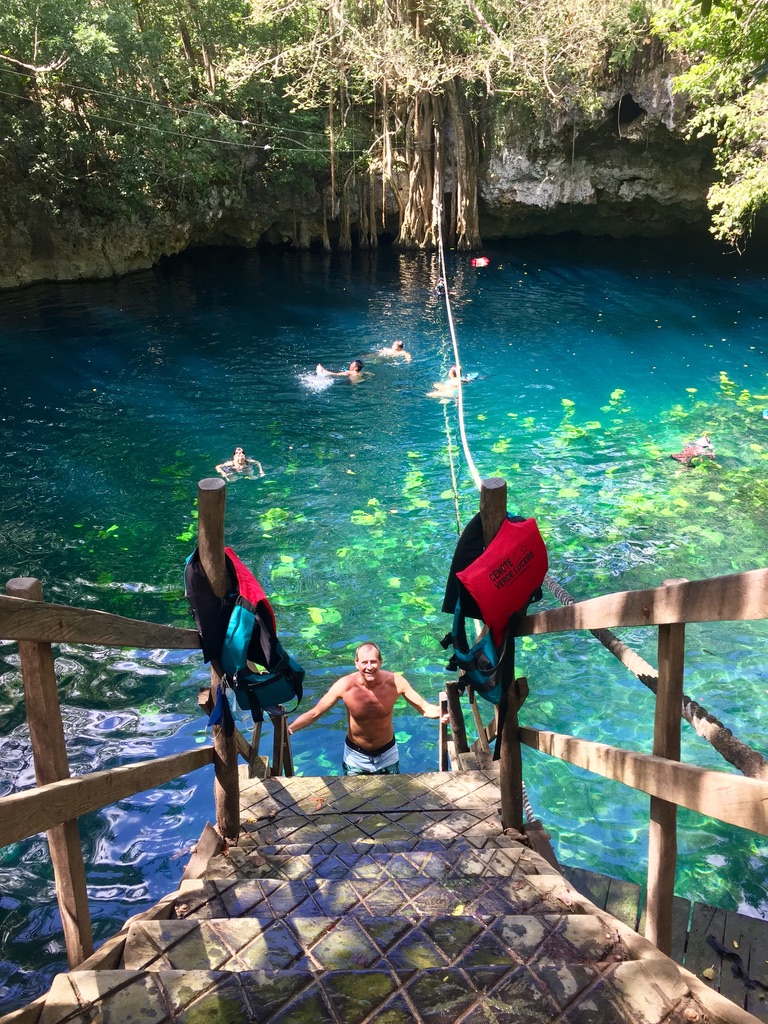
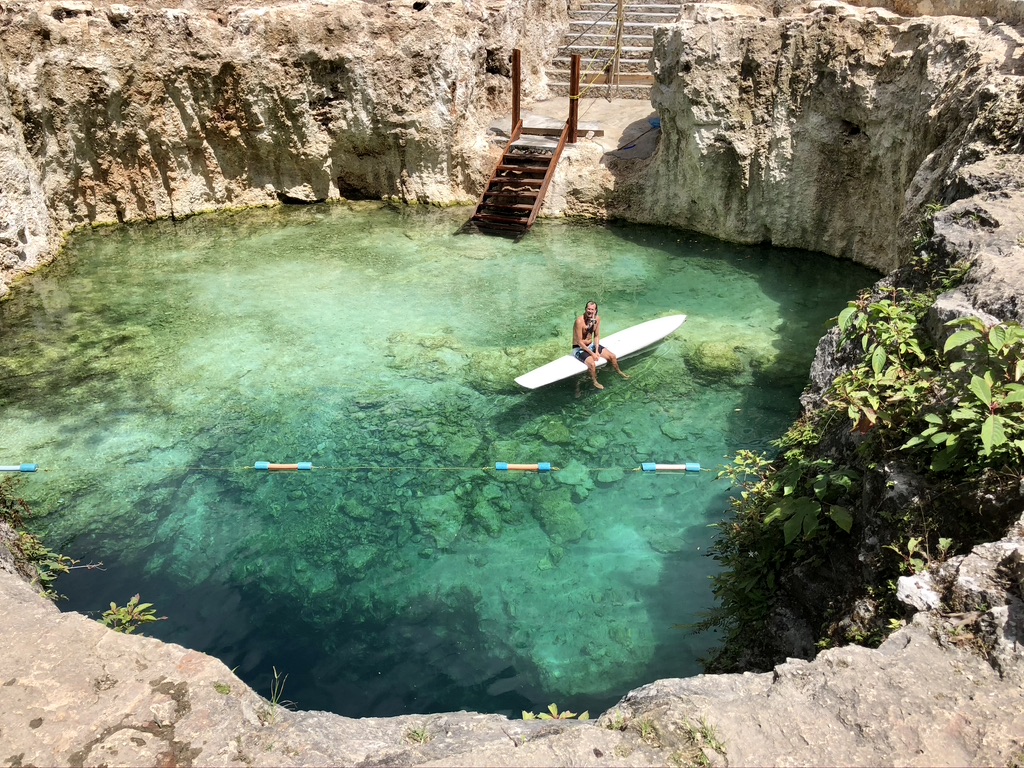
Another attraction to Puerto Morelos lies a few miles inland. Las Rutas de Cenotes runs from Puerto Morelos to the inland town of Leona Vicario, a straight stretch of highway covering just over twenty miles. The cenotes – fresh water-filled limestone sinkholes – that line the ruta range from small open-air pits (maybe featuring a rope swing) to enclosed caverns with a narrow opening and even one with a series of connected caverns each having it’s own small access. Over the course of two mornings we visited three different cenotes and found total enjoyment in each kind. Our first day we were lucky to be the only visitors at the Kin-Ha cenote, an enclosed cavern with one narrow opening providing access and light. Afterwards we drove to the Verde Lucero cenote and joined a handful of others floating in the cool waters of the open-air cavern under a sunny sky. On our second trip to the ruta, we spent the better part of a day (with new friends from our guesthouse) exploring the interconnected caverns of the Siete Bocas (Seven Mouths) cenote, then relaxing under one of their palapas, sipping beers and watching others jump into the deep pool of an open section.

The enclosed cavern of the Kin-Ha cenote.
Entrance to the Verde Lucero cenote.
Taking a break at the open pool of the Siete Bocas.

We couldn’t have picked a better starting point for our Yucatan road trip. Puerto Morelos offers everything we look for in a Mexican beach town – white sand beach, clear water, great food and a relaxed atmosphere. We’ve already decided to extend our road trip for another month – which will give us plenty of time to get back to Puerto Morelos for another visit.


Leave a comment

Costa Rica – That’s A Wrap!

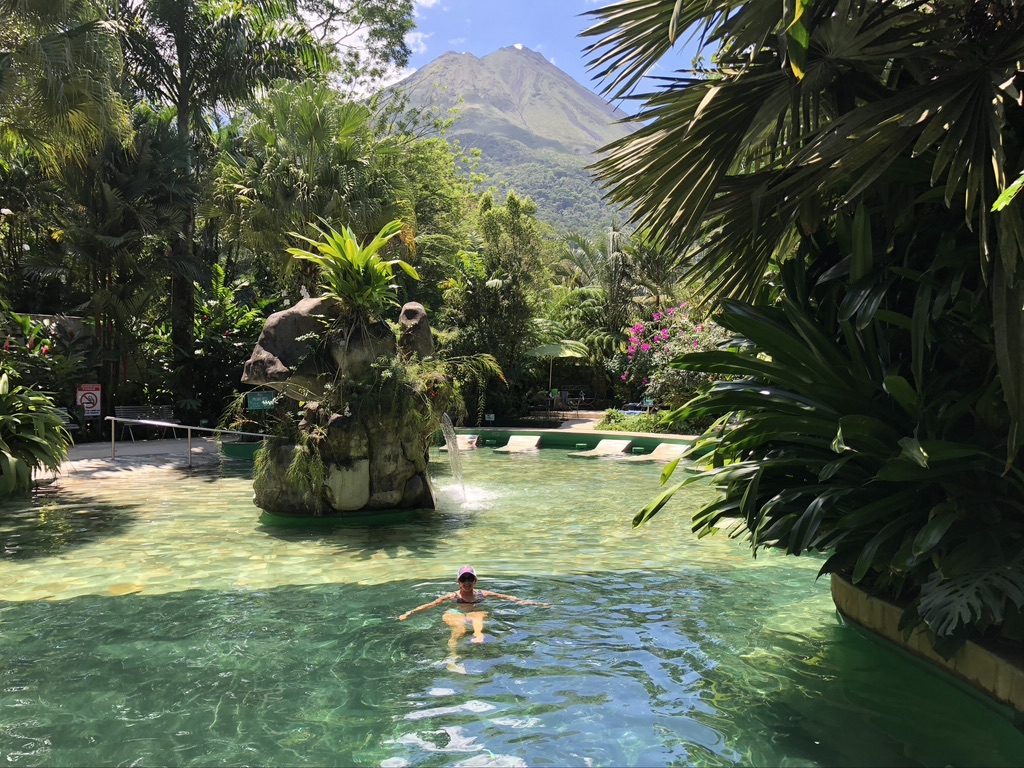
Our visit to Costa Rica has come to an end. We left the Caribbean coast a week ago and headed inland to Lake Arenal, famous for its namesake volcano, adventure tours and hot springs. We unpacked our bags in an out-of-the-way lodge perched on a hillside overlooking the lake’s northern shore, in the town of Nuevo Arenal (the original Arenal now sits at the bottom of the lake, created by the building of the dam in 1972). We had hoped to also unpack our paddle boards and launch them onto the lake for a couple days of paddling, but the incessant wind dashed those plans. We consoled ourselves by visiting one of the areas many hot springs on our first day. It seems most folks visit the well-known hot spring resorts and we wanted to avoid the crowds at those. Fortunately, Cindy, the owner of our lodge, suggested one that would offer a more intimate and quiet experience. Her recommendation was spot on. When we visited Paradise Hot Springs we shared the seven pools (the water heated by the thermal activity of the Arenal Volcano – which could be seen from the pools) with only three other visitors. The resort (there are rooms available here) offered a luxurious experience – in-pool loungers, lush foliage (think beautiful moss and vine-covered palms sprouting orchids in a rainbow of colors), flowering bougainvilleas, soft music from hidden speakers, a swim-up bar and those awesome views of the volcano. It certainly was paradise.

Heather in Paradise!

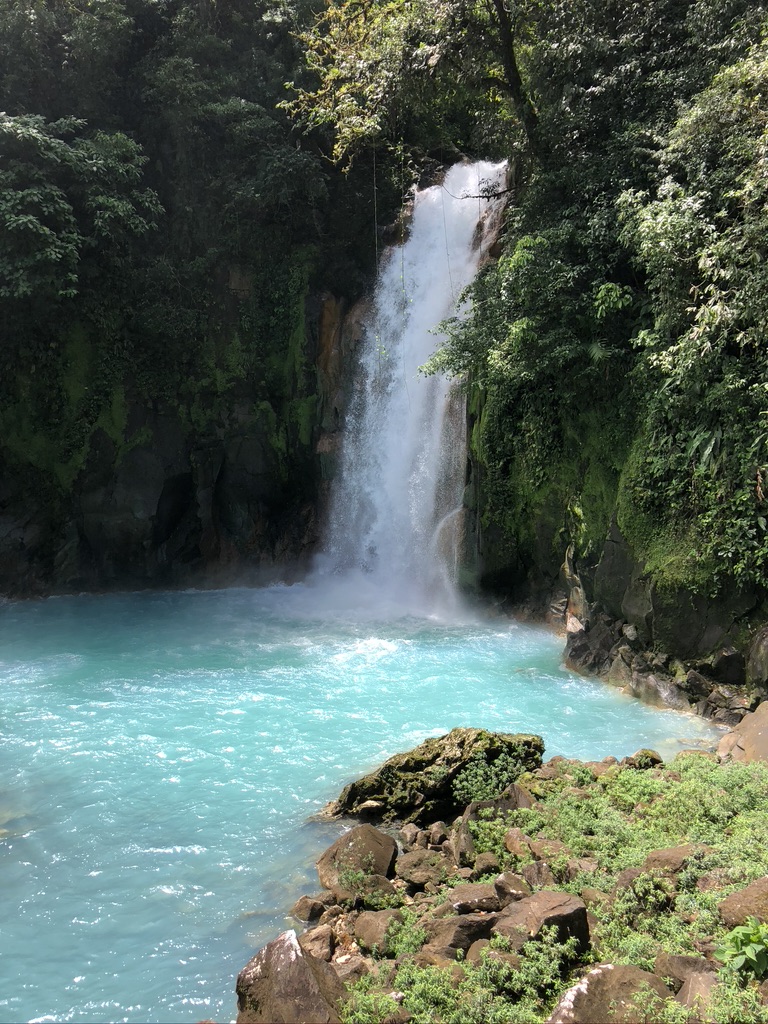
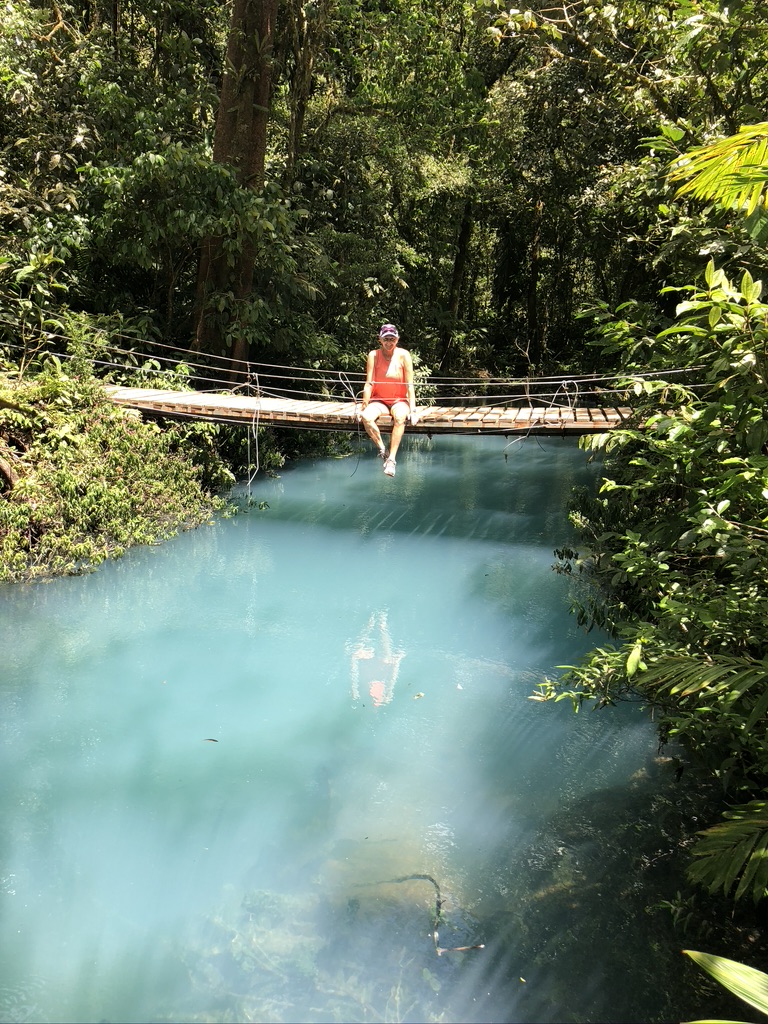
Our second day we opted to drive an hour north to Tenorio Volcano National Park. The highlight of the park (the volcanic peak remained shrouded in clouds throughout our visit) was a hike along the Rio Celeste (Heavenly River). The name comes from the unusual color of the water. The turquoise hue is formed when suspended minerals (aluminum and silicon) of one river mix with the highly acidic water of another and refract sunlight into the blue color. The trail passes a spectacular waterfall, a small lagoon, a section that features a bubbling sulphur spring and ends where the two smaller rivers converge and the coloration begins. The roundtrip hike took about two and a half hours and we returned to Lake Arenal by an alternative route that took us through hilly pastureland, past long rows of wind turbines and beneath the shadow of yet another volcanic peak.

The waterfall at Rio Celeste
Taking a break on the Rio Celeste hike.

Our final day at the lake we returned to Paradise Hot Springs for another ‘soak session’. As with the previous two days, we capped off the day by dining at the superb restaurant attached to our lodge. The open-air restaurant had a perfect view of the setting sun, offered a selection of tasty Costa Rican craft beers, delicious ceviche, fresh fish and a damn fine Black Angus burger. The staff was wonderful, the food was incredible (we never did save room for their chocolate cake over three nights) and the walk home (about ten steps) was manageable.

Sunset over Lake Arenal from our lodge’s restaurant.

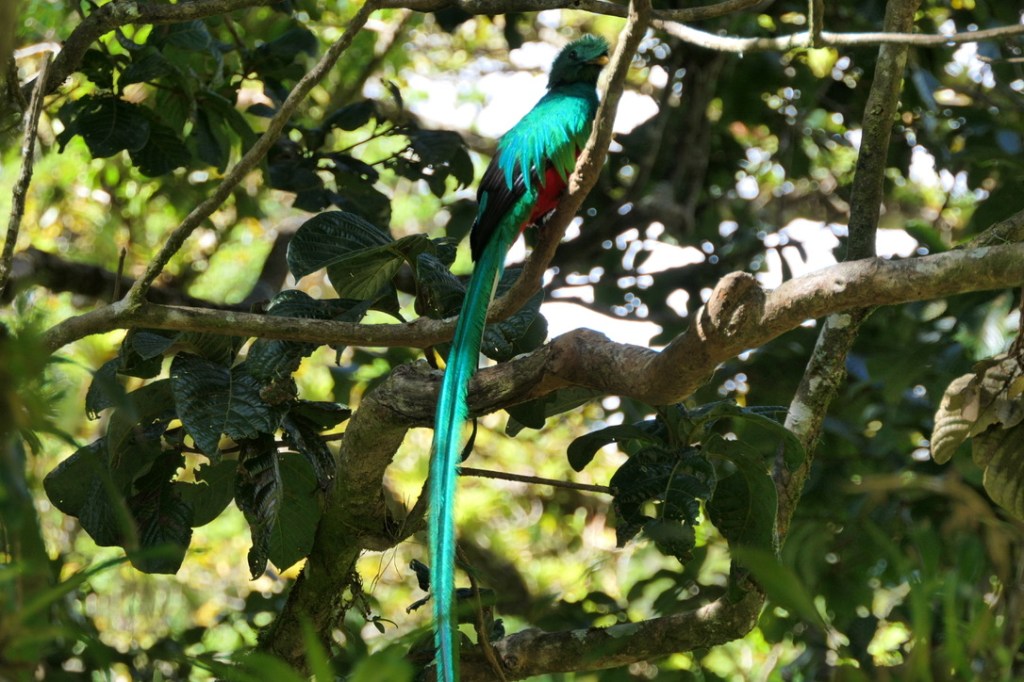
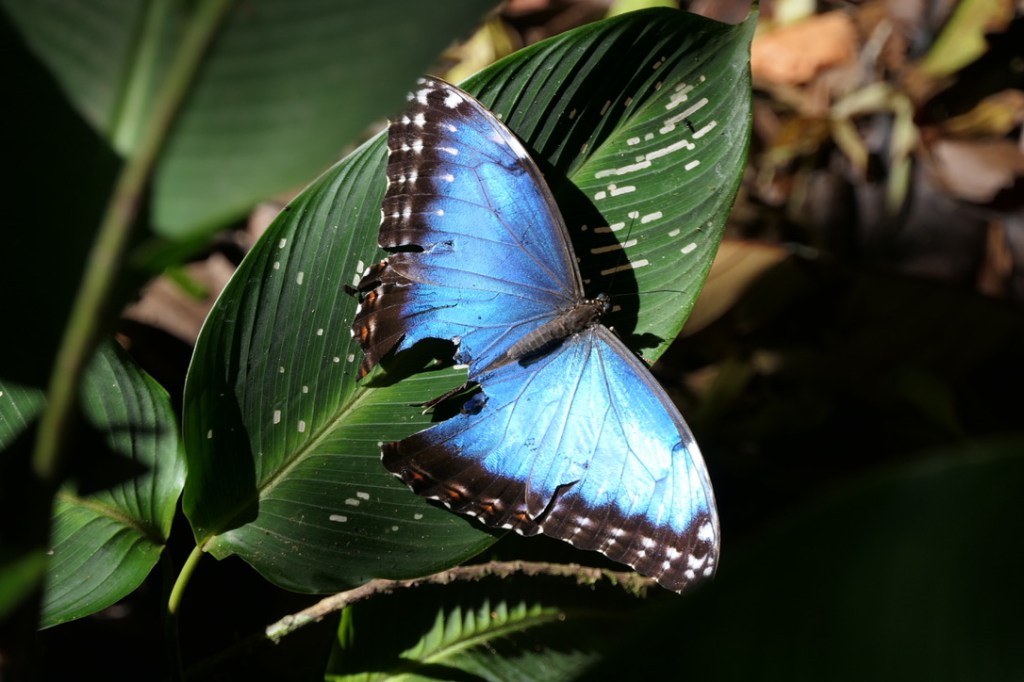
Our final stop would be the mountain town of Santa Elena – base for exploring the nature reserve of Curi Cancha and the cloudforest reserves of Monteverde and Santa Elena. We had visited all three parks last year and were eager to revisit Curi Cancha, where we had been able to view the Resplendent Quetzal, one of the world’s most beautifully colored birds. As in Lake Arenal, the wind would alter our plans – wind-driven rain would force us to pass on a visit to the cloudforest reserves (both at higher altitudes than the nature reserve). We visited Curi Cancha and once again were lucky enough to see a pair of quetzals, some white-faced capuchin monkeys, a large blue morpho butterfly and enjoy the entire park (all 200+ acres) while seeing only five other visitors.

A Resplendent Quetzal at Curi Cancha Reserve.
Blue Morpho in Curi Cancha Reserve.
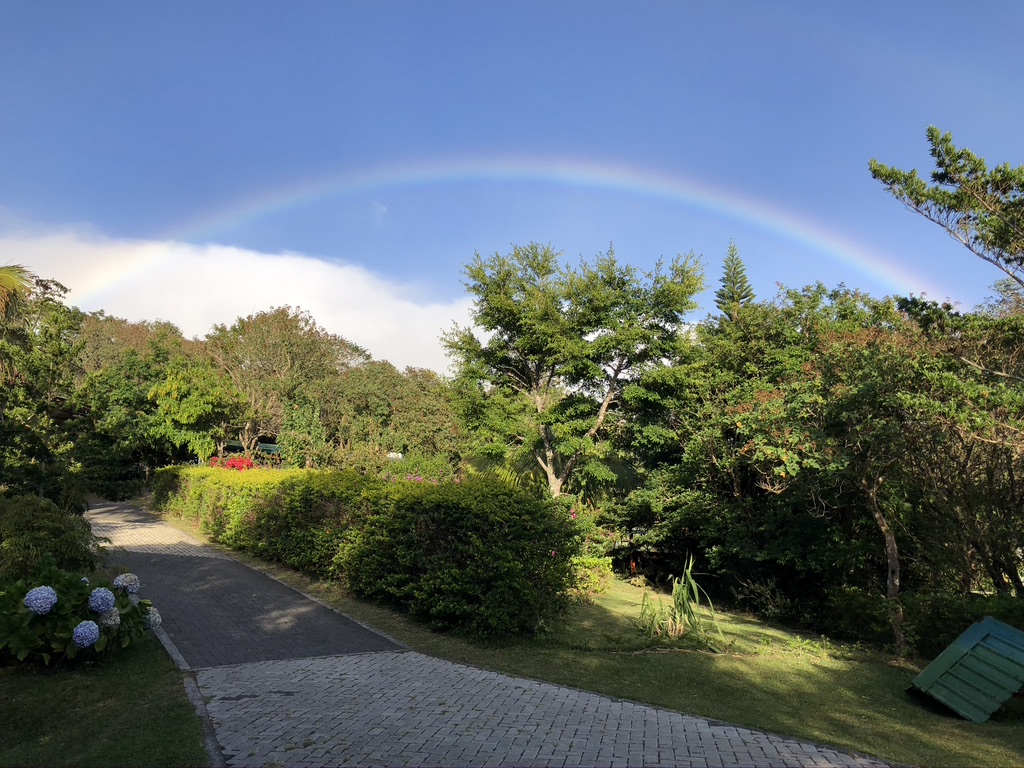
Rainbow outside our cabin near Santa Elena, our last stop in Costa Rica.

On our last night in Costa Rica we sat on a bench outside of our cabin. We watched the sunset paint the sky in varying pastel shades. We reflected on our visit – in four months we had traveled over 2,700 miles in our rental car, stayed in sixteen different guesthouses and visited thirty-nine different beaches on two coasts. And broken one bone. Not often can you travel abroad, break your foot, have surgery, spend six weeks recovering and rate the trip a huge success! As we leave we won’t say ‘adios’ (goodbye), but rather ‘hasta luego’ (see you later), to Costa Rica and it’s ‘pura vida’ lifestyle . . . and tomorrow say ‘hola’ to Mexico!


Leave a comment

The Wild Side

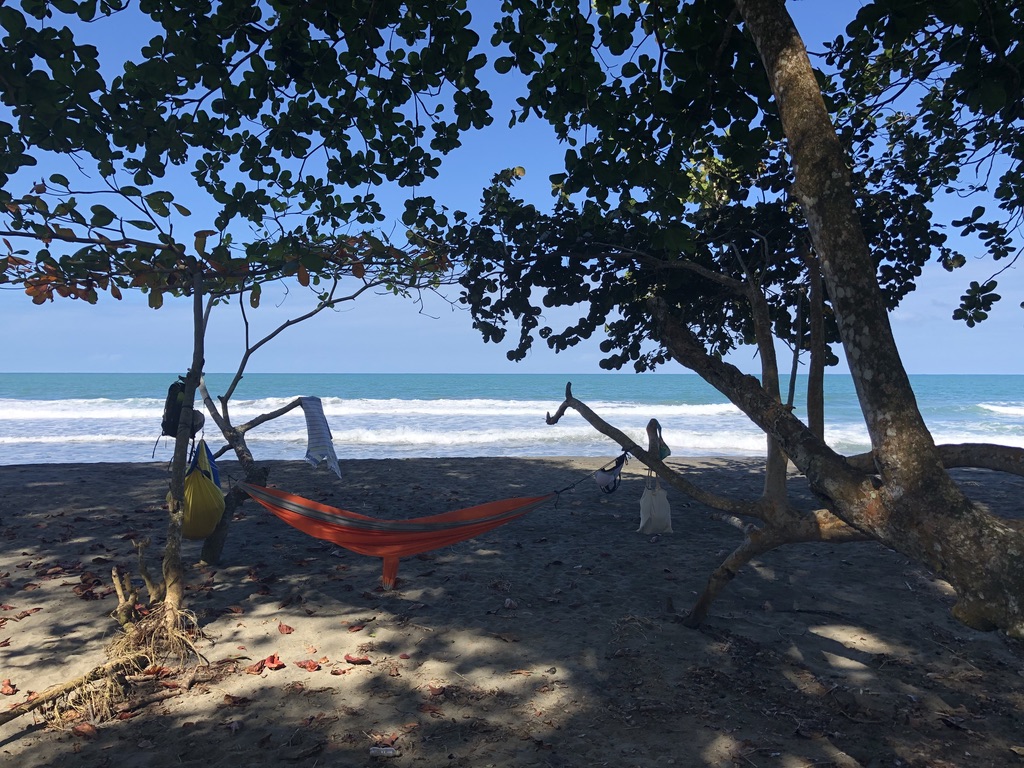
There’s a string of beaches stretching south along route 256 from the town of Puerto Viejo, on Costa Rica’s Caribbean coast, to the end of the road at the little village of Manzanillo, eight miles away. Each of them – Playa Cocles, Playa Chiquita, Playa Manzanillo and Punta Uva, attract a fair number of ticos (Costa Rican nationals) and tourists alike. On busy days (which includes every weekend of the year seemingly) they can get downright crowded. Families and groups arrive bright and early, erect their tents and shade canopies, switch on their music players, unload coolers and fire up the grills. Ticos LOVE their beach time. At times it can get a little overwhelming – a bit much for a couple who just want to hang their hammocks, read, relax and maybe grab a nap. So we were pleasantly surprised to find a beach in the area that attracted . . . no one. Playa Negra lies just north of Puerto Viejo and has nearly three miles of black sand beach, the majority of which is accessed by a narrow, potholed dirt road. Only a few scattered homes are tucked back into the forest, and the beach is completely undeveloped and wild. So it was here that Heather and I found ourselves spending most of our beach time during our first week on the ‘wild side’, with only a handful of other people to be seen throughout an entire day, most of whom would stop their car, take a photo of the uncrowded beach and then return to their car and drive off again. We swam, we read, we napped. Perfection!

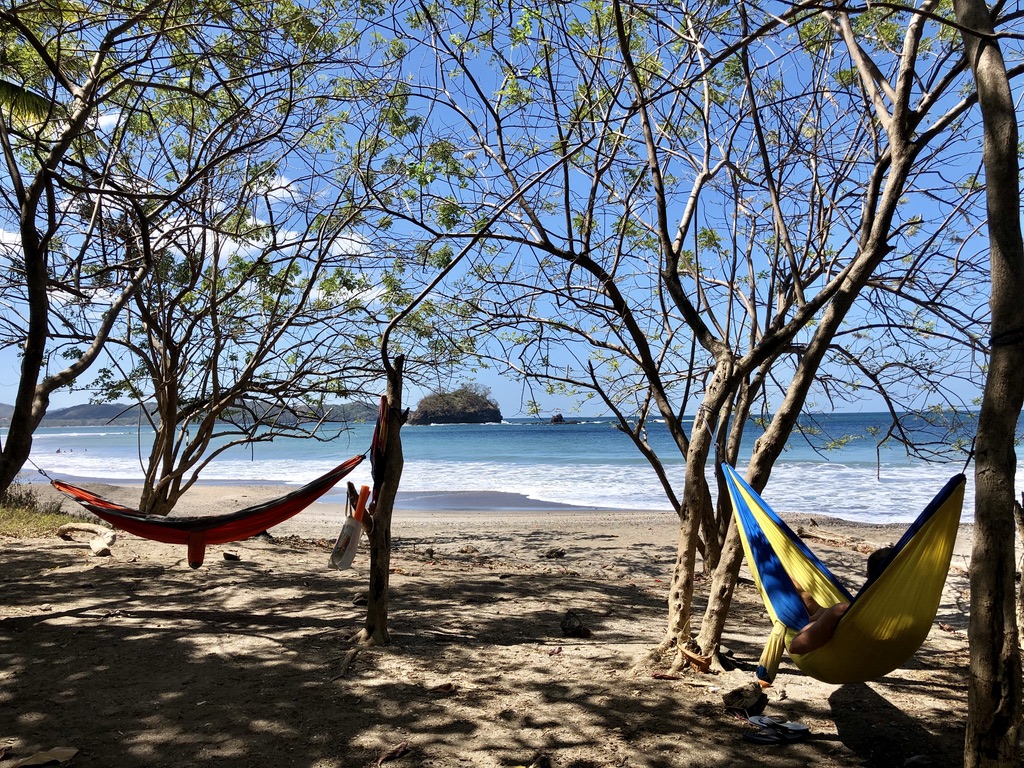
Set up for success on Playa Negra.

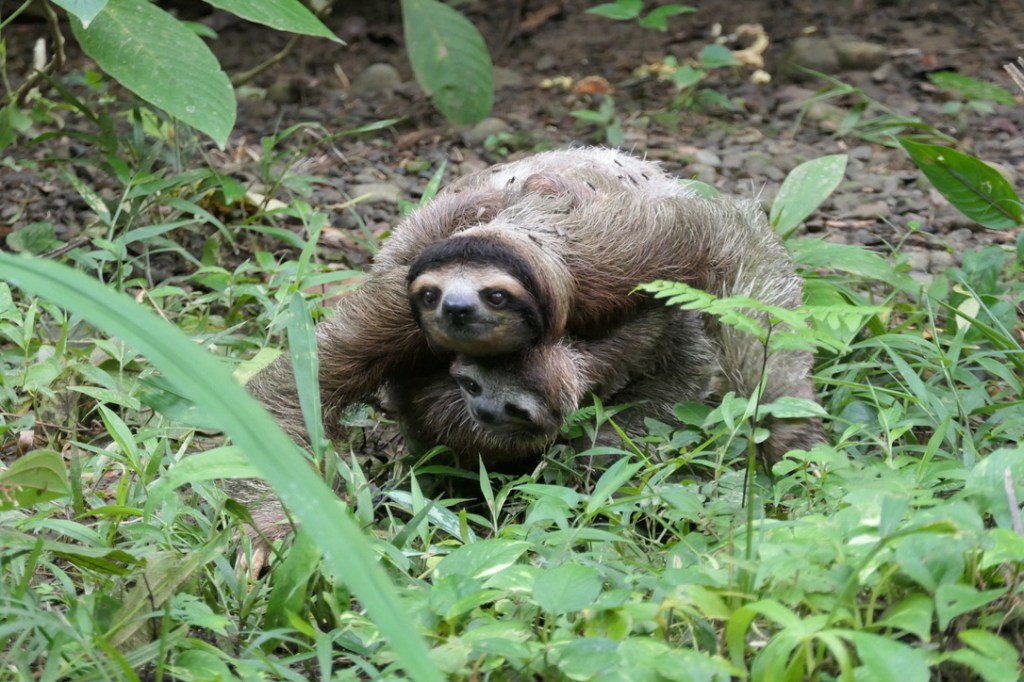
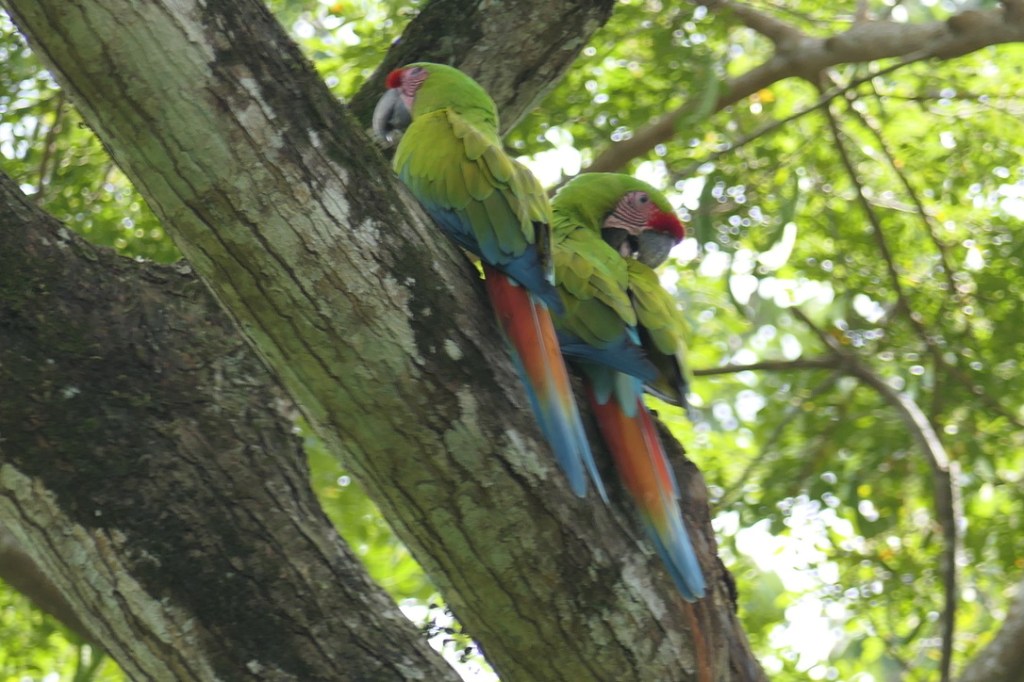
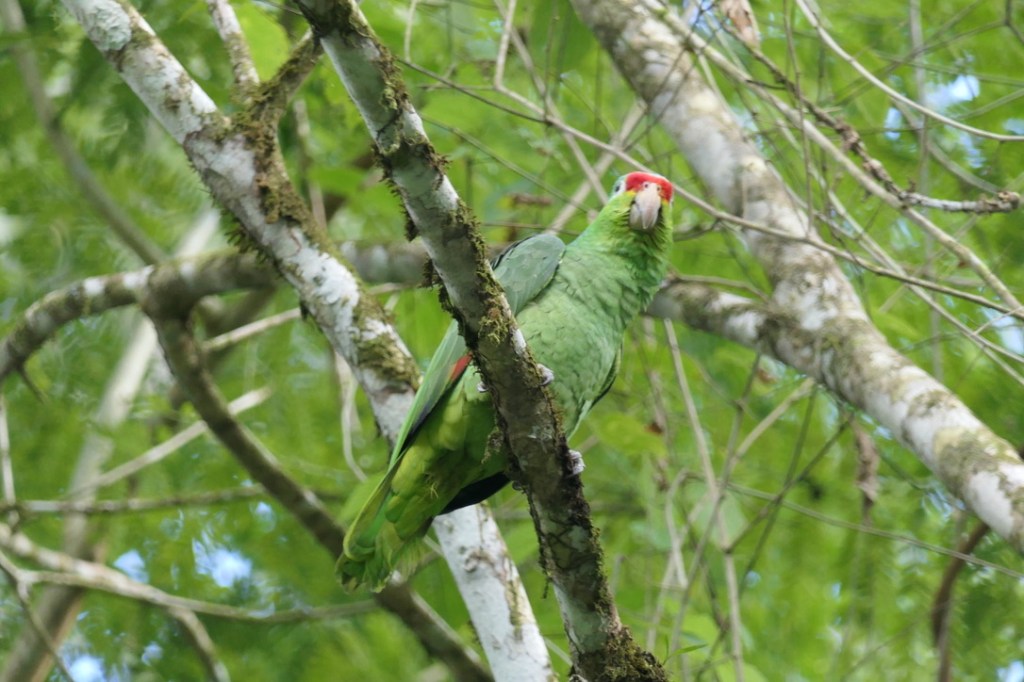
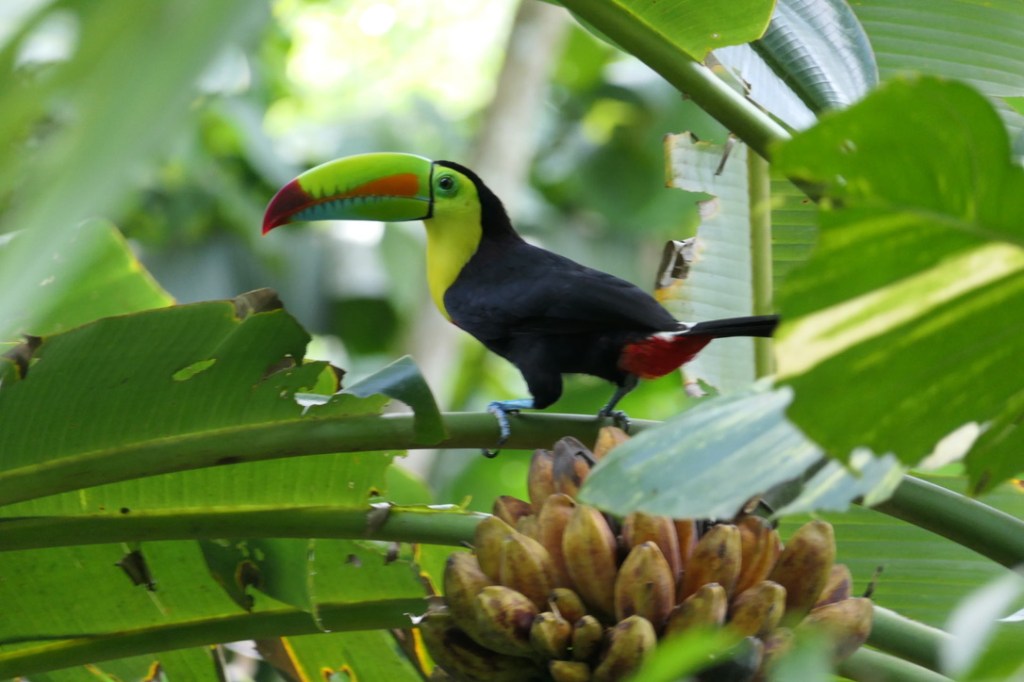
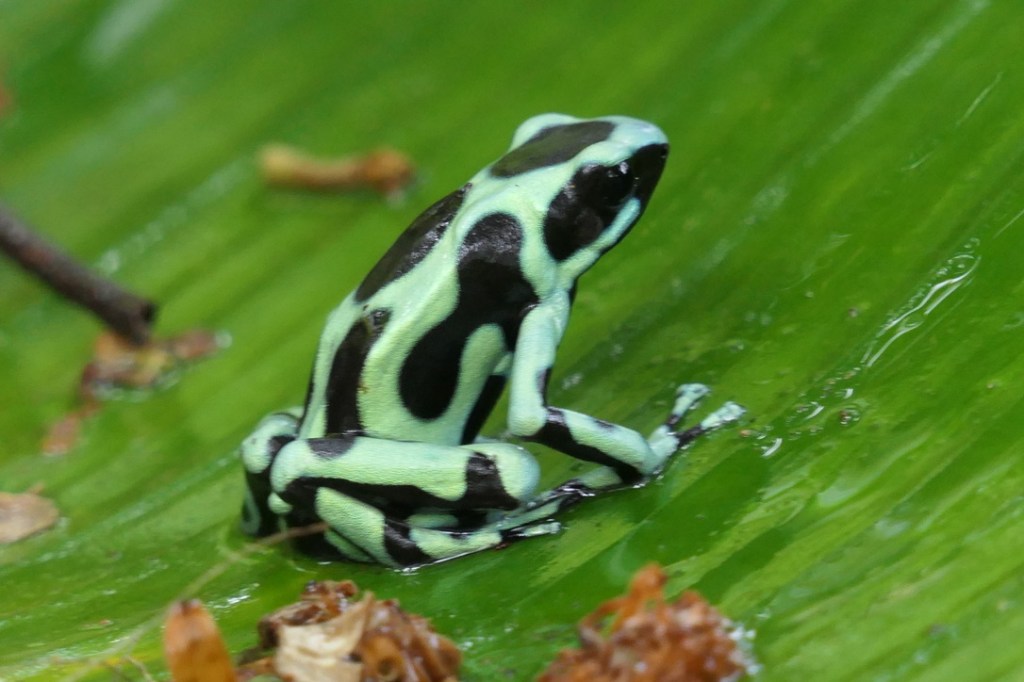
In Cocles we stayed at the aptly named Wild Side Jungalows (Jungle-bungalows!), which are set within the rainforest. We came to the Caribbean coast not just for the beautiful beaches, but because this area is teeming with wildlife. So it was no surprise that we spied a variety of creatures during our stay – sloths, howler monkeys, agoutis (guinea pigs on steroids), kinkajous (tree-dwelling mammals), mouse opossums, toucans and tree frogs. And spiders – lots of spiders. The surprise was that all these animals were seen from the deck of our jungalow! It felt like an immersive, IMAX, 3-D Animal Planet experience. All from the comfort of our deck chairs. Outside of our little enclave, we also got to view several green macaws, whose screeching calls we heard through the open car window as we drove to the beach one morning. Pulling to the side of the road we spied a band of the colorful birds high up in the trees, cackling to each other. When they moved between trees we caught sight of their green, red and blue feathers – a rainbow in flight. At times, enjoying the solitude at Playa Negra, we were joined by a troop of howler monkeys moving through the same trees we were using for shade.

Momma sloth on the move outside our jungalow.
Keel-billed toucan helping himself to the breakfast buffet.
These little guys easily blend into the forest.
Green macaws.

About ten miles north of Puerto Viejo, where the ‘banana belt’ begins, the small village of Cahuita sits on the coast. Most folks come here to visit the national park, which lies at the southern end of town. We had stayed in town and walked the park’s lone trail on our visit last year, but chose to stay outside of town, within walking distance of the uncrowded stretch of Playa Grande (seems we’re drawn to remote and empty beaches). Cahuita has an added benefit for us – it’s the current home of an old friend from Steamboat Springs, our base in Colorado. It’s always a treat to catch up with friends in exotic parts of the world!

Talaya Thomas (that’s her son Enzo photo-bombing) and Heather catching up over passion-fruit mojitos.

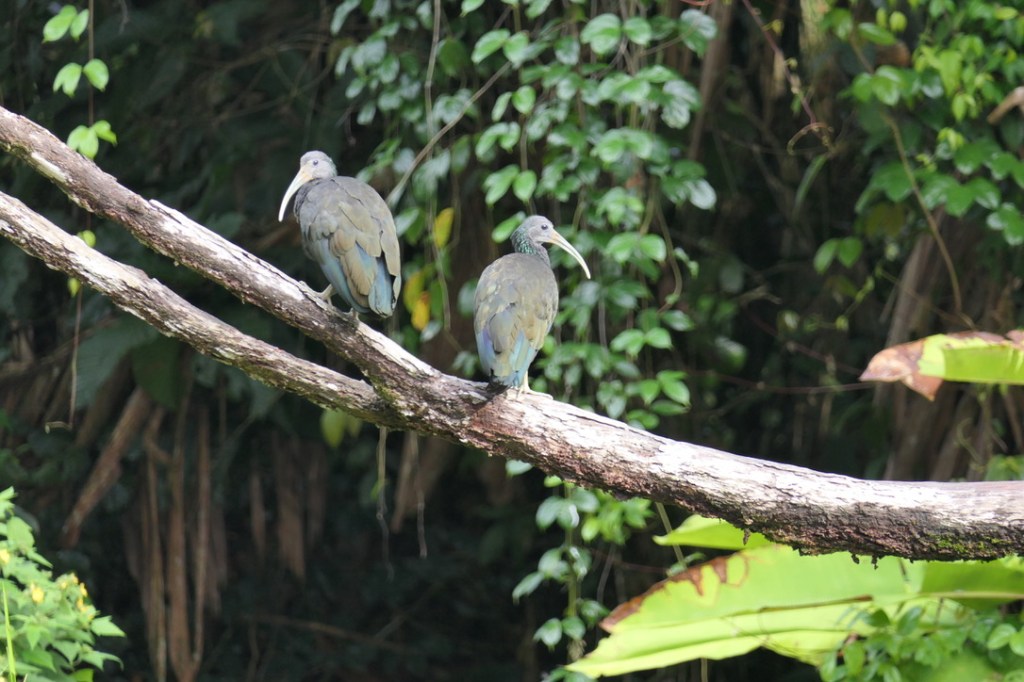
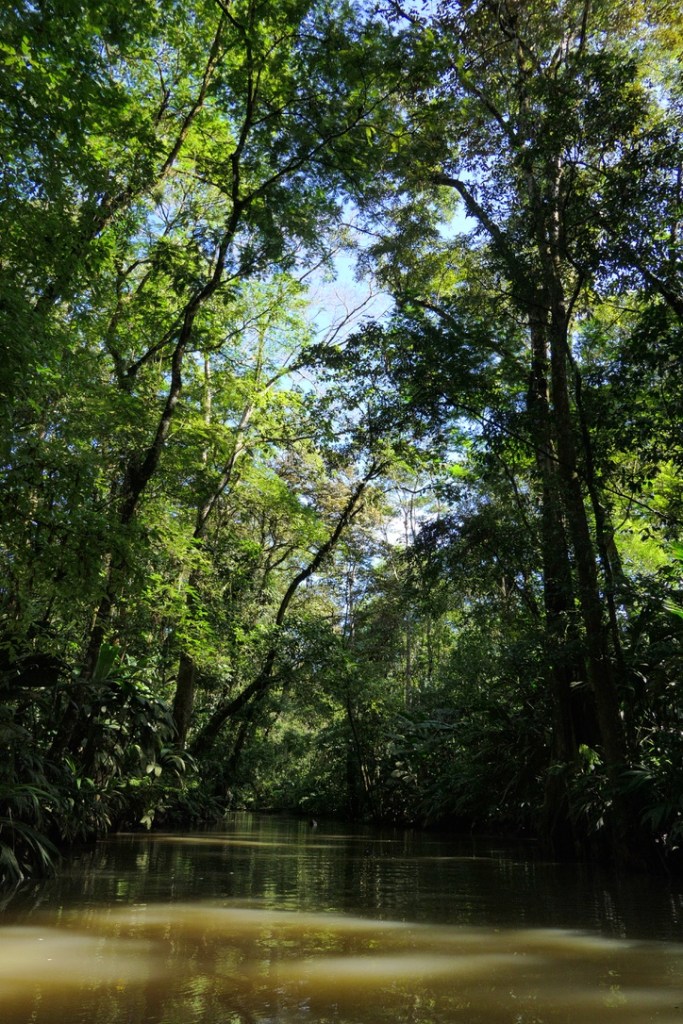
Tortuguero National Park lies on a thin peninsula in the far northeastern part of the country. Known principally as a spot for nesting sea turtles (during the nesting season from July to October) but attracts visitors year-round for wildlife spotting along the river system and on the trails of the park. For those without the deep pockets to afford the small plane flight from San Jose, the park and town of the same name are accessed via a water taxi from the mainland town of La Pavona. It’s here that we left our rental car in a secure parking area after the four hour drive up from Cahuita. Along with a dozen other passengers we boarded one of the narrow shallow-draft outboard engine boats for the one-hour trip down the Rio Suerte, where we hoped to spy some wildlife along the banks of the river. As we began the journey down the narrow, twisting river, we immediately began spotting tiger and blue herons; cattle and snowy egrets; basilisk lizards and giant iguanas; spider monkeys and even a number of caimans (small crocodiles). If the trip out to the national park was this good, we couldn’t wait to do a tour within the park itself. Our first afternoon in town we strolled the main street – which took about three minutes from end to end. We found dinner at a restaurant and retired early, since we had to get up with the sun for our morning river tour. From our lodge overlooking the Tortuguero River, we departed in a small boat powered by an electric motor with our guide. Again, we were able to spot all kinds of waterfowl, spider monkeys and several caimin throughout our three hour tour. Upon our return to the lodge we enjoyed breakfast on the terrace, followed by a walk into the national park and eventually drinks and dinner along the waterfront. Our visit ended the following morning after breakfast as we took the water taxi back to La Pavona.

A caimin warily eyes our boat.
A pair of green ibis roosting above the river.
One of the narrow waterways in Tortuguero National Park.
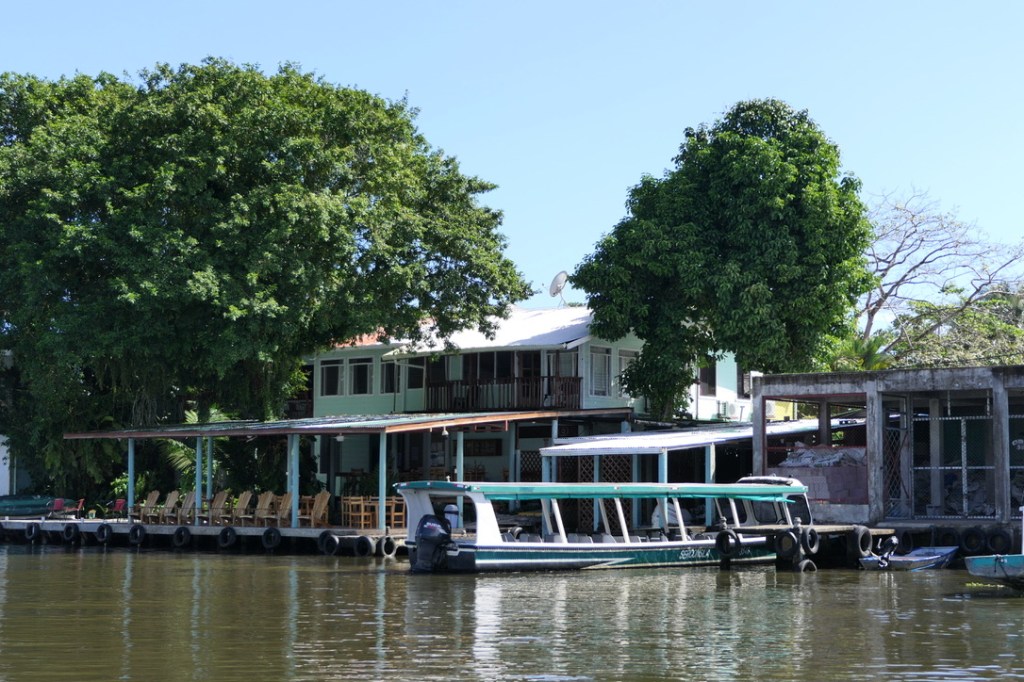
Casa Marbella, our riverside lodge in Tortuguero.
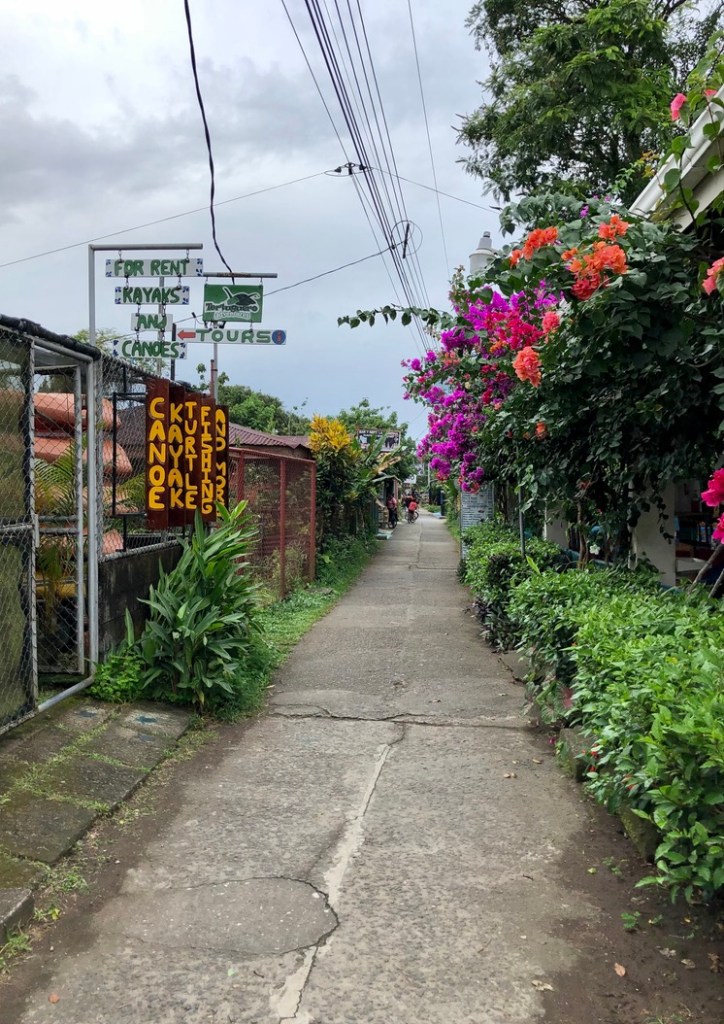
Main street in Tortuguero town.

Picking up our car in La Pavona, we headed inland, ending our two week visit to Costa Rica’s ‘wild side’. Our last week in the country will take us to Lake Arenal, for volcano views (and hopefully paddling on the lake) and then Monteverde, for cloudforest walks and quetzal-spotting.


Leave a comment

Recovery Time

After four weeks in sunny Playa Potrero, on Costa Rica’s Nicoya Peninsula, we loaded up the rental car and headed inland. It was time to get back on the road. We had been pretty sedentary, taking it easy in order for Heather’s left foot to heal following surgery back on Christmas Eve to repair a broken bone. One week into our stay in Potrero, she got the okay to start using the pool in our complex. The following week she was given permission to put weight on the foot, while wearing the boot, and gleefully discarded the crutches she had used for the past month. The last hurdle was to get an x-ray at a local clinic (we used the inaptly named Beachside Clinic in Huacas, located eight miles from the water), send the results to her doctor in San Jose and hopefully get the ‘all-healed’ response from him. That’s exactly what happened Wednesday morning and minutes later we were on the road, headed across the country from the Pacific coast over to the Caribbean side. We left under a cloudless sky, the heat already building towards its typical 90-degree high. We left behind the dry, brown vegetation of the Nicoya and pointed the car towards the cloud-covered mountains of the interior. By the time we reached our mid-point destination, the jungle town of Sarapiqui, where we would stop for the night, the landscape had turned lush and green, a light rain was falling, the temperature had dropped into the low 70’s, and Heather was wearing every piece of warm clothing she had.

Sarapiqui is known for its access to great hiking trails, an abundance of birdlife, hot springs and a multitude of raftable rivers. Given this was Heather’s first full day without her walking boot, we had to forego the trails and other outdoor adventures and content ourselves sitting outside the room of our lodge, watching the birdlife that flitted amongst the trees in the lodge’s expansive courtyard and listening to the frogs and cicadas fill the air with their music. As it grew dark we headed over to the dining area where our hosts, newly arrived from Spain, fed us dishes inspired by their homeland, including chicken braised with vegetables, steamed yucca, salad and a lemon-infused rice pudding, accompanied by a luscious Spanish red wine. We made it an early night, tired from our five-hour drive, and eager to get a good nights sleep before finishing the trip to the coast.

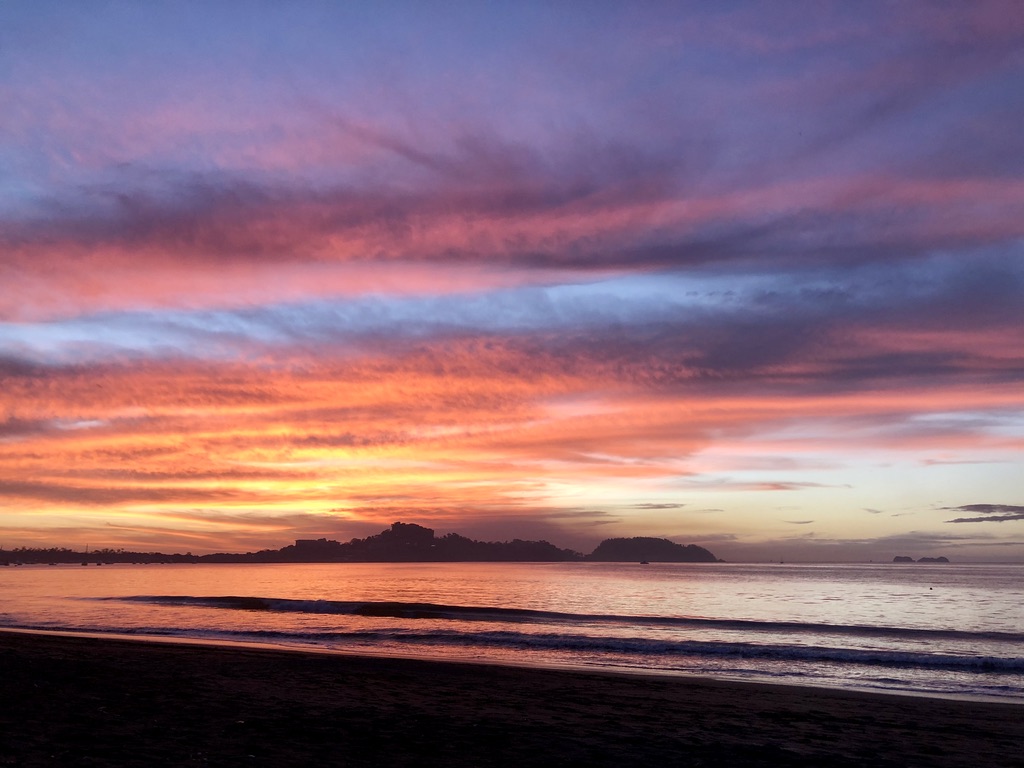
A final sunset from Playa Potrero.
Suffering through ‘rehab’.
An afternoon at Playa Punta de Pelencho, one of seven beaches within a few minutes drive from Potrero.

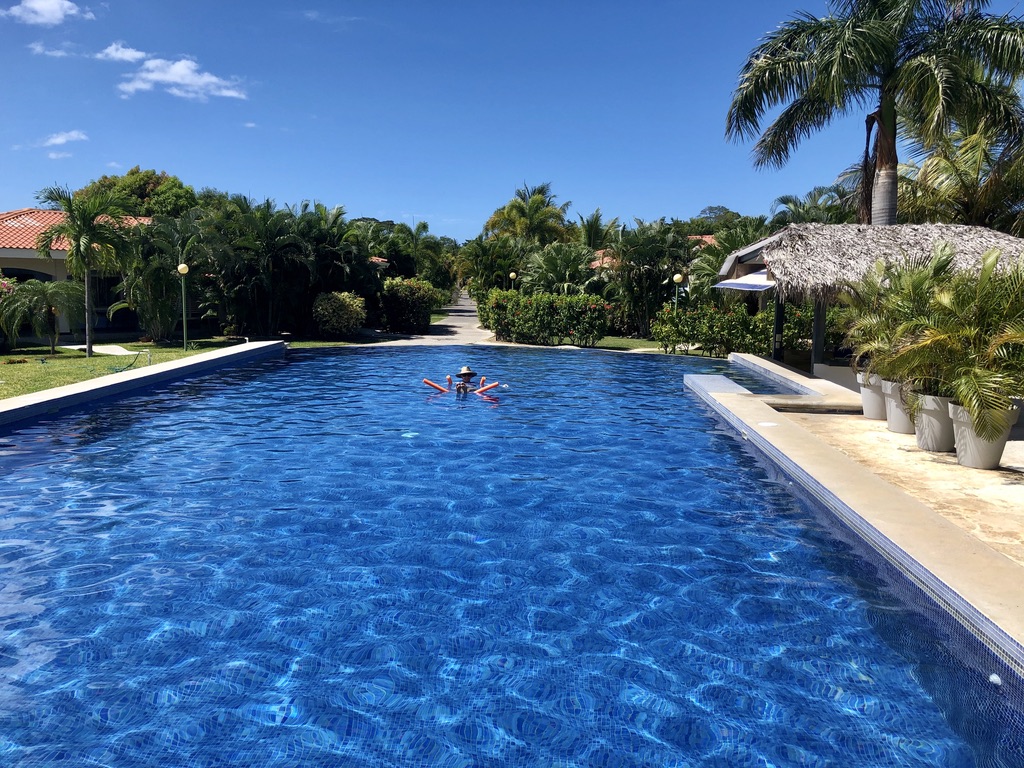
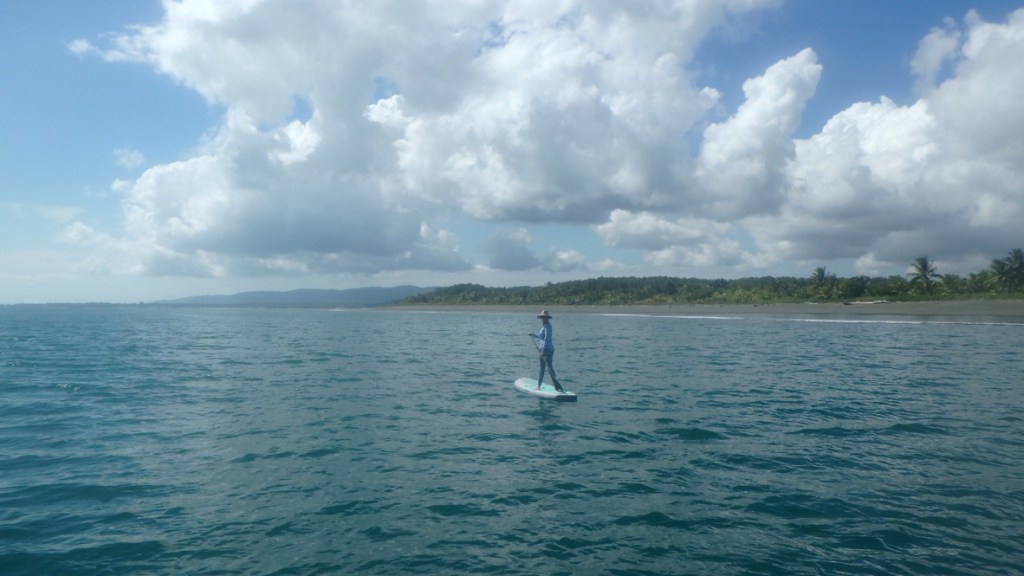
I can’t write enough good things about Potrero. We picked it mainly because it offered good-value accommodation near a nice beach. Our little villa had access to a beautiful lap pool, I could walk to the black sand beach in two minutes (I did enjoy the beach a bit more than Heather could), the water was calm enough that I could paddle (early in the morning before the breeze picked up), the town and beach are much less crowded than the more famous Playa Flamingo, just to the south, and for a small beach town, Potrero had a remarkable amount of fantastic restaurants, from little sodas serving typical Costa Rican dishes, beach-front restaurants offering fresh seafood and live music to an Italian restaurant that offered some of the best pizza and pasta we’ve ever had. While Heather’s injury prevented her from enjoying a lot of what Potrero and the surrounding area had to offer, we expect we’ll return at some time in the future. But for now, we’re looking forward to all the Caribbean coast has to offer (spoiler alert: sloths).


Leave a comment

When The Going Gets Tough . . .

San Jose is not typically on the backpackers travel itinerary. Like other Central American capital cities it’s big, sprawling, boasts a large population, traffic-clogged roads, crime and pollution. Travelers tend to limit their exposure to these big cities to passing through the international airports that are entry or exit points to their respective countries. Unfortunately, our recent visit to San Jose wasn’t to reach the airport. It was to visit one of the cities hospitals for a surgical repair of the broken bone in Heather’s left foot.

As we finished our two week visit to the Osa peninsula with a three-night stay in an ecolodge just outside of Corcovado National Park, Heather had an unfortunate misstep shortly after our arrival to our cabin in Dos Brazos. She forgot about the step down from the rear of the cabin to the lower kitchen/living area and landed on her bare left foot with a resounding crack on the tile floor. Upon inspection there wasn’t any crack in the tile itself, leaving her to realize it was her foot that had made the sound. Not ideal, considering we were in the midst of the jungle on a remote peninsula, without internet or phone service, and over three and a half hours drive to the nearest clinic. We did have our travel first-aid kit, so she swallowed some ibuprofen for the pain, wrapped her foot in an Ace bandage to combat the swelling, then settled into a hammock with a glass of red wine (yes, our first-aid kit includes that, along with white wine for emergencies before 4 pm). She was able to tolerate the pain and toughed it out over the next three days, and even felt improvement in the foot, and we held out hope that the injury wasn’t as severe as we had originally thought. But we did decide to get an x-ray to give us clarity on the extent of the injury. Finding a radiology clinic close to Dominical, where we had landed after our trip down to the Osa, wasn’t difficult, and with our guesthouse owners assistance, were able to get an appointment for the following day. We made the drive over the mountains to San Isidro the next morning and found the clinic without difficulty. Heather had a series of x-rays taken and the pictures left no doubt – a complete break of one of the metatarsal bones. As disturbing as this was, it was also apparent that the broken bone was ‘displaced’, meaning the two pieces weren’t aligned correctly and probably wouldn’t heal properly. This meant we needed an orthopedic surgeon’s opinion on whether surgery was indicated. Disheartened by this news, we left the clinic and walked across the street to our car to return to Dominical, only to discover a parking ticket on the windshield! Upon our return to Dominical we decided we had to make the two and a half hour trip to a hospital in San Jose in order to consult with an orthopedic specialist. We loaded up the car and headed north along the coast. An hour into the trip the car started to act up – without warning it would accelerate on its own – gaining speed without any pressure on the gas pedal. Unnerved, we left the highway at Jaco and found a spot to pull off the road and call the rental company. After hearing our report and my insistence that we wouldn’t continue to drive the unsafe car, they agreed to bring a replacement car to us. We waited under the mid-day sun in the 90+ degree temperatures for two hours for the replacement car to arrive. Excited to get back on the road when it did, we were further disheartened to find the new car already had a flat tire. Another half hour passed as the driver took it to a service station for repair. Finally we were able to hit the highway again – just in time to get bogged down in the slow-moving traffic approaching San Jose. If it wasn’t merging lanes through construction zones, getting caught behind slow-moving trucks going up long, winding stretches of highway or creeping past broken-down vehicles, we lost another hour, turning the two+ hour trip from Dominical into a five and a half hour slog.

When we arrived at the hospital, we were met outside the emergency entrance and Heather was placed in a wheelchair and taken in for examination. I hadn’t even completed the check-in process at the reception desk when the doctor came out and asked me to join them. Holding the x-rays, he told us that surgery was indeed necessary and would take place the following evening – Christmas Eve.

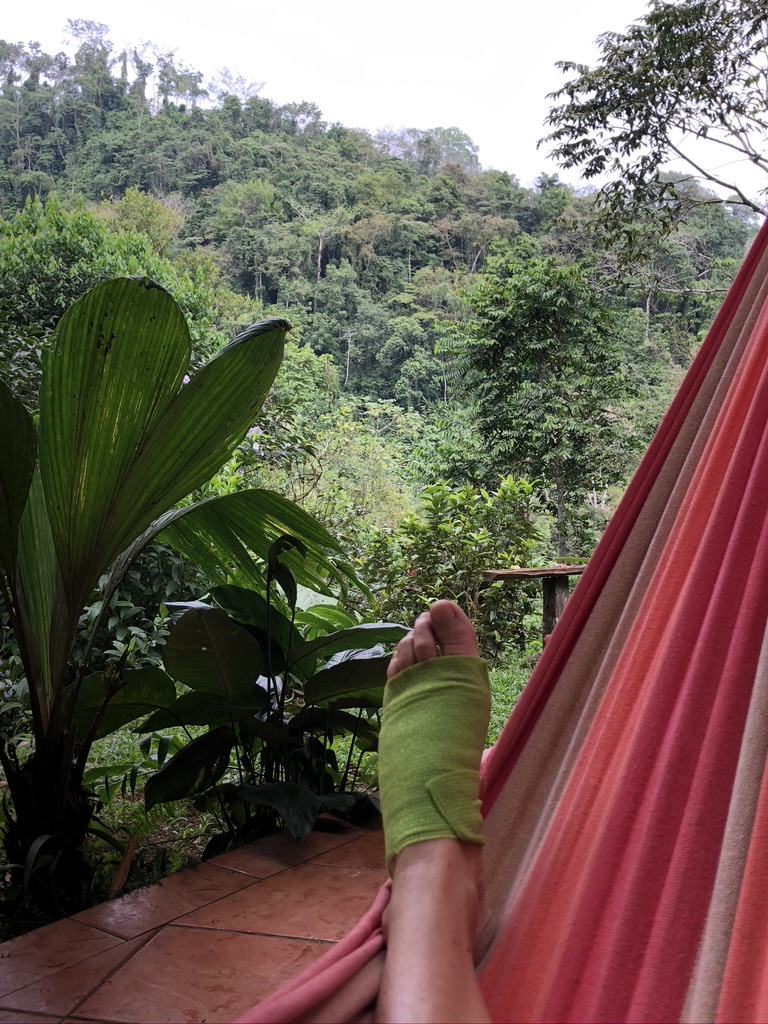
Compression and elevation at Amazonita Ecolodge.
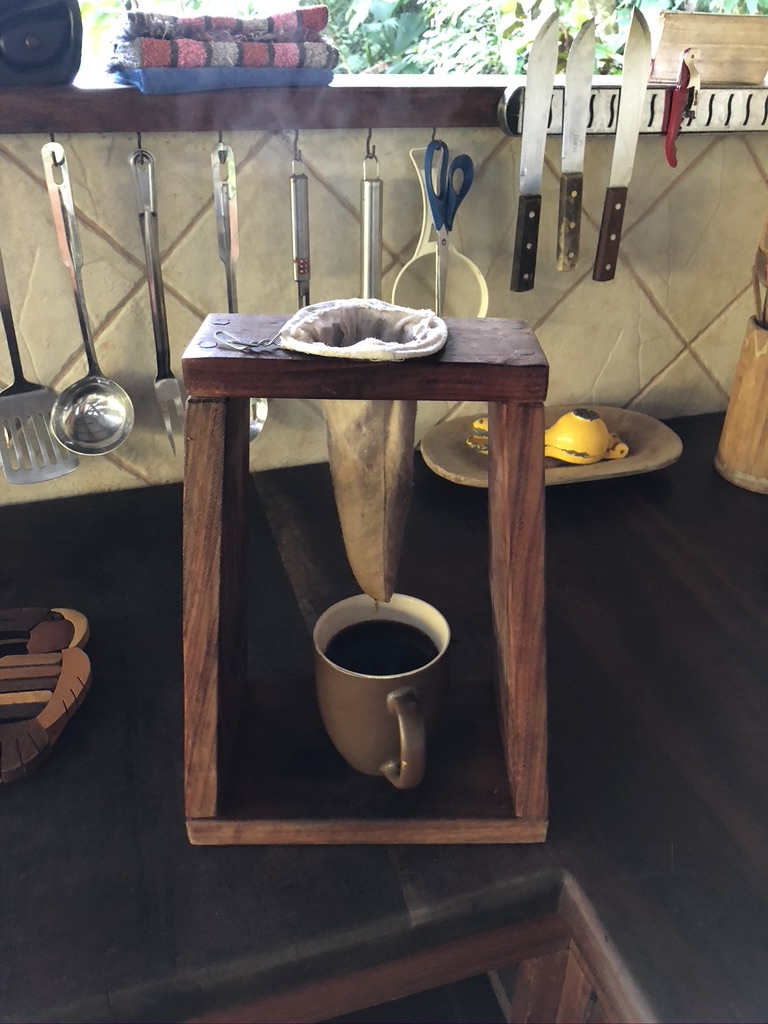
Nothing to do with the injury. Just an interesting way to brew coffee in the jungle.
Ummm, yeah, you’re gonna need surgery!

The next afternoon, as directed, we arrived at the hospital to go through the check-in process, which included a COVID test (surprise!) before the one-hour procedure to insert a metal plate and six screws into her foot. Now the recovery process begins – six weeks, non-weight bearing, in a boot and crutches. I’m going to have to restock the travel first-aid kit – a lot.

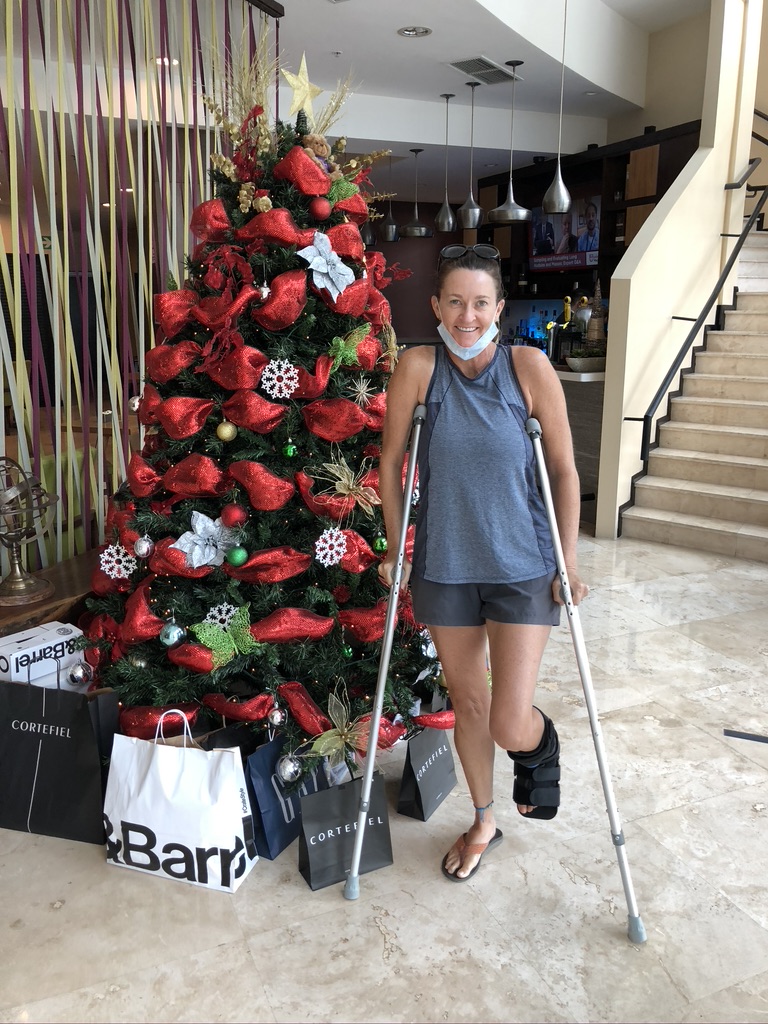
Happy holidays from San Jose! Pura Vida!


Leave a comment

Wild(er) Costa Rica – The Osa Peninsula

In front of us, at the horizon, we could see a line of squalls moving over the water from west to east. The setting sun filled the gaps between the clouds to our left with a golden glow. Overhead, dozens, if not hundreds, of parrots flew in pairs to their nightly roosting spots. A toucan landed in a papaya tree, the top of the tree nearly at eye level to the deck of our cabin, which perched in the jungle canopy on a hillside overlooking Drake Bay. In the bay a couple sailboats, newly arrived, barely bobbed in the calm water as they lay at anchor. It was the end of another extraordinary day on the Osa Peninsula of Costa Rica.

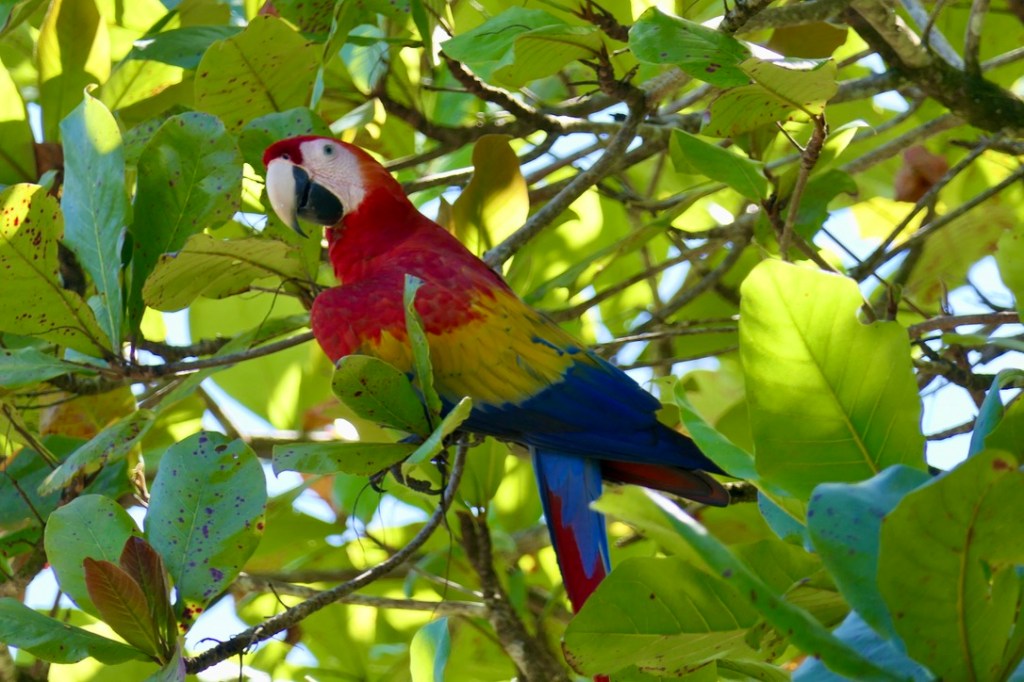
We had come to the Osa Peninsula to visit one of the country’s most remote and biodiverse national parks – Corcovado. To avoid the arduous dirt track and the five river crossings to get to Drake Bay, the closest entry point to the park, our rental car had been left in the small riverside town of Sierpe. There we boarded a small boat which carried us down the Sierpe River, past the mangrove-lined bank where we spotted crocodiles sunning themselves. Eventually the river emptied into the ocean and we turned south, hugging the coastline, which consisted of what seemed like one long dark sand beach, occasionally broken by clumps of black rocks, and backed by verdant green jungle-covered hills. We were dropped onto the beach in Drake Bay, driven up the hillside to our lodge and installed in a rustic, yet comfortable, cabin with one of the most striking views we’ve ever seen (at least from a rustic, yet comfortable, cabin). Our host, Josue (ho-sway) could only shake his head and chuckle as Heather ran from one end of our deck to the other, pointing out all the bird life that surrounded us. “We have a lot of birds here” he chuckled. An understatement – the next evening, I actually counted the number of green parrots that flew over our cabin in the half hour before sunset – 276! And we hadn’t even entered the national park yet.

The million dollar view over Drake Bay.

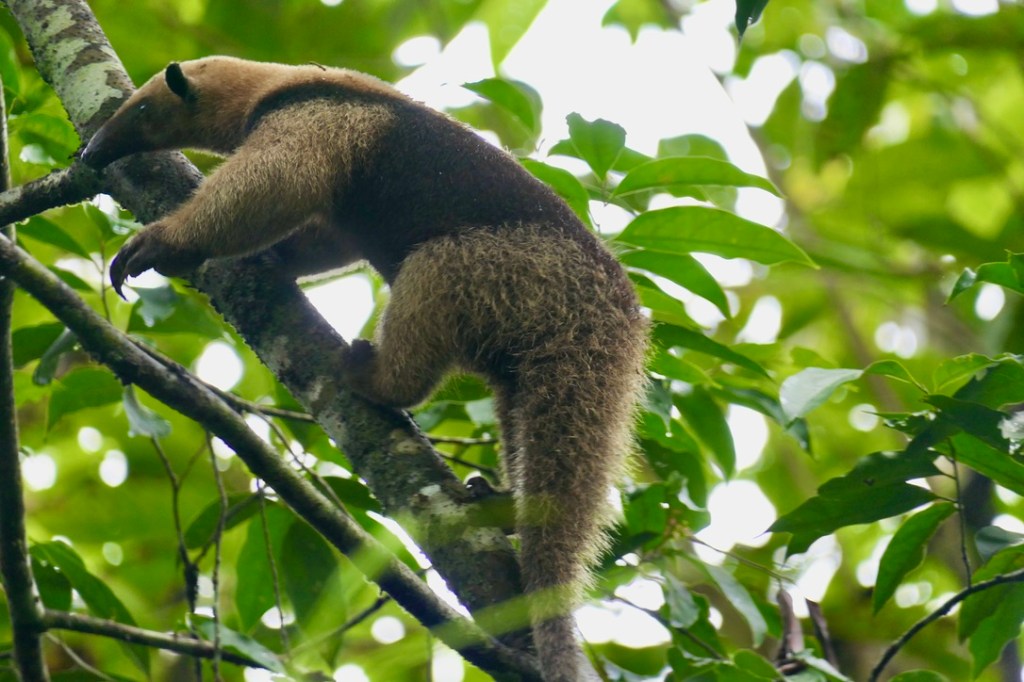
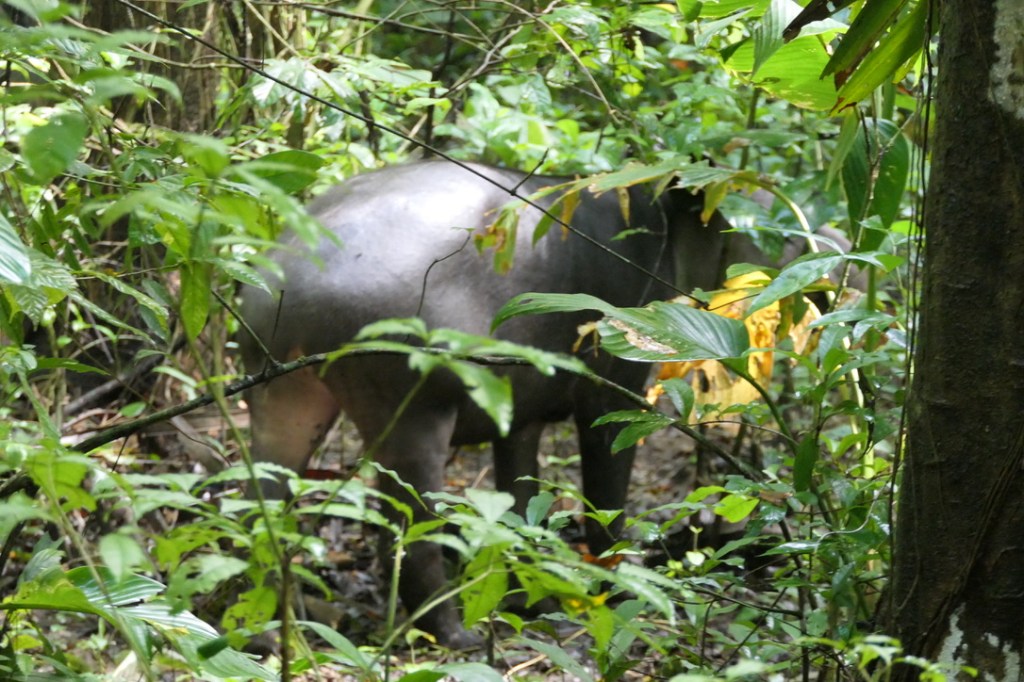
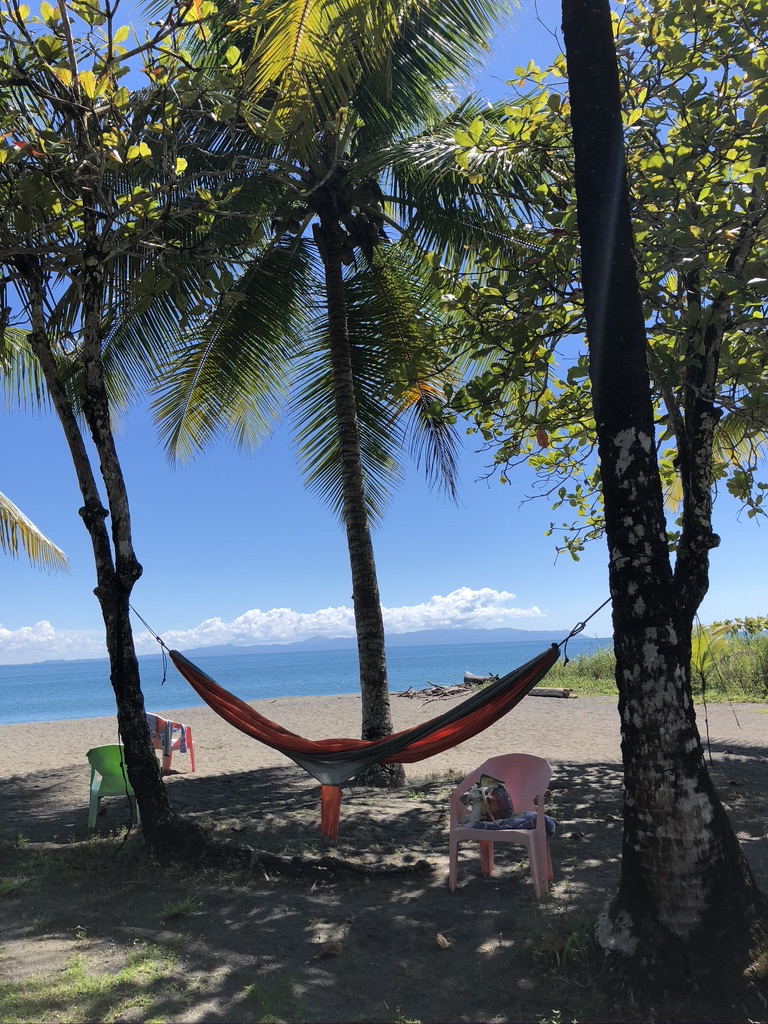
To visit Corcovado you’re required to have a naturalist guide lead you along the park’s trails. We joined a group tour our second day, which had us rise before 5 am, wolf down breakfast and be down at the beach by 6 in order to meet the boat that would take the group to one of the park entrances. The half hour boat trip was just as scenic as the trip from Sierpe to Drake Bay. We disembarked on a beach in front of the San Pedrillo ranger station, one of three within the park, and began our walk which wound through humid jungle, occasionally popping out to stunning stretches of beach. Along the trail we caught sight of spider and howler monkeys, a tree-climbing anteater called the tamandua and several curassows, a large turkey-like bird, rummaging along the jungle floor. The two most coveted animal sightings – the tapir and the puma – eluded us, but through no fault of our guide, Javier, who, at the sight of tapir tracks in the mud of the trail, would launch himself into the heavy ground cover bordering the trail, leaving us to listen to him hacking and pushing his way deeper into the foliage. Upon his return, sweating and breathless, he would make a comment like “Do you know what jungle means? Impenetrable!” After a full morning of hiking we returned to the beach, waded into the surf to board the boat and made the return trip to Drake Bay. After lunch at one of the local sodas, we retired to the deck of our cabin to watch the wildlife come to us. We booked a second tour that would take us to the Sirena ranger station in the southern part of the park, which was just reopening after being closed for the last nine months. Our guide that day, Fernando, assured us the animals would “be happy to see us”. And it seemed as if they were – spider monkeys were spotted quickly, followed by another tamandua, along with plenty of birdlife – toucans, tiger herons and an osprey. We also spotted tiny squirrel monkeys in the treetops and a group of twenty coatis crossed the trail in front of us. It was near the end of our days walk when Fernando shouted “Tapir!” and dashed off the trail into the undergrowth, our group excitedly following behind. We caught sight of a pair of the squat, hippo/pig-like animals, who possess a short nose trunk, foraging along the muddy ground. They seemed unperturbed by our presence, letting us approach fairly closely before ambling deeper into thicker ground cover and disappearing from view. On our ‘off days’, when we weren’t hiking the jungle trails of the park, we launched our paddle board from the beach in the calm of the early morning to tour the bay, walked the dirt road following the shoreline to a hill-top view point, hung our hammocks under the palms at the back of the beach, swam and spent a lot of time on the deck of our cabin enjoying the million-dollar view.

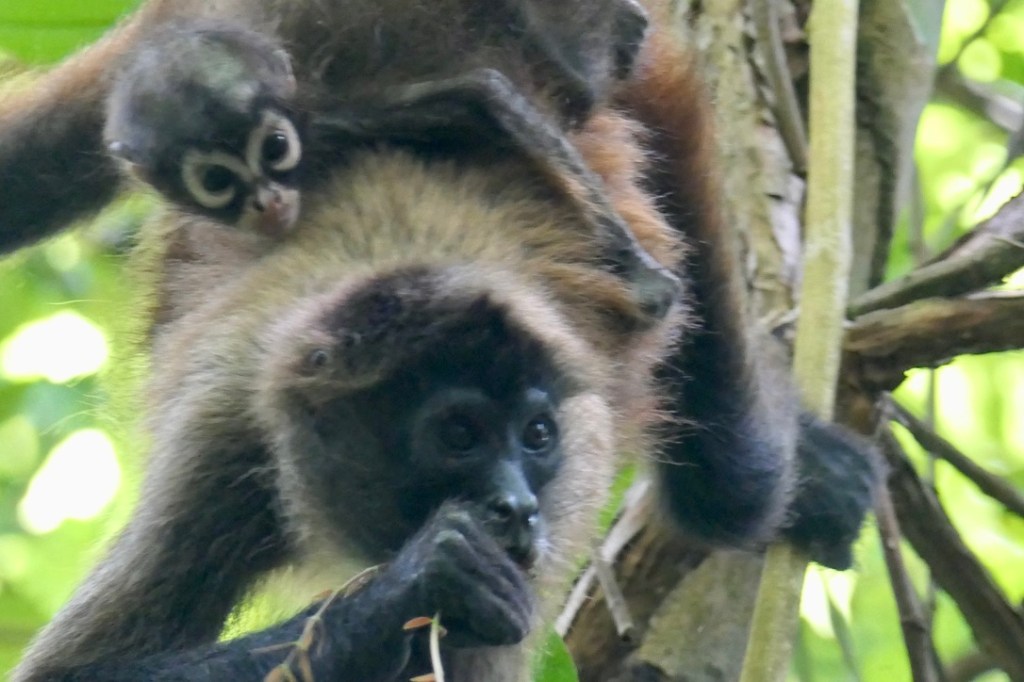
Spider monkeys.
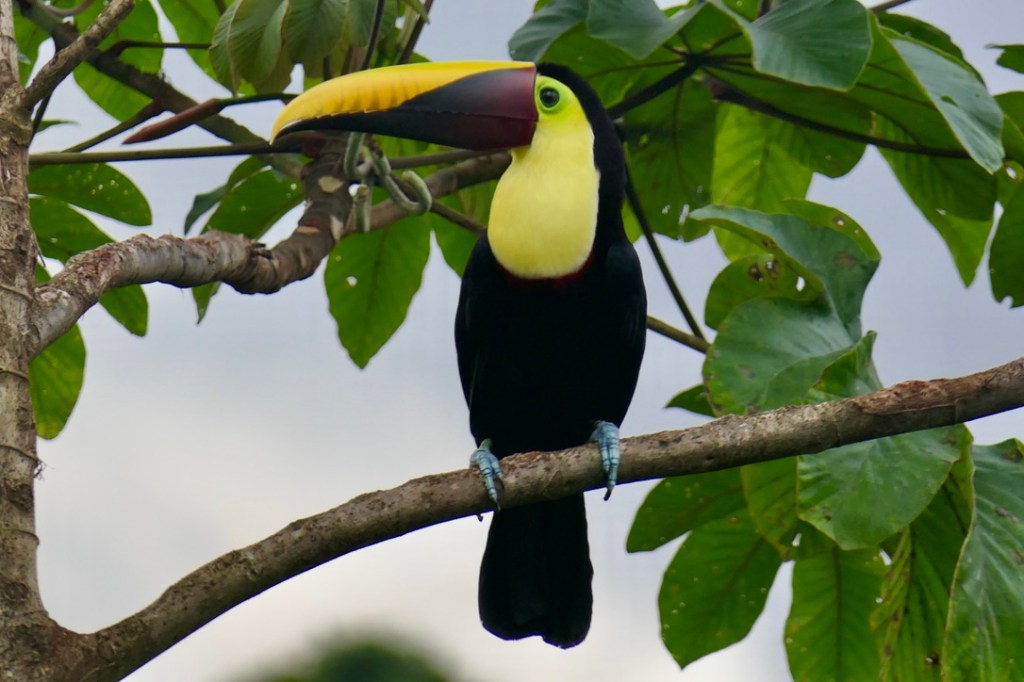
Toucan in Drake Bay.
The tamandua on the prowl.
A fleeting glimpse of the tapir.

After five days in Drake Bay we returned to Sierpe by boat, retrieved our car and drove down the east side of the Osa, along the Golfo Dulce (Sweet Gulf), which separated that side of the peninsula from the mainland. Visitors to Puerto Jimenez, the main town on the eastern side, generally come for a couple nights in order to access Corcovado from the El Tigre entrance by land, rather than the water access through Drake Bay. Heather had found us accommodation just outside the town, along the five-mile long beach of Playa Platanares. The calm waters of the golfo, and the estuary just behind the beach, seemed like it would offer good paddling. We didn’t expect to find such comfortable lodging surrounded by abundant birdlife, fronting such a long, beautiful beach, with no around. One of our hosts, Manuel, grew up on the Osa and was a fountain of knowledge about the wildlife here. We spent six days (more had the lodge not been booked up after that) waking up to the sunrise, paddling the waters of the golfo, enjoying a feast at breakfast featuring the eggs from the lodge’s own chickens, swimming and lounging in our hammocks at the beach most of the day, paddling the estuary in the afternoons (during high tide) and enjoying fresh seafood for dinner at one of the local restaurants in town overlooking the water. Life on the Golfo Dulce was sweet indeed!

The sweet life on Playa Platanares.
Regular visitor to the beach.
Sunrise paddle on the golfo.

Our last stop on the Osa would be the secluded village of Dos Brazos, for some time immersed in the jungle. Amazonita (Little Amazon) Ecolodge is a set of three cabins on a hillside overlooking a branch of the Rio Tigre. In addition to the jungle seclusion and access to the river, the lodge abuts the entrance to a private nature reserve featuring a network of hiking trails that bring the visitor to a series of waterfalls and overlooks of the river valley. Without any wifi, this would be an opportunity to disconnect from the rest of the world, get some exercise on the trails and watch the flora and fauna from the comfort of our hammocks.

A curious neighbor at the Amazonita Ecolodge.

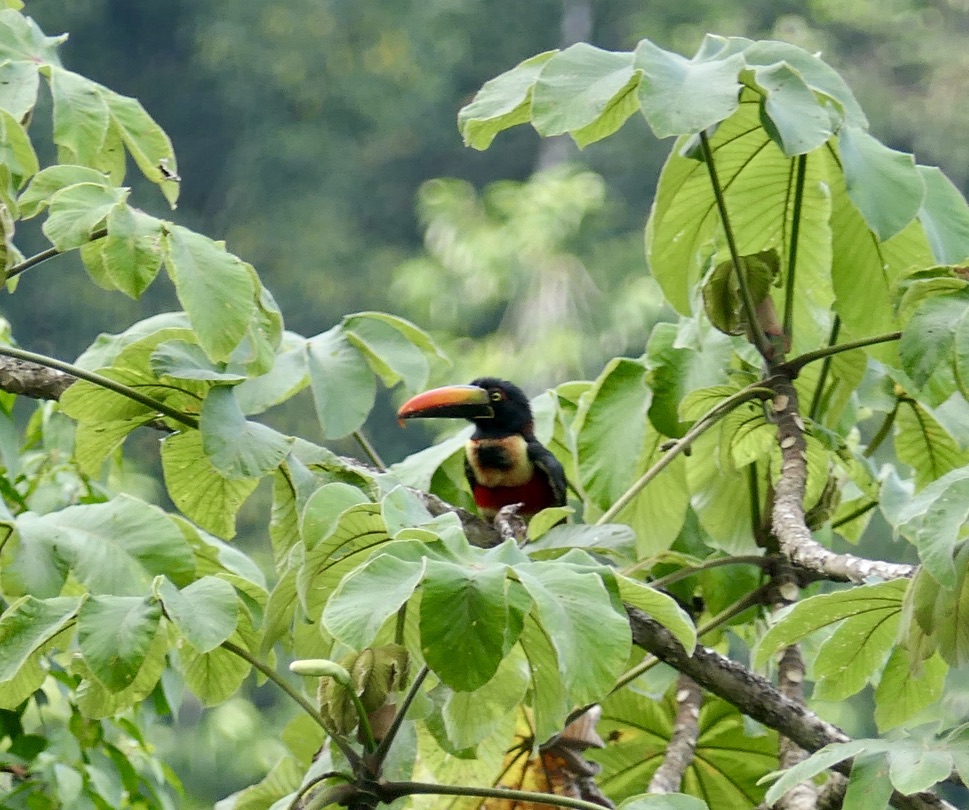
An aracari makes an appearance.

What had been planned as a six-day visit to this wild and remote area turned into a two-week trip as we couldn’t bear to leave behind such abundant wildlife and stunning scenery. From here we planned to return to the mainland and spend the Christmas holiday up in the beach town of Dominical – but that plan would soon change . . .