The Rhum Line

The aimless and sometimes muddled route of a traveling couple looking for their next great adventure


Leave a comment

Our Heads Are In The Clouds

Reluctantly, we left the Caribbean coast and headed inland to Costa Rica’s capital, San Jose. The city held no interest for us, but it did hold our intended rental car, which would whisk us through the rest of Costa Rica over the next four weeks. While Heather had been busy over the last week researching flights for upcoming legs of our winter trip and putting together our visit to Cuba for the end of February, she assigned me one task – find a rental car in San Jose. ‘How hard could that be’ I thought. I get online, find a local company, pick their cheapest vehicle, make the reservation. ‘Gonna save us a bunch of money’ I thought. Mission accomplished. Time for happy hour.

We spent the night in a wonderful B&B in San Jose that Heather found for us, with the added bonus that it was located within walking distance to the rental car office. After a nice breakfast we strolled the short distance to grab our car. As we entered the small lot there seemed to be lots of traffic in and out – folks picking up and dropping off cars. Not surprising, given its the height of the season here. We were greeted by a nice guy who spoke perfect English and he immediately called up our reservation on his computer. He seemed a little perplexed when he saw my vehicle selection. “I’ve never rented this vehicle before” the attendant said. “This is really for work” he added. Turns out I had rented a panel van. A cheap panel van. For a month. While Heather walked away and put her head in her hands, I asked if it were possible to substitute any car in place of my new work vehicle. “Nothing else is available since it’s high season” he told me. Panic started to set in. We went to inspect the van which was big, boxy and all white. He opened the rear door to expose a large, windowless, metal-encased cargo space, completely closed off from the driver’s compartment, which would have to hold our bags, as there was no room in the front for anything more than a cup of coffee (not even a grande). The seats didn’t have any adjustment. With no rear-view mirror and limited visibility through the side windows, I would have to roll down the windows in order to check traffic or attempt to back up. Trying to make light of the situation, he joked to Heather that we could save even more money by sleeping in the back. “That’s exactly what my husband will be doing” she deadpanned. Left with no alternative, we saddled up and drove out of the lot into the San Jose traffic, headed to the mountains. “Think of it as just another adventure” I offered. “Think of it as your bedroom” she retorted. But, true to her nature, after a half hour on the road, she smiled and began laughing at my screw-up.

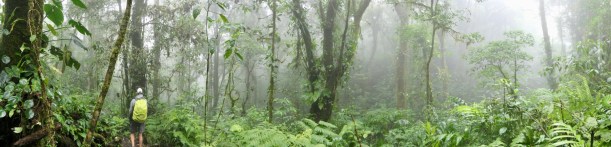
While the Monteverde Cloud Forest Biological Preserve is the most well-known, and most-visited, park in the area, there are several forest and wildlife preserves around Monteverde. Being the weekend, we decided to visit two other parks and leave the main attraction until Monday, when we thought the crowds would be lighter. On Saturday we headed to the Santa Elena Cloud Forest Reserve. This park offered a variety of walking trails through dense cloud forest at the top of the mountain range. Immediately upon entering the preserve we marveled at the dense jungle, clouds swirling amongst the treetops, the sound of water dripping from the canopy above the only noise to be heard. We walked slowly and quietly and spoke in hushed voices, the magnitude of the space and the surreal beauty commanding respect and hushed admiration. “Magical” Heather said. “And I never use that word to describe something that’s not underwater!” ‘Mystical’ I thought – and I never use that word to describe something that’s not in Lord of the Rings. We crossed paths with only a half dozen or so folks, reinforcing our decision to avoid the more popular park over the weekend. We tried to make comparisons to other places we’ve been, but nothing really comes close to a cloud forest. It was a palette of greens, as the leafy trees were all covered with a layer of moss, and then entwined by creeping vines, which surrounded the trunks and cascaded from the branches above. Only occasionally would a lone flower make an appearance when an opening in the canopy allowed a small amount of sunlight to penetrate to the forest floor. Beyond the sound of dripping water, no animals could be heard. This was forest – primeval and awesome.
0DD349FB-2922-427F-9B79-D9697DE913F9_1_105_c

Santa Elena Cloud Forest Preserve – feeling small in a mystical place.

AB477383-A143-4291-90A8-3F1E3654487A_1_105_c

Fern tips.


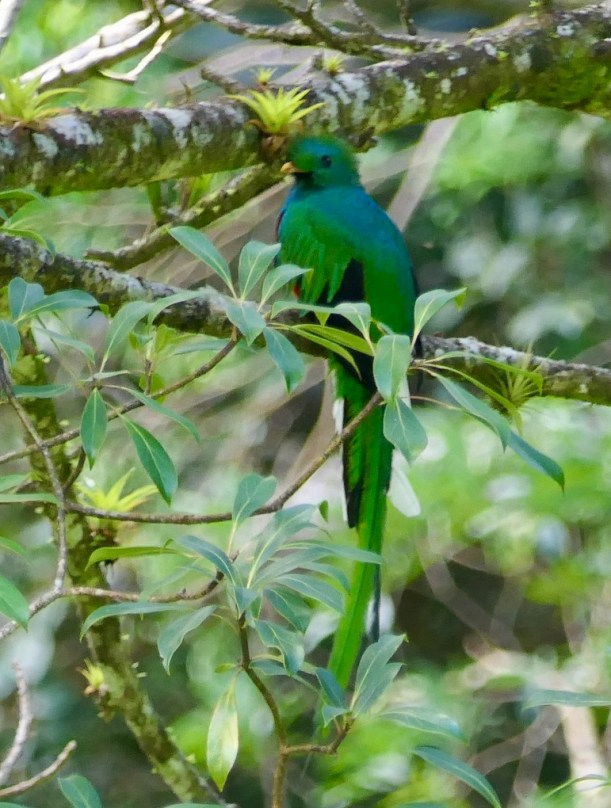
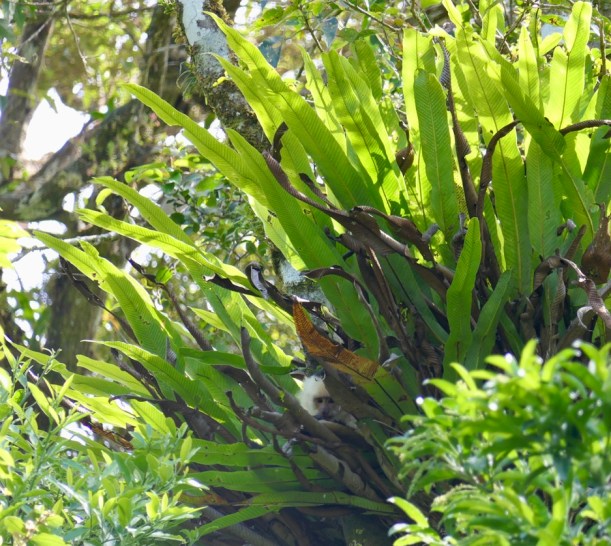
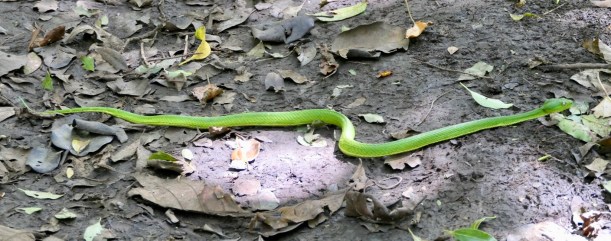
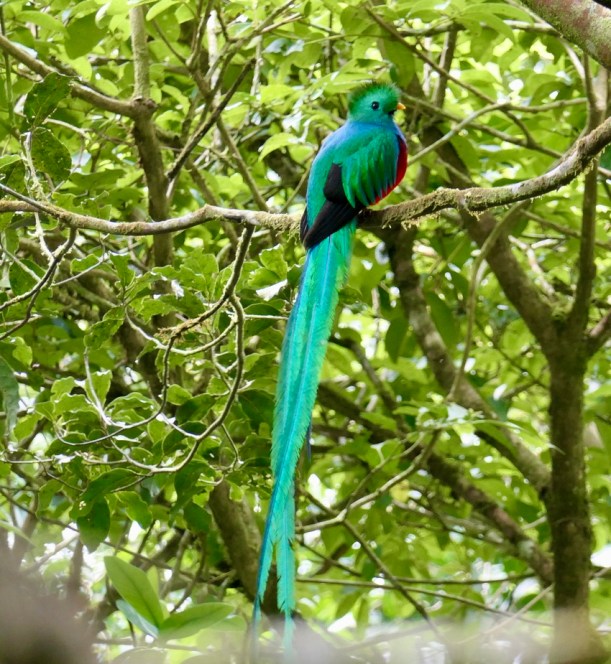
Our next day took us to the Curi-Cancha Reserve, a lower elevation park, hence drier and with more open views. The Reserve is known for it’s birdlife, in particular as home to the brightly-plumed, and highly-sought (by birders) quetzal. This was the primary reason for our visit – to hopefully catch a glimpse of this bird. Luck was with us this day as minutes into the park’s walking trails we came across a small group gathered near an immense old avocado tree. Sure enough we were able to spot a male and female pair, resplendent in green, blue and red, with the male having an especially long and delicate tail. After an hour and countless photos later, the pair departed and I was able to convince Heather to move on to the rest of the park. Soon after, white-faced capuchin monkeys were spotted frolicking in the trees overhead. Continuing on, we walked along the well-maintained trails with our heads on a swivel, scanning the treetops for more wildlife. Our luck continued to follow us this day, for I just happened to glance down at the trail and was able to stop short – just two paces from a palm pit viper that was crossing in front of us. I could hear Heather suck in a breath as I put my arm out to stop her too. But as scared of snakes as she is (and who wouldn’t be scared of a pit viper) she instinctively brought her camera up before even moving a step back. The snake slowly crossed the trail and slithered off into the forest while we slowly began to breathe again. Returning to the avocado tree from earlier, we once again spotted not two, but three, quetzals. Later, as we passed through the park office on our way out we chatted with one of the naturalist guides. Seeing Heather’s photos of the viper, and given that we had seen five quetzals, he remarked “you are the luckiest visitors in the park today”. We know.

B20F848A-0FEB-4AFB-B9A0-F0E0F44FC6FD_1_105_c.jpeg

The elusive quetzal.

0866B46B-3812-4C3B-94C9-36428C3E1CF7_1_105_c.jpeg

A female.

33E25952-00E3-43A0-82CC-A989AD5353AB_1_105_c.jpeg

Can you spot the monkey?

FE279D3F-D73A-45A5-A750-0296742D8EB7_1_105_c.jpeg

Danger!

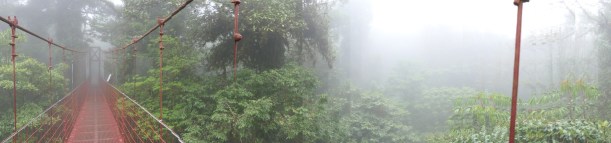
Our final day brought us to the famous Monteverde Cloud Forest Biological Preserve. Given our incredible visit to the previous parks, and the number and variety of animals we had spotted, we weren’t holding out high expectations that we would be wowed again. But wouldn’t you know it, within the first minute upon entering the park we came across another pair of quetzals. Quite a welcome to be sure. After another hundred or so photos I once again persuaded Heather that we still had a big park to see and we set off on a series of trails that one of the rangers had suggested for us to follow. Beyond the quetzals the wildlife was scarce in the rest of the park and it was hard to get away from the crowds, but when we did the cloud forest here was equally impressive and inspiring. Also, we crossed a hanging bridge that allowed us to walk at the treetop level of the canopy, high enough that we couldn’t even make out the ground below.
5705922E-45C3-493B-B653-3F50CF0BFBEE_1_105_c.jpeg

A good view of the elongated tail of the male quetzal.
D76120A4-484A-4527-8BB1-02C5AD3DCC37_1_105_c.jpeg

The hanging bridge through the canopy.

36D44C8A-BDF4-4962-8859-B302C20BCAD1_1_105_c.jpeg

A peaceful waterfall near the end of our Monteverde hike.

All in all our visit to Monteverde far exceeded our expectations. Once again we were able to tick off another animal-sighting experience (or two), we enjoyed the wonder of the cloud forest and got in a good bit of hiking along the way. Now it was time to load up the ol’ panel van and hit the coast for some beach time.
1 Comment

More Caribbean Coast in Costa Rica

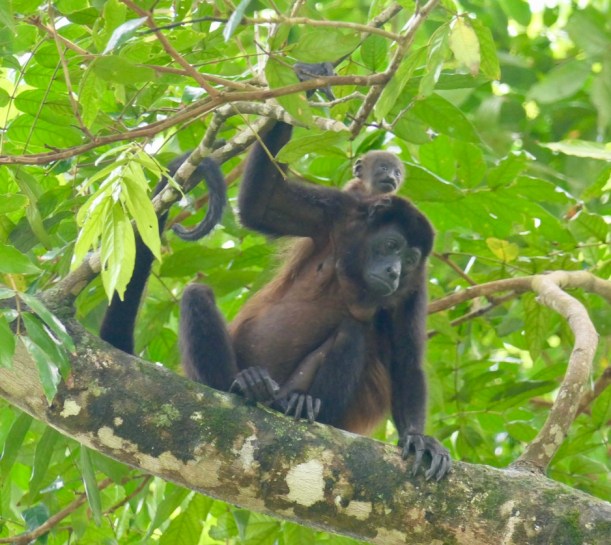
I felt like we were trying to sleep inside a giant snare drum – such was the sound of the pounding rain on the corrugated metal roof of our cabin in Cocles, just south of Puerto Viejo, Costa Rica. While lying awake, just when you thought it couldn’t possibly rain any harder – the downpour would intensify. Every once in a while a falling coconut would hit the roof, providing the clashing cymbal to the nightlong drum solo. Then, just as it seemed we had fallen back to sleep when the storms abated, dawn brought the raucous chorus of howler monkeys, screeching parrots and squawking toucans. No sleeping in here – such is life in the rainforest.

The other thing about the rainforest – bugs. You’re always warned that you’d better be comfortable being in ‘nature’ when visiting Costa Rica. By ‘nature’ they mean bugs. Crawling, flying, slithering, hopping. Drop a cracker crumb or leave a package of snacks open and before you know it a trail of ants have found it. Hole in the window screen – beetles, mosquitoes and crickets will find their way in. In the bathroom you can always count on at least one mean-looking spider setting up shop for the duration of your stay. Due to the heavy rain and the fact nothing ever got a chance to dry out – we had snails appear in our shower.

B28C3EF2-6DDC-4F1D-B5E8-B2D42696CA32_1_105_c

Bad nature.

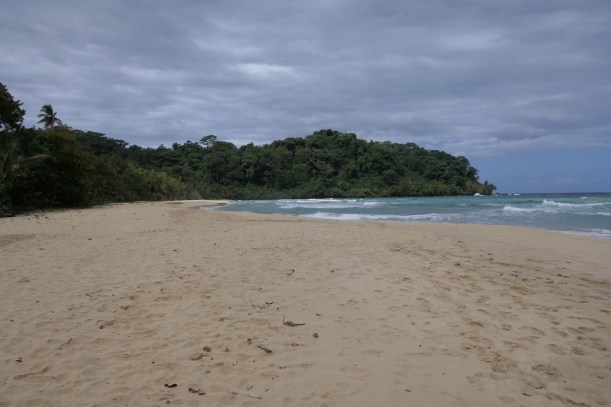
The unrelenting rain had put a literal damper on our one-week stay. Heading to Costa Rica we had dreams of swimming, snorkeling and walking the long beaches of this stretch of Caribbean coast. But the surf was big enough to swallow the beaches up, huge tree trunks rolled in the roiling waters and the frequent downpours made leaving the cabin a risky proposition. When we did get breaks in the storms we ventured out to the Gandoca-Manzanillo National Wildlife Refuge to walk it’s nature trail where we spotted spider monkeys, strolled along dirt tracks from our cabin to see sloths and, best of all, viewed those parrots and toucans right from the deck of our accommodation. The good kind of ‘nature’.

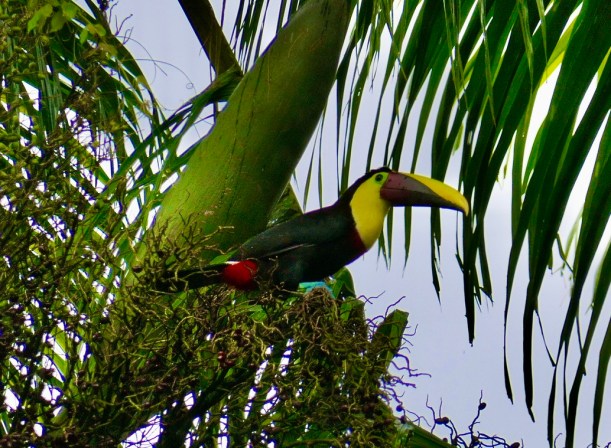
39587DC3-C5AD-4B62-B721-EB7EEC4A15F4_1_105_c

Keel-billed toucan from our deck (good nature).

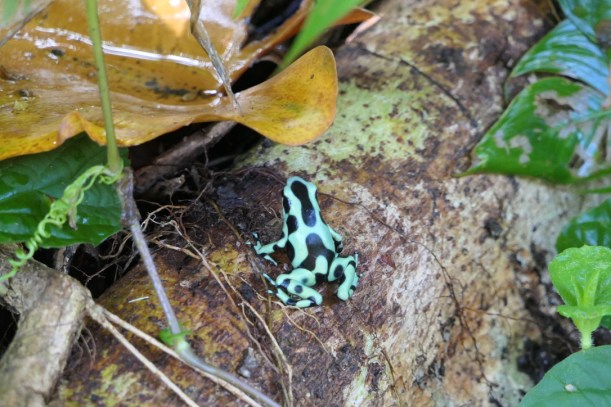
709C6FC9-E01A-4A7E-B56F-2541D6F1B382_1_105_c

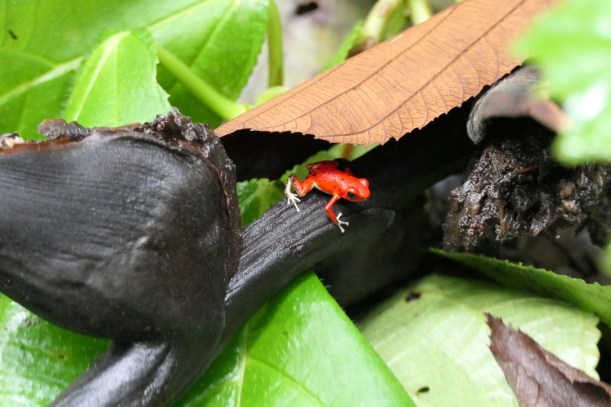
Green poison dart frog.

731CA239-3737-47C7-AA13-0D2B0B200DA8_1_105_c

Spider monkey mom and babe.

After about three days of incessant rain (following a week of similar weather back in Bocas del Toro) Heather was yelling at the sky for relief. ‘Can’t fight the weather’ I’d mumble under my breath from my hammock. But by day five I too was standing next to her screaming “Enough already!”

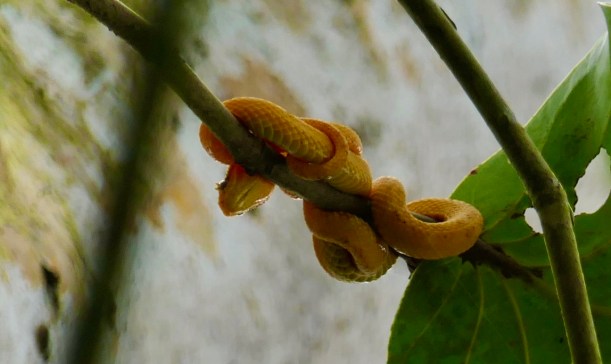
After our wet week in Cocles, we moved north to Cahuita, which sits just outside of the national park of the same name. Once there, a funny thing happened – it stopped raining. For three whole days! We took advantage of our good fortune by strolling through the small town, which is best described as . . . unassuming. Functional, perhaps. Certainly nothing fancy, flashy or overly charming. But it held a small selection of restaurants, a couple grocery stores, and, just outside of town, what seemed like the world’s greatest collection of sloths. They were everywhere. Hanging from the lower limbs of trees, snoozing or moving at the ‘speed of sloth’ as they snacked on leaves. At first we marveled at Carlos’, our guide for our walk through the national park, ability to spot them in the upper reaches of the trees there. Once we learned what to look for, it was easy finding them on our own. But without Carlos’ eyes during our park visit, we surely wouldn’t have seen the yellow pit viper, or the brown pit viper, or the flat-nosed bats or the Jesus Christ lizards that he pointed out to us. He also gave us insights into life in Cahuita before the park, when the area was just another place that lived off the harvesting of cacao and bananas. He also pointed out all the medicinal plants that his mother would gather to treat colds, indigestion, asthma and anything else that his family might have suffered from.

E8B9791A-CC89-4691-B150-B5F5C52F4C5A_1_105_c

Carlos, our guide in Cahuita National Park.


0017FC6A-D370-4390-A938-1F1DBC4CE8EE_1_105_c

How did Carlos find this yellow eye-lash pit viper twenty feet up in a sea grape tree?

32DF436E-C3B7-45E4-A578-8ECB3BA5652E_1_105_c

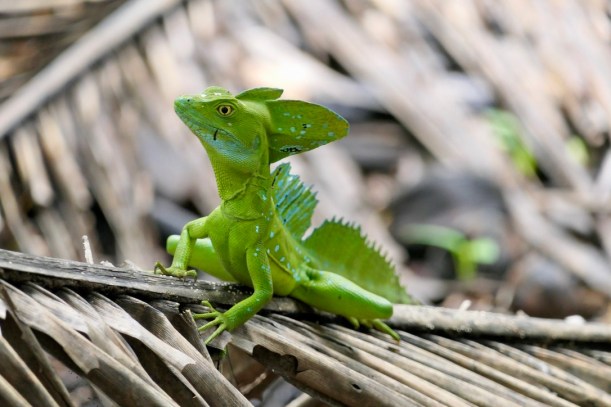
Jesus Christ lizard – so named because they can walk (or run very fast) on water.

7D387B17-A86A-4977-B59B-66431D53EF64_1_105_c

Moving at the ‘speed of sloth’.

ED9CC2E5-3923-45CD-86E9-6AA042F8144D_1_105_c

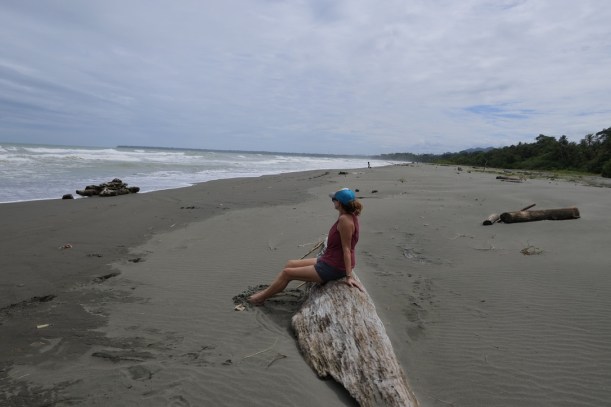
Enjoying some quiet time on Playa Grande outside Cahuita.

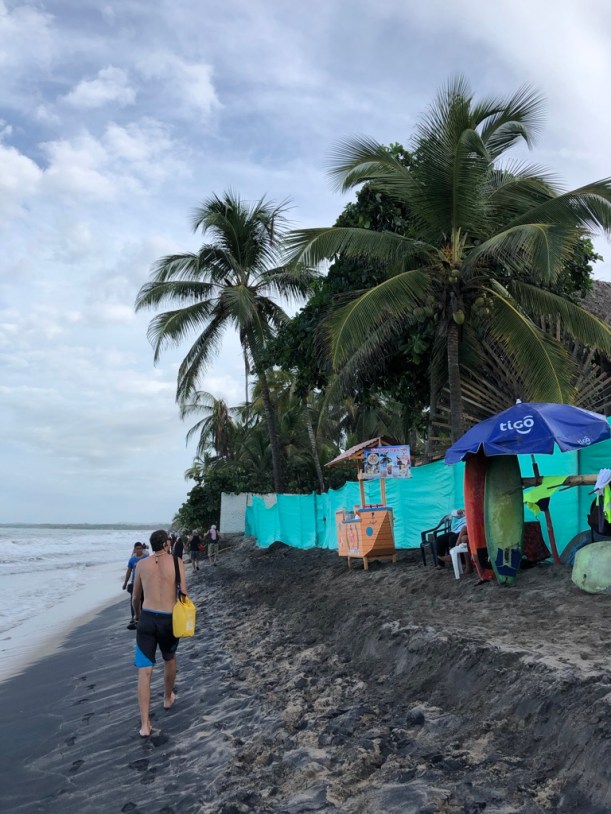
While we never did get to snorkel the stretch of coast here, and the heavy rain pushed us to our limits, being immersed in Costa Rica’s nature (the good kind) was immensely satisfying and enjoyable. We also managed to get a nice walk in on the desolate stretch of black sand at Playa Grande and enjoy some drinks at the Reggae Bar (which every beach town in Costa Rica has at least one of). After checking off the sloth, pit viper and a few other animals from the must-see list on the Caribbean coast we’ll head across the country to visit a couple more national parks as well as some Pacific coast beach towns, taking our time, and a cue from our new friends, by moving at the ‘speed of sloth’.


Leave a comment

A Visit To Bocas del Toro

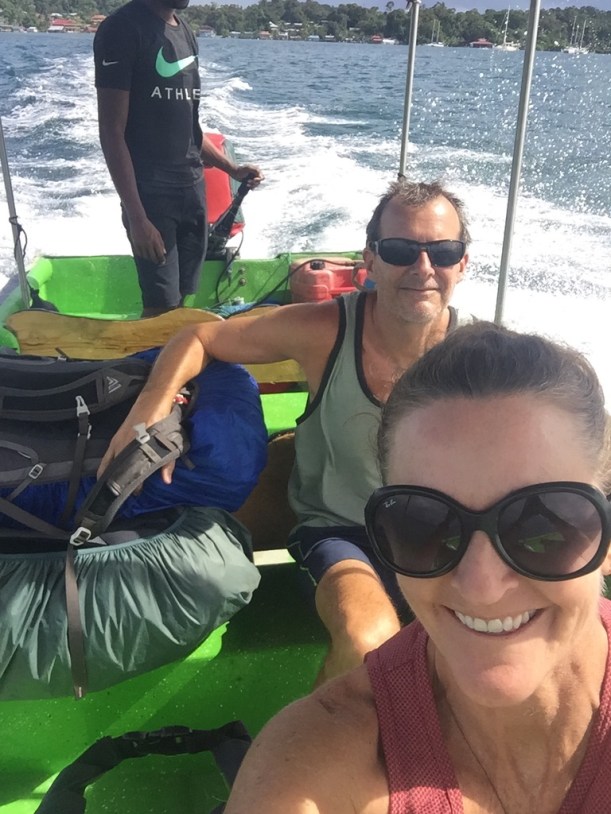
“I think you’re going the wrong way!” Our boat driver waved off our concern about the direction to our accommodation on Isla Solarte, clearly shown on Google Maps, as Heather held out the phone to show him – again. “No, I like to go this way!” he said. As he motored along the southern shore of the island, one of several in the Bocas del Toro archipelago, he asked to see the phone once more. Our location was clearly on the wrong side – Red Hill Villa was definitely on the northern shore. After circumventing the island and it’s profusion of mangrove-filled islets, our lodge came into view. The driver couldn’t help but smile, and we had to laugh, at his refusal to heed the proof of the map. “Free island tour!” he joked as we docked.

CFE4F692-5A1B-426D-9018-5DCCE3C7094F_1_105_c

Water taxi to Isla Solarte – the long way.

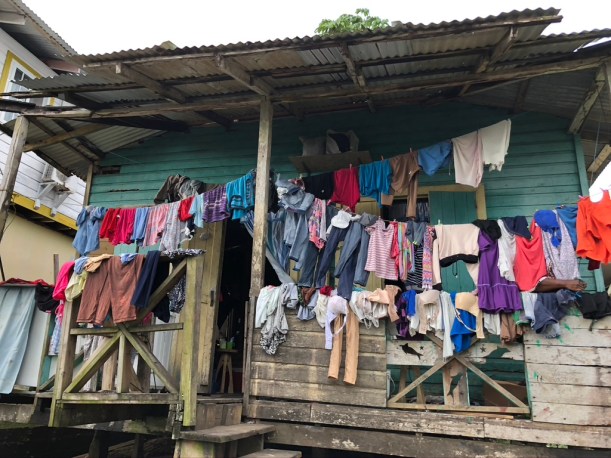
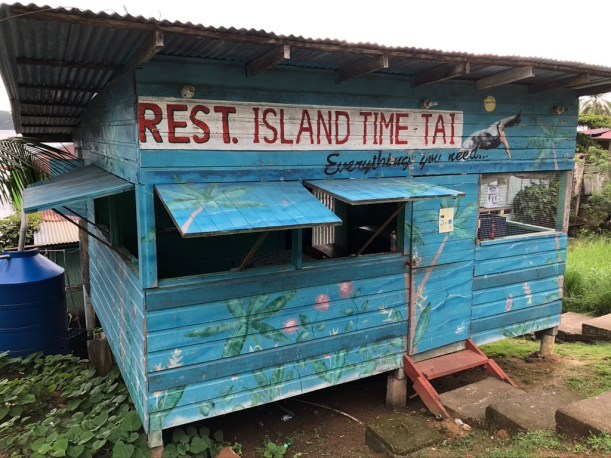
Most visitors to Bocas del Toro base themselves in Bocas town, on Isla Colon, where the mainland ferry arrives. Town offers most everything the young, partying backpacker could want – cheap hostels, cheap eats and cheap happy hours along with overpriced waterfront pub crawls and packed-boat island tours. Heather and I were looking for something different. Exotic wildlife was at the top of our list. We had picked two outer islands for stays of three to four days each: Bastimentos, which offered hike-to only Wizard Beach, popular Red Frog Beach for the wildlife and the village of Old Bank for access to restaurants and basic groceries (beer and wine). We also chose Solarte, which offered a fairly comfortable and totally secluded lodge with paddle boards, kayaks and a dock for relaxing over the water. Upon arrival to Old Bank we were a bit disappointed with our choice – the village was fairly decrepit, the homes along the waterfront were surrounded by trash and the restaurants seemed to be offering nothing more than the basic fried chicken/two starch meals common throughout rural Panama. Our lodge was rustic, to be kind, but the owners were real friendly and trying their best with what they had. But truth be told, the place really grew on me. Not town – that was still disgusting. Not the food – that was still bland and boring. But our lodge had a certain shabby charm to it (Heather never really came around). When we weren’t hiking to the remote beaches through the islands jungle interior, or walking into town for yet more beer, we relaxed in hammocks and played with Mommy, the lodge’s dog, watched sunsets and enjoyed conversation with the other guests. The best part for me, though, was the view from our room’s window just before falling asleep or after waking up. Just past the sea grape and coconut palms the sea crashed against the rocky beach and a nearly full moon painted the water’s surface a beautiful silver throughout the night.

526B2814-01D9-4D9F-8C60-C4E5E57E6AA4_1_105_c

Laundry day in Old Bank.

21FFA8B2-989F-44D9-A2E6-B390478395D2_1_105_c

The restaurant scene in Old Bank.

C71ABF2F-CA69-4072-B015-CEEB1DE56B91_1_105_c

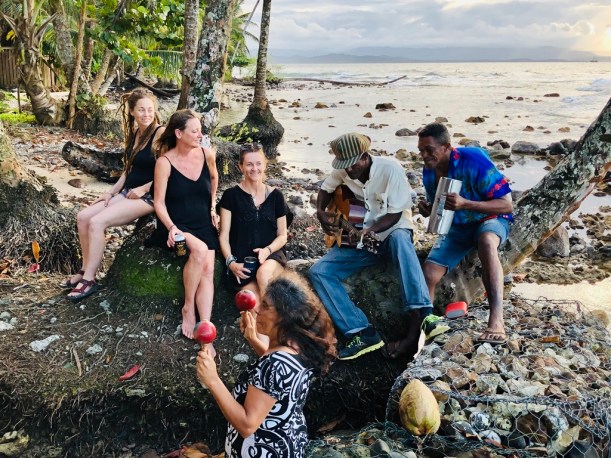
An impromptu jam session with ‘Calypso Joe’ at sunset outside our lodge.

E0C670AA-B946-424C-976D-945B31940445_1_105_c

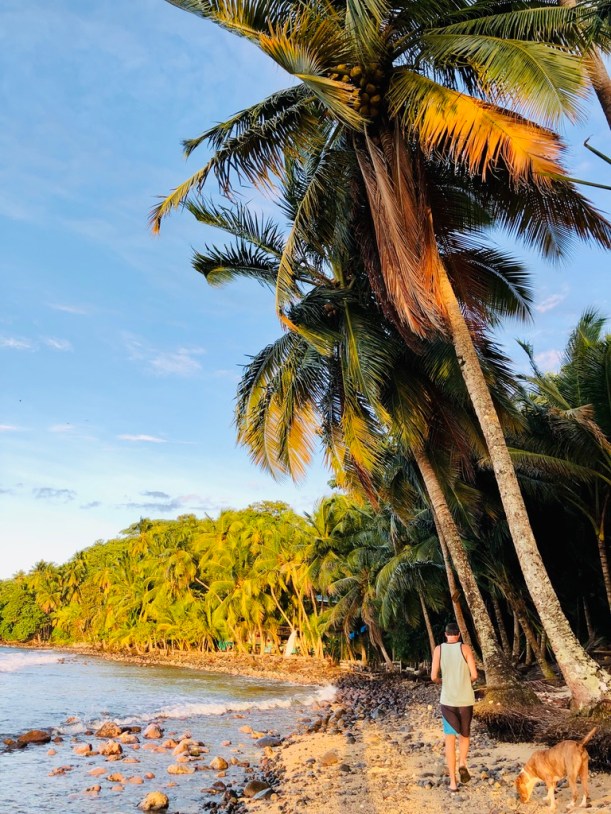
Taking a stroll with Mommy along the beach on Bastimentos.

4ED4B87B-1861-4134-B1C5-B3DA1D978EC0_1_105_c

Deserted Wizard Beach on Bastimentos’ north shore.

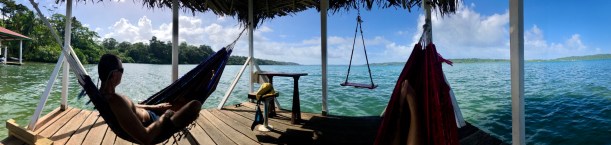
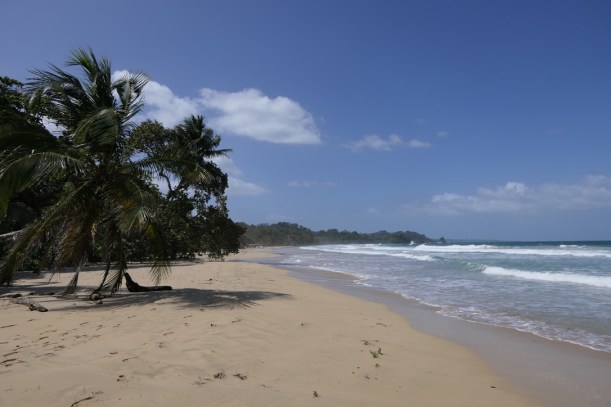
At Red Hill Villa on Solarte we also encountered amiable hosts (David and Inga from Hungary!) and enjoyed hammock time on their dock (in the breeze and away from the bugs) along with Blacky, the lodge dog. We were able to paddle each morning before breakfast and access Red Frog Beach (it was actually closer to us here even though it was across the channel on Bastimentos). David ran us over in the lodge’s small skiff a couple times (spotting dolphins each trip) then we would cross the island on a paved path to the beach on the northern side. While the beach wasn’t swimmable due to rip currents and raging surf, a decent beach bar offered reasonably priced drinks, passable fish tacos, and, on our second visit, an amazing grilled lobster for lunch. But the highlight of each visit to Red Frog beach (I did mention the lobster, right?) was the wildlife encountered on the walk over. The area is known for hosting sloths and red poison-dart frogs. To say Heather was excited to get here and see these creatures would be understating the case. She had been talking about sloths since we started planning this trip back in the summer. So far, through out Panama we had not been able to catch sight of one. But Red Frog beach did not disappoint. The furry creatures could be seen in the trees feeding on leaves or napping on each of our visits. We also had good luck in spotting the namesake red frogs as well. And that’s no easy task as the critters are no bigger than the size of a thumbnail and like to hang out amongst all the debris on the floor of the rainforest.

ECF5ECFF-94D1-4933-B496-AD81D20850B5_1_105_c

The view from the dock at Red Hill Villa.


70F2A0FC-16F4-4B23-A274-301FA2C31C91_1_105_c

Red Frog beach – pretty, right? There’s a beach bar down there somewhere.

3B09A99A-3B95-4385-B10E-40B102B4A66D_1_105_c

Three-toed sloth on Isla Bastimentos.

D1C9C5CE-436D-48A7-A369-AB62DA669E8F_1_105_c

Tiny little bugger!

A week in Bocas put the wrap on the Panama leg of our winter trip. We felt quite happy with our visit to Panama – sailing and snorkeling the San Blas islands; extended beach time with retired Canadians in Coronado; mountain hikes and craft beer in Boquete and finally sloths and frogs in Bocas. Our next stop will be just across the border – Costa Rica awaits!


Leave a comment

Journey To The Center

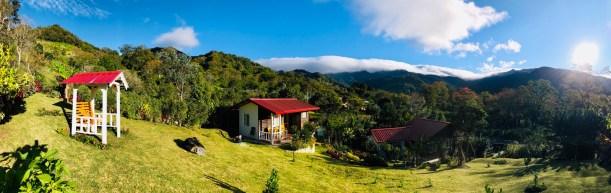
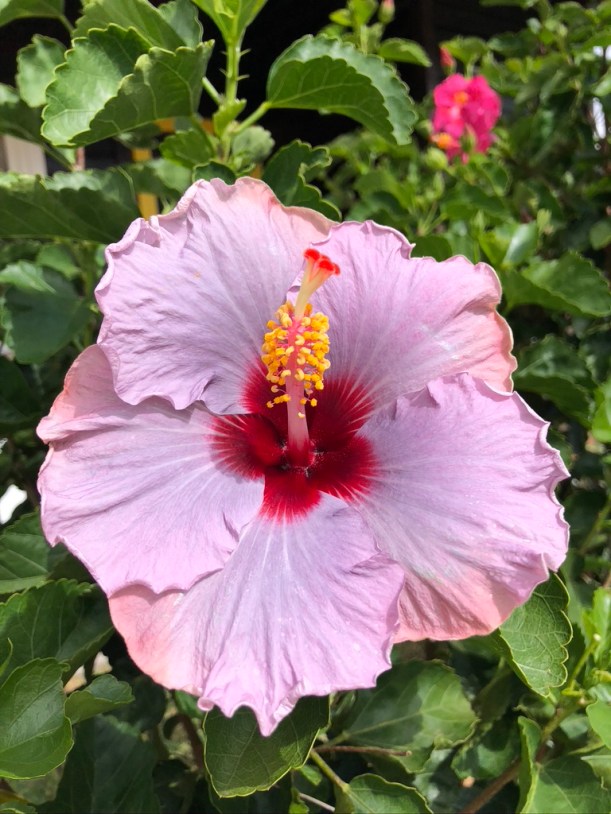
Our bus had turned into a sauna. What had started out as a slow, cramped, over-packed ride on an old school bus from David to Boquete had just taken a turn for the worse. The rain clouds we had seen hovering over the central mountains had moved our way and, once it began raining, the bus attendant had insisted everyone shut the windows, closing off what little air movement had been keeping it nominally comfortable on board. Immediately the windows steamed up. My shirt was stuck to me like a second skin. As before, the oversized handbag of the woman standing in the aisle next to me banged the side of my head each time we rode over a pothole. Panamanian roads have lots of potholes. After an hour we mercifully arrived in Boquete. Heather peeled herself out of her pooled sweat and I unstuck my knees from the seat back in front of me. We collected our bags, stretched our limbs and waited for our Air B&B host, Katrina, to pick us up as planned. Soon after she arrived and we loaded our bags to begin the ten minute drive out of town to her home and our cottage. Katrina, born and raised in the UK, had been living in Panama for forty years and offering the Sunshine Cottage for rent for the last four. As is so often the case when traveling, low times are soon followed by high times. Arriving at the cottage we marveled at the blazes of color in her perfectly-tended garden (remember, she’s English, so it’s not a ‘yard’) and the stunning views to the nearby mountains. Hisbiscus, the largest blossoms I’d ever seen, of yellow, scarlet and purple; hydrangea; citrus fruit and banana trees; foliage of all shades of green were all in perfect order. While the rain had passed, low-lying clouds still draped the tops of the mountains and crept fingers down some of the slopes to the valley. The cottage itself was charming – a terrace held a table and chairs, the bed was soft, the tiny kitchen had all the essentials (including a fresh baguette and a small jar of homemade jam) and the shower offered hot water and plush towels. As it turned out, we spent nearly as much time sitting on that terrace, taking in the views and enjoying the riot of color in the garden as we did exploring town or hiking the hills. Katrina offered advice on several walks available right from the property, told us how to use the collectivo, or local minivan service, to get to and from town and gave us a rundown on her recommended restaurants before taking her leave.  Once back in town we found the Boquete Brewing Company and ducked inside to check it out. It offered a pretty impressive selection of craft beers, the smells emanating from the food truck adjoining the outdoor patio promised tasty grilled burgers and fries and the speakers played a cool mix of Ramones, Lou Reed and Elvis Costello. A nice end to the day.

FB27F936-AC1B-43A9-9689-3394B3260F71_1_105_c

Sunshine Cottage nestled in Katrina’s garden.

4887D28F-1328-4C4D-AC2B-00C89D7C460F_1_105_c

HUGE hibiscus blossom.

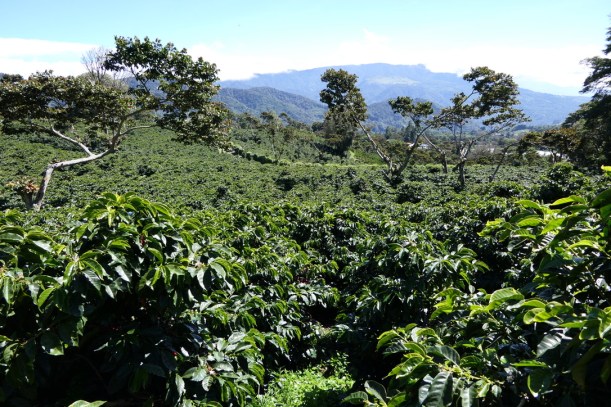
After breakfast at the cottage we followed Katrina’s advice and took to the hills. A two-track trail a couple minutes walk from the property took us up through the grounds of an abandoned coffee plantation. While the coffee plants were overgrown with weeds and vines, they still were producing berries. It seemed sad to think that all that coffee would probably eventually rot on the branch. As we rose in elevation the views of the surrounding mountains improved. Passing beyond the plantation we entered the rainforest. Huge trees were cloaked in vines, cicadas filled the air with their call and the ground was covered in thick broad-leafed foliage. Continuing up the trail we entered a small banana plantation, then passed a couple cottages. As we walked by several children came outside to gawk at the visitors and greeted us with “Hola!”. We eventually reached a saddle giving us views into the next valley (which we would hike the next day) before turning back to retrace our steps.

84912A59-4AE1-4962-807D-D474A01ABEB7_1_105_c

Looking past coffee plants and rainforest to Boquete’s mountains.

C3418038-0DA8-4179-883F-552CC240619D_1_105_c

Headed through the rainforest.

698959DE-0447-482B-A252-E57DB172699C_1_105_c

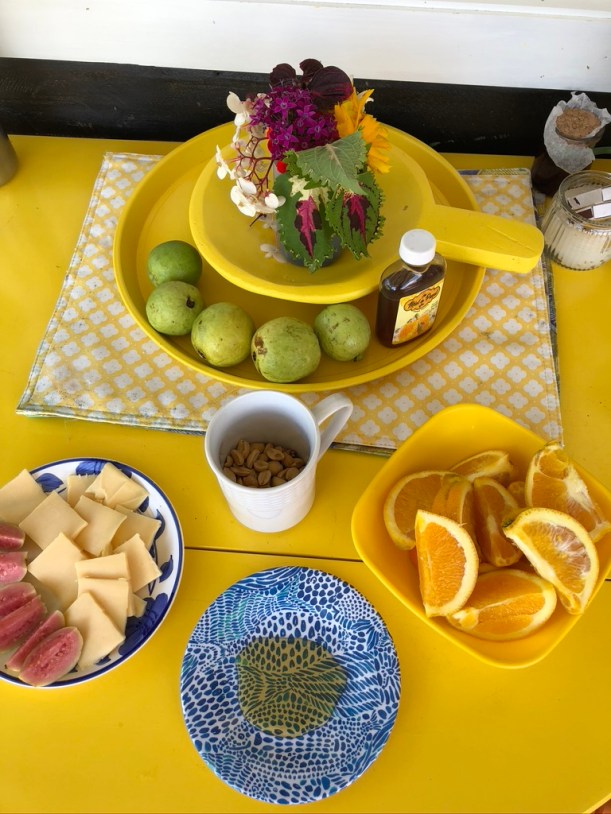
Afternoon snack of fresh guava and oranges picked during the day’s hike along with store-bought cheese and nuts and honey from the El Valle Sunday market.

That evening we dined at one of Boquete’s newest restaurants and were overjoyed at finding really good Panamanian food. So far the food had been uninspiring, if not filling, due to the custom of serving heaping portions of at least two different starchy sides – rice, fried potatoes, yucca or plantains. But at Donde Giselle we dined on a rich soup of potatoes, onions and fall-off-the-bone chicken, as well as a house specialty consisting of rice, beans, ropa viejo (literally meaning ‘old clothes’ – slow-cooked shredded beef with onions, peppers and carrots) and fried plantains wrapped in a banana leaf. While still starch-heavy, it was tasty starch and the meats were delicious. The best glass of $4 wine Heather had had in two months and the cheapest restaurant beer I’d seen rounded out the best meal so far in Panama. The trend continued the next night at a farm-to-table restaurant where we splurged on organic roast chicken (again – falling off the bone) and a double-cut pork chop with assorted vegetables and imported wines. Food that was so good we returned the following night as well.

ADB405BE-FCD7-4F75-A350-AD88D99C6862_1_105_c

Coffee beans drying in the sun at Finca Lerida, site of our second hike.

762C631E-128F-4B77-974C-86553AFEC7D9_1_105_c

A healthy crop at Finca Lerida.

Our plans for a hike on our final day were dashed by high winds and slashing rains. We were consoled by holing up in our little cottage reading and doing trip research. Had it not been for a reserved room waiting for us in Bocas del Toro, we gladly would have stayed on in Boquete to enjoy Katrina’s hospitality, the magnificent garden and views surrounding the Sunshine Cottage and the amazing food on offer in Boquete town.


Leave a comment

A Perfect Place For The Holidays

We had spent the previous month traveling across Colombia, sailed across a small corner of the Caribbean to Panama with family and new friends, and spent one last night out in Panama City with those folks before we all went our separate ways. Now we wanted a little ‘down time” (I know, our whole life seems to consist of ‘down time’), preferably with a beach, some palm trees, no crowds, and, hey, while I’m wishing, how about a swimming pool. Asking for too much? Maybe. Anyway, we happened upon a town about an hours ride west of Panama City called Coronado. Online research described the beach as one of Panama’s most beautiful, lined with pricey second homes and a magnet for North American ex-pats. We found this to be pretty accurate. The beach was gorgeous – a mixture of black and white sands stretching for miles with the calm waters of the Pacific lapping at it’s shore; there were definitely some HUGE homes along the beachfront – and just about every one of them was empty (at least until New Year’s Eve); and there certainly was an ex-pat community – we had definitely found Canadian Florida (pickle ball anyone?). Oh, and the charming little casita we rented for two weeks – located, along with three others, around a lush yard brimming with tropical foliage, hammocks, a ping-pong table and a . . . pool! Paradise indeed.

2FDF5ED7-0DF4-46ED-AF67-C763F57FE3DC_1_105_c

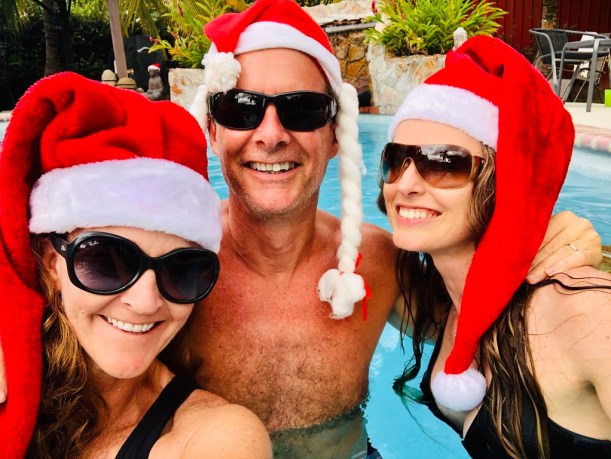
Christmas pool fun with our friend Rene.

5959A86B-7D3B-468B-AF0D-7C210F8DBC3D_1_105_c

Playa Coronado – empty beach and empty homes – all ours!

Our Coronado accommodation was run by a Canadian woman named Panama Sarah. She certainly lived up to her ‘super host’ tag on Air B&B, given to those owners who provide the best customer service. Need a cooler for the beach – got that. Don’t want to lug groceries back from the store under the hot sun – there’s a golf cart for that. Wondering where to watch the highly-acclaimed New Years fireworks – here’s a key to get you onto the rooftop terrace of the 24-floor beach-front condo tower giving you 360 degree views of fireworks in every direction. Super host indeed.

Our days were spent lounging by the pool if we weren’t walking the beach, or swimming in the ocean, enjoying sunsets or exploring with the golf cart, or traveling further afield by rental car to other beach towns like Santa Clara, Farallon and Buenaventura, or getting up into the mountainous interior to El Valle to visit the Sunday market which offered locally-grown produce and fruits, honey, baked goods and handicrafts. I also discovered Heather’s REALLY competitive side at the ping-pong table as she got increasingly frustrated at being unable to defeat me even once. Admittedly, she was very good for never having played before. I waited until the next-to-last day of our stay to divulge the fact that I grew up with a table in my home, playing regularly for years.

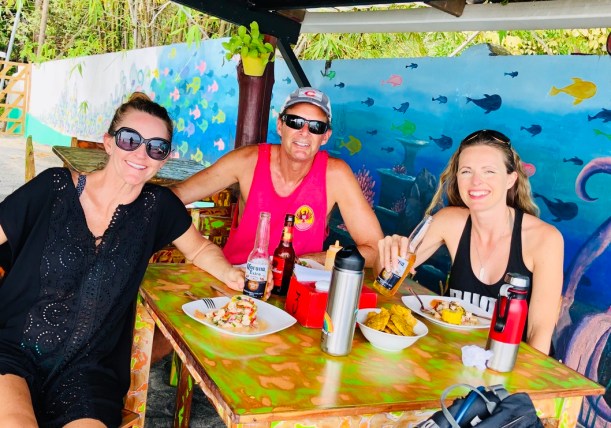
851D0B94-E1CD-4C58-9F60-0D135ECAEC1A_1_105_c

Enjoying ceviche at Playa Farallon.

A3D6FA7A-6F8E-473F-B417-BE832E51C4DA_1_105_c

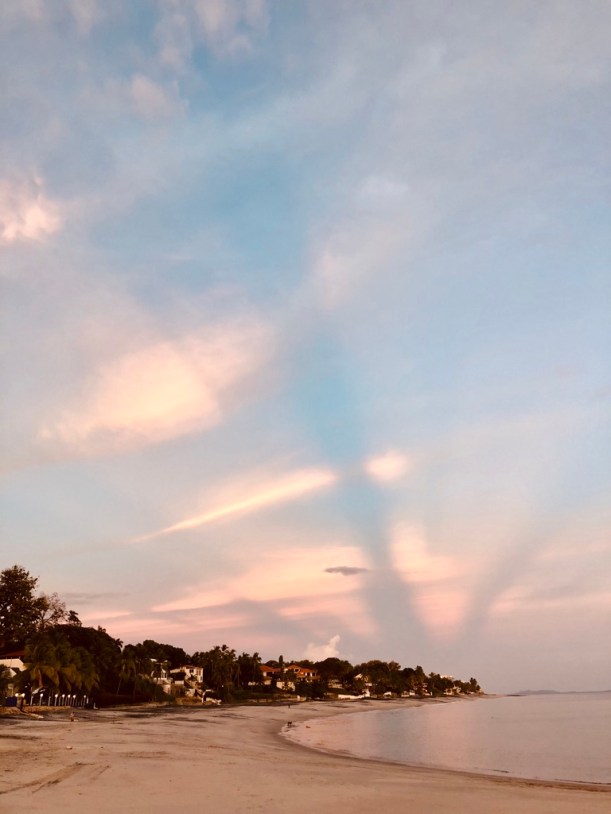
A Coronado sunset.

At the close of two weeks we were definitely sad to be leaving, but it was time to get back on the road. Coronado had filled the bill, giving us that much-anticipated break, recharging our batteries, allowing us to make some new friends and do a fair bit of trip-planning for the rest of Panama. Our next stop will be the mountain town of Boquete. When asked about catching a bus there, folks in Coronado told us “It’s easy. Just go out to the highway and stand on the side of the road, then wave your arms when you see a big bus, going very fast, that you think might be going to in the right direction. And hope it stops.” Easy, indeed.


2 Comments

Leaving Colombia By Boat

After our relaxing days and river adventures in Palomino, we returned to Cartagena for the last time to await the arrival of members of Heather’s family. Her uncle, aunt and cousin were joining us for the next leg of our journey – sailing from Cartagena to Panama via the San Blas Islands. Through online research I had found a small fleet of sailing vessels that made regular crossings between the two countries – certainly a more interesting way to travel than flying. Throw in three days exploring and snorkeling the beautiful San Blas and the decision was a no-brainer. Even Heather’s family from California couldn’t resist the allure of this adventure and had booked passage just three days after hearing of our plans. After a one-day delay and a change of boats due to mechanical issues the five of us boarded Catamaran 360, along with five strangers on the evening of December 13th. After we had settled into our respective cabins and gotten our briefing from the Colombian captain, he and the two-person crew headed ashore for a meal and a shower, telling us they’d return by midnight and we’d get under way. We spent some time getting to know our fellow passengers and soon headed to our bunks, excited at the prospect of waking up on the open sea (the first two days would be an open ocean crossing until we reached the San Blas). Surprisingly, we slept soundly that night to the gentle rocking of the boat. At first light I woke and peered out of the porthole in our cabin to see . . . the lights, buildings and other boats of Cartagena harbor. We were still anchored in our spot from the night before. As we all came up on deck we noticed one other thing – the captain and crew had not returned. And they had our full payments and passports, which he had asked for just before leaving for shore. ‘Nah, he couldn’t have . . .’ As we shook off the sleep and tried to dispel the uneasy feeling that was gnawing at the back of some of our minds, we heard the drone of an outboard motor crossing the harbor. The captain and crew, and Sancho the boat dog, approached. The captain boarded his boat and set about preparing for departure. Finally, one of the crew told us that the other crew member had dropped her sunglasses overboard during the dinghy ride to shore the previous night and was insistent on waiting for daylight in order to try to retrieve them using a mask and snorkel. ‘Hmmm. A lame excuse to push our schedule back by eight hours’ I thought, but they’re here and we’re leaving and our excitement (and relief) grew anew. We were given breakfast and then found spots on deck to watch the Cartagena skyline fade into the distance and were soon surrounded by nothing but open water. For the next forty-two hours only three or four container ships broke the seascape of Caribbean blue. As we bobbed on the swells several of our group began to feel the effects of seasickness, yet none would actually get any more than a little nauseous. However, none of the copious amounts of beer and wine brought on board would be touched during this time.

B49CAC49-FAB4-4E42-A7CE-06D9EBBC97BB_1_105_c

The family the first morning – all smiles.

21771259-5491-4DFB-B432-14CDCBD74199_1_105_c

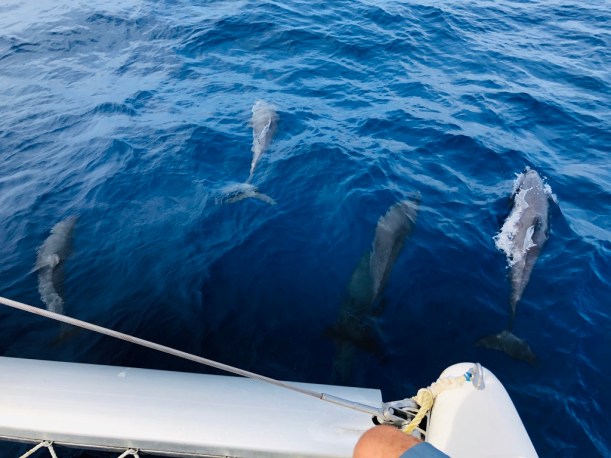
Dolphins provide some excitement on day 1.

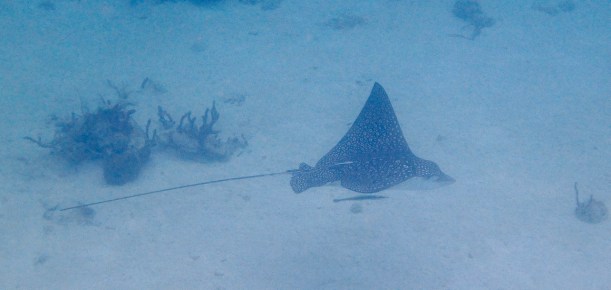
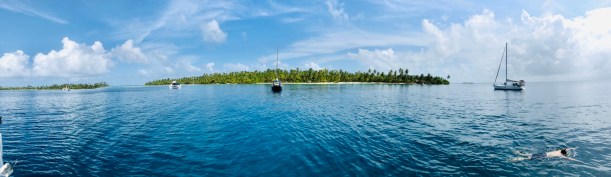
Early in the morning of day three we woke to the sight of land. Once again peering out of the small porthole of our cabin at first light, I spied the dream landscape: a white sand-fringed island, dotted with palm trees, surrounded by clear blue water and the dark outline of a coral reef. Soon we heard the soft patter of feet on deck followed by the splash of bodies eager to get into the water following two days of confinement. A group of us swam to shore, scrambled up onto the beach and crossed the small island to gaze at the surf rolling in on the exposed side. Following a swim back to the boat we devoured breakfast and then donned masks and snorkels for our first of three trips along the reef. We were pleasantly surprised by the profusion of hard and soft corals. Fish were certainly present, though not in the numbers one would expect to see on what appeared to be a fairly healthy reef. However, sighting a large spotted eagle ray, decorated crab and a nurse shark were enough to raise our excitement levels.

341D920C-9704-4744-888D-29EF91D76ED4_1_105_c

Our first stop in the San Blas islands. Locals delivering the fresh catch to another anchored boat.

OLYMPUS DIGITAL CAMERA

Spotted eagle ray.

OLYMPUS DIGITAL CAMERA

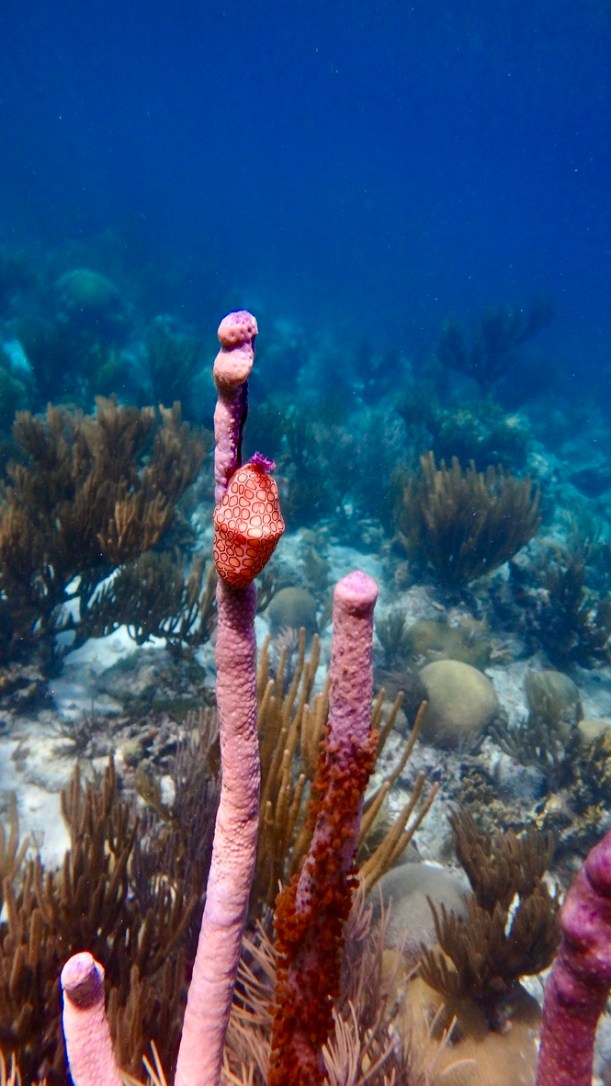
Flamingo tongues on finger sponges.

Day 5 had us moving just after breakfast. En route to our next island idyll, the captain anchored just offshore of what he called “immigration island”. This small island hosted the lone immigration post that served the 365 islands of the San Blas chain and would officially welcome us into Panama. We would also pay our $20 USD fee which gained us access to the Guna Yala indigenous area, which encompassed the San Blas as well as 230 miles of Panamanian coastline. Formalities taken care of, we once again set sail towards our final night’s anchorage. By mid-day we were comfortably nestled amongst several other sailboats protected by three islands and a fringing reef surrounding all. We didn’t hesitate to get in and start exploring. Once again, the reef didn’t disappoint.

53A352CD-B595-4570-9751-3FCAD3AC2044_1_105_c

Our anchorage for night 4.

6CB87CF7-1165-41D6-9166-65C922421732_1_105_c

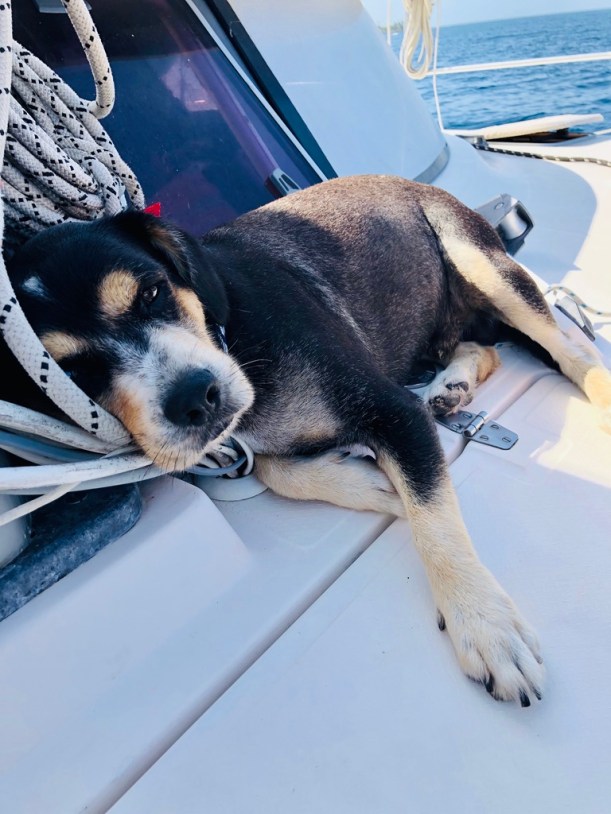
It’s not easy being a boat dog.

OLYMPUS DIGITAL CAMERA

A well hidden moray eel.

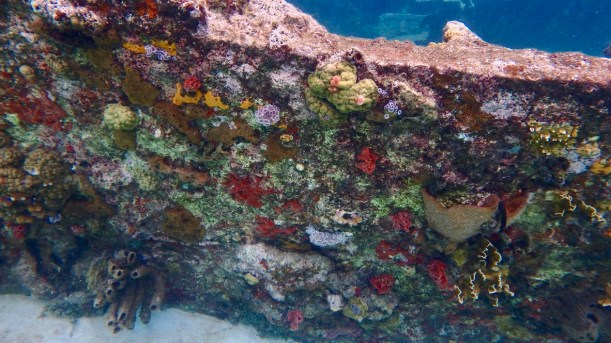
Before our trip ended, we had the chance to visit a Guna Yala village on one of the islands. Our captain gave us insights into the matriarchal family life (“the men wear board shorts and fish all day”), including the peculiar fact that even if a family doesn’t have a female child, the youngest son will be treated as one, ensuring the mother’s bloodline continues. We also motored over to the shallow wreck of a cargo ship for one last snorkel before being off-loaded to a small motorboat which would take us to the mainland for the two hour roller coaster ride through jungle and mountain to Panama City, where we would split from family – they returning to California and Heather and I moving along the Pacific coast for some more Panamanian beach time.
46CB8968-20EC-4BE6-A56F-CCC63A3C0569_1_105_c

Kids being kids.

B2B85AF5-8D9C-4525-80F2-E92BEDD53AD1_1_105_c

Guna Yala woman in traditional dress – especially noted for their copious bracelets and anklets.

AB7A8D21-4692-4703-8DD9-1BBBF5D8AA2A_1_105_c

Always eager to contribute to the local economy, Heather gets a custom-made bracelet.

OLYMPUS DIGITAL CAMERA

An explosion of color on the shipwreck.


Leave a comment

Palomino, Colombia

Our travels thus far in Colombia had taken us to mountain villages, coastal cities and Caribbean islands. Our next objective was to check out a Colombian beach town and Palomino was our target. Located four (according to the bus company) or six (in reality) hours east of Cartagena, Palomino sat on the Caribbean coast at the foot of the Sierra Nevada mountains, the northernmost reach of the Andes range. Sitting between two rivers, the town consisted of a jumbled grid of dirt roads lined by guesthouses, bars and restaurants, and companies offering tubing trips on the Rio Palomino. If one were so inclined, surfing was available as well. Our guesthouse host, Alejandra, also indicated paddle board tours were offered on another nearby river, which was of particular interest to us. We asked her to arrange a tour for the following day, then set off for the beach. After lunch at a vegan cafe fronting the sea (Heather’s idea) we searched for a suitable beachfront purveyor of beverages (my idea). Bar San Sebastian seemed to fit the bill perfectly – thatch roof, cheap plastic chairs and a hand-painted sign offering 2-for-1 mojitos. For $3. And the beer was even cheaper. After ordering a mojito for Heather and a beer for myself we settled into our seats and took in the scene – Colombians enjoying the surf, sun-burned tourists strolling along the sand, salesmen offering sunglasses and roasted cashews (not together – these guys are specialists). We eventually struck up a conversation with one of the men offering cashews (he piqued our interest when he offered ‘happy hour’ pricing). His story was an interesting one. A former taxi driver from Venezuela, he had moved with his wife and child to Colombia seeking a better life. Selling just three jars of cashews a day (at $3 each) provided ample income to support his family. Humbling to think we would eventually spend about three days wages in an afternoon at the beach.

9CD19B9B-C3AB-40AD-A418-2492B4AE377B_1_105_c

Surfside at Bar San Sebastian.

The next day we were excited for our paddle boarding adventure. Alejandra explained that we needed to walk out to the highway, flag down a westbound bus, ride for about fifteen minutes to a small village called Don Diego where we should wander the village looking for the office of the tour company. And no one would speak any English. No problema! With a bit of trepidation, we got out to the highway to find a bus waiting on the side of the road. The driver, seeing us approach, asked where we were headed. Understanding ‘Don Diego’, he indicated this was, indeed, our bus. Soon we were off and enjoying the scenery of jungle-clad mountains on one side and the bright blue sea on the other. As fifteen minutes elapsed, we started to think about where we should ask the driver to let us off. Noticing our anxiety, he motioned for us to relax, and he would let us know when we should step off. Within minutes we arrived in Don Diego and he indicated for us to get out. Now, if we could just figure out where in the little village we’d find our tour company. We needn’t have worried. A fellow standing at the bus stop asked us if we were looking for a boat ride, fishing or tubing. Since I didn’t know the Spanish term for paddle boarding, I just said “Paddle board”. “Ah, down this street, on the right” and pointed across the highway to a dirt road. As we set off in the direction he had pointed to, moments later he roared past on his motorbike, and, as we learned in a couple minutes, had alerted the tour office that their gringos had arrived. After two blocks another guy was standing in the street waving his arms to guide us in. As we found time and again throughout Colombia, the people are incredibly friendly and helpful.

Our tour began with a lancha ride up the Rio Don Diego, hauling our paddle boards and our guide’s kayak. Twenty minutes later the boatman pulled up to a sand bar and our watercraft were placed on the shore. Donning life jackets, our guide indicated if we had any paddling experience. “Muchas” we replied. With that he jumped in his kayak and headed into the current and was out of sight before we had a chance to adjust our paddles, secure our water bottles and flip-flops and get on our boards. Following the current we floated peacefully downriver through bamboo and leafy trees lining the waterway. Occasionally, over the next hour and a half, we caught glimpses of our guide as he waited to check our progress and at times indicate a particular channel of the river to shoot for. Along the way we passed a group of three people tubing, but otherwise had the river, and the views, and the birds, to ourselves.

24693E01-4CF1-4066-8D99-9977A6815D82_1_105_c

The lancha transporting us upriver to the starting point.

D6ECDEC8-E62B-429C-9459-EE4F1770878B_1_105_c

Heading down the Rio Don Diego.

0AD5BBFD-31F8-4267-BCA7-6F9784589FCC_1_105_c

Looking back upriver towards the Sierra Nevadas.

Our trip took us all the way down to where the river emptied into the sea. A wide beach framed the river mouth and we found our guide, lancha and a palapa waiting there. Under the palapa a guy had set an old refrigerator on it’s side, filled it with ice each morning and stocked it with cans of Club Colombia and Aguila beer. Not ones to pass up a cold one after a morning on the river we indulged in a couple frosty brews with our toes in the sand and views of mountains and sea.

DC50E188-16E9-4D60-BC56-10B4BC299229_1_105_c

Pure genius!

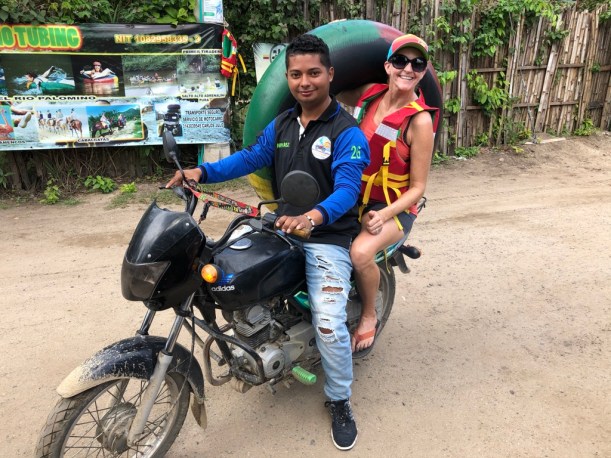
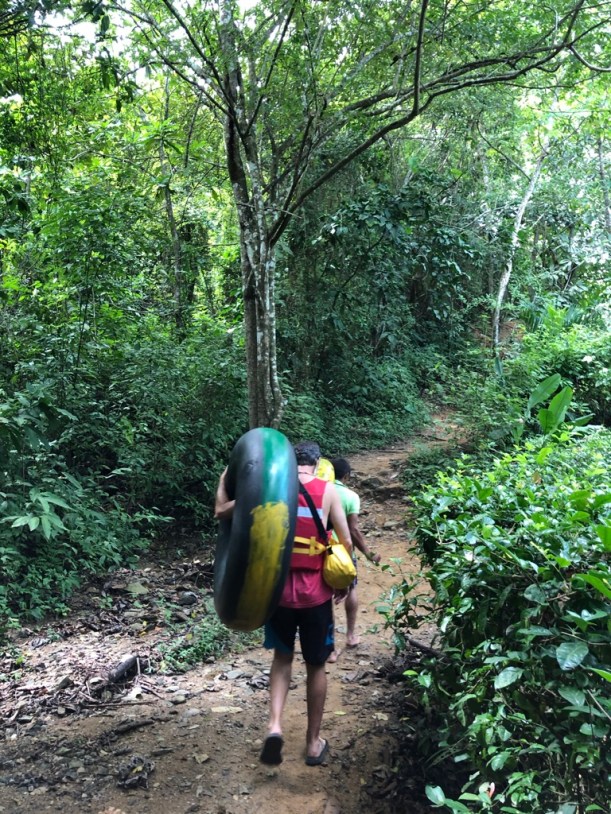
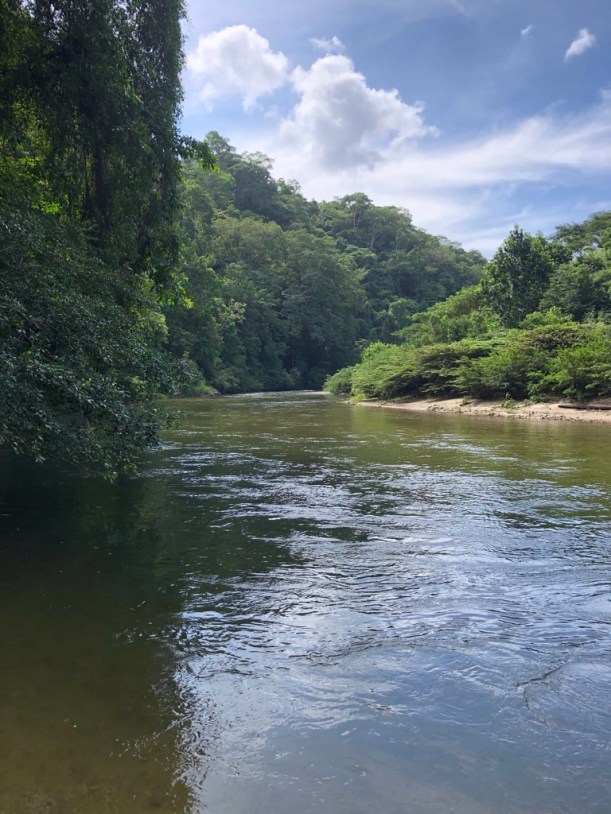
Day three of our visit would take us tubing down the Rio Palomino. We’ve got quite a bit of tubing experience, as the Yampa River flows through our hometown, and is accessed by a short walk from our home. In Palomino it was going to take just a bit more work to get to the river. About midday we made arrangements with one of the companies offering tours. While we donned life jackets (essential for getting through the police checkpoint) and picked a suitably-sized tube, our guide rounded up a couple motorbike drivers. We would travel on the back of the motorbike for about twenty minutes, first through town, then across the highway to another dirt road heading into the mountains, which would eventually narrow to a rocky, rutted path steeply climbing a hillside until the bikes could no longer navigate the trail at all. While holding a giant inner tube with one arm. We dismounted and continued by foot, first climbing (and perspiring heavily) and then descending for another thirty minutes, occasionally catching glimpses of the river through the forest canopy. Upon reaching the riverbank and our put-in point, we discovered another Colombian entrepreneur who somehow transports a cooler, ice and beer here each morning. Of course we purchased a handful of beers (for the outrageous price of $1.65 each!), but didn’t need to buy more then one each as we found a vendor at each sand bar we passed along the way.

D8778E0C-2027-4A22-93D8-DC48DFBA0DA5_1_105_c

Ready for adventure!

46A63233-7ADD-4F25-88AE-FB01A36C52C7_1_105_c

It shouldn’t have to be this hard.

3A1510A8-7BE0-43B8-9C90-3E7833F46AD5_1_105_c

The start of the float. I’m discussing with our guide how many beers we should buy.

6EE2FE06-8D85-436A-8088-CB67C4D67895_1_105_c

The lazy river.

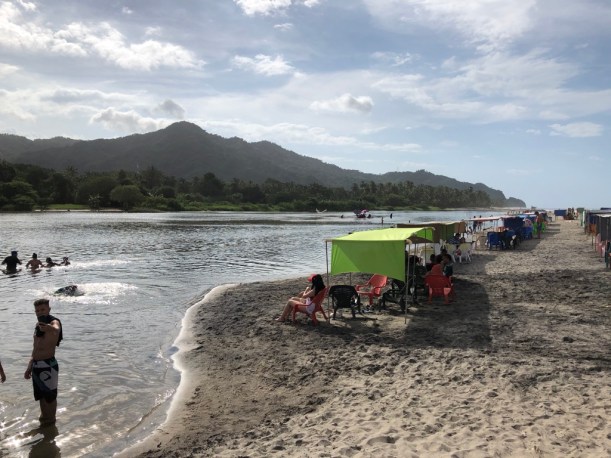
As with our paddle board tour, this also ended as the river met the Caribbean Sea. This beach was a bit more crowded with two restaurants, chairs and sun shades and quite a few Colombian families enjoying the sand and surf. While our guide departed with our tubes to return to town we decided to linger over lunch and enjoy the rest of the afternoon before also strolling the beach back to town and our guesthouse. And one more stop at Bar San Sebastian for those mojitos.

103B66F4-72FA-405A-A82A-B1C70F86DDCE_1_105_c

The scene at the beach where Rio Palomino meets the sea.

8AC1B5AD-A848-487F-89A8-E3CD39144DF4_1_105_c

Heading back to town after another great day on the river.


Leave a comment

The Caribbean Coast, Colombia

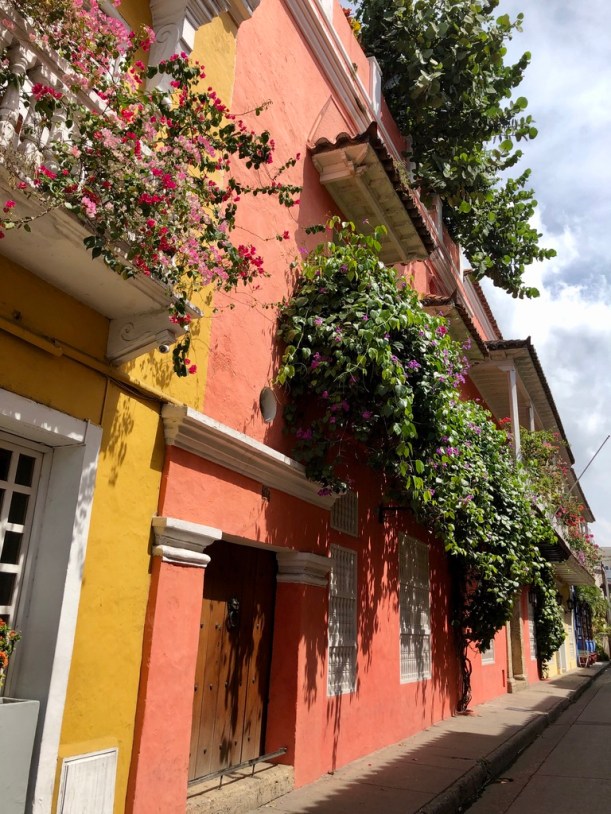
Finally we had found the heat. While we were still back in Colorado in mid-November, watching record-breaking snows blanket town, we dreamed of the tropics. Hot and humid, sweltering, even. The kind of heat that turns your beer bottle into a river of condensation and makes you drink it down in just a couple hearty swigs. Shirt-stuck-to-your-back heat. We found it in Cartagena – mid 90’s with a humidity to match. Its old town fronts the sea, surrounded by a 16th century stone wall which contains cobblestone streets, colorful colonial buildings and leafy plazas. One can’t help think of Disney’s Pirates of the Caribbean while strolling through it. From the airport we taxied to our hostel, dropped our bags and were grateful for the air conditioned room that awaited us. We would not linger long inside as we had a quest – Cartagena is known for it’s ceviche, and we were hungry for lime-soaked seafood, and a bottle, or two, of beer dripping with condensation.

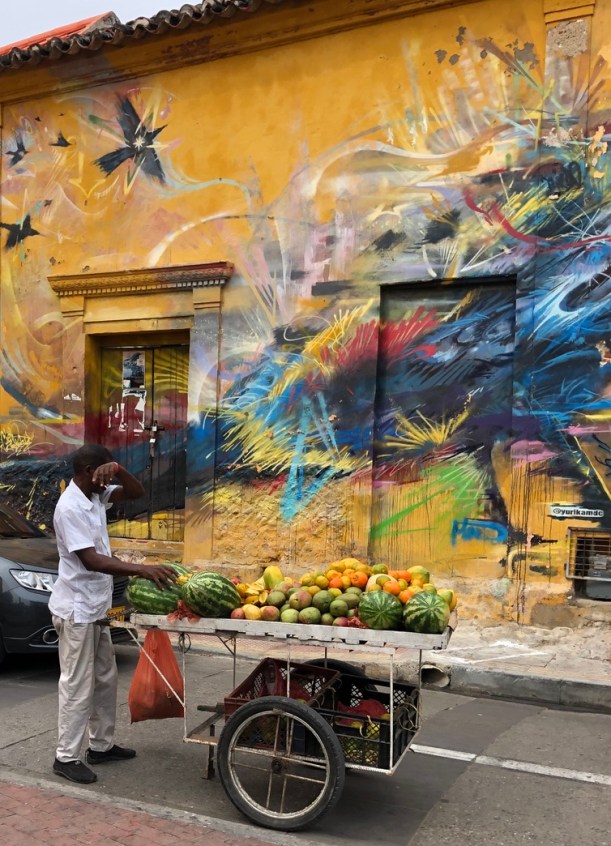
La Cevicheria was our first stop. The problem was there were so many choices. Fish? Shrimp? Octopus? The traditional style with onion, cilantro and lime. Perhaps with green mango, or corn and avocado, or something with a bite of fresh chili? We settled on a mixto, with all three seafoods, dressed with coconut milk, lime, onion and cilantro. Sitting outside at a table under an umbrella we watched as vendors hawked their wares (‘Sunglasses?’ ‘Um, you can see I’m wearing a pair, right?) and ladies, dressed in brightly colored skirts and tops, offered fruit from the baskets sitting atop their heads.

After that first afternoon we learned a lesson: hit the streets early after breakfast, grab some fresh fruit from a street vendor before returning to the air-conditioned comfort of our room by noon, then head back out to catch sunset from the city walls and find a dinner spot for the evening.

1EA989D2-8101-4E76-ADC0-0C8B271C067D_1_105_c

Colorful Cartagena.

D1C27B04-5C32-4A19-8823-8290C23D429C_1_105_c

A quiet street scene.

292B3C9C-2139-4F5D-BD7C-58FB0693DDEC_1_105_c

Fresh fruit is never far away.

2724CAFD-F923-48A0-BBCC-838D06DE2CC3_1_105_c

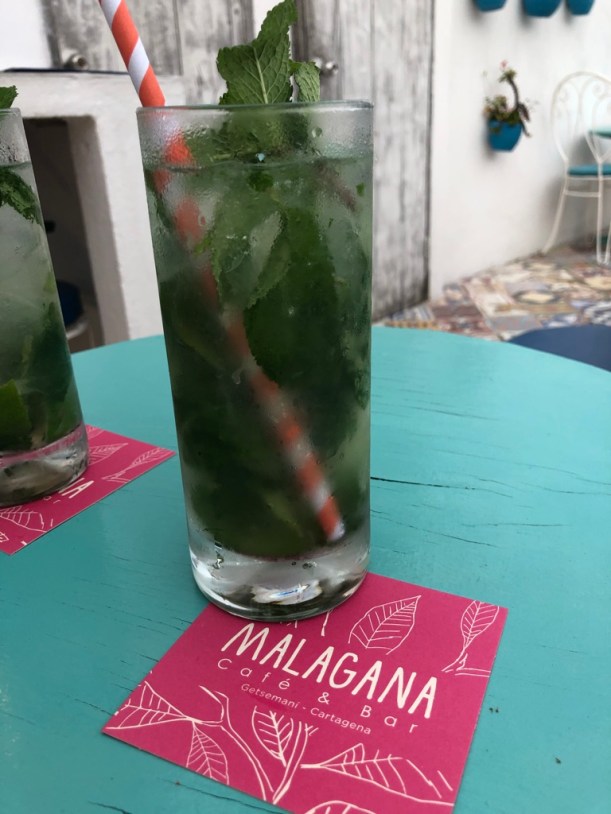
We didn’t spend all our time drinking beer. Cartagena is justifiably famous for its mojitos too.

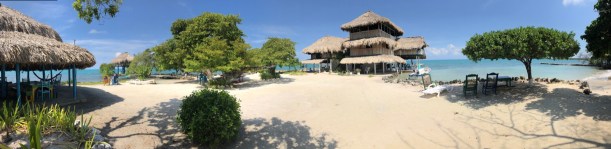
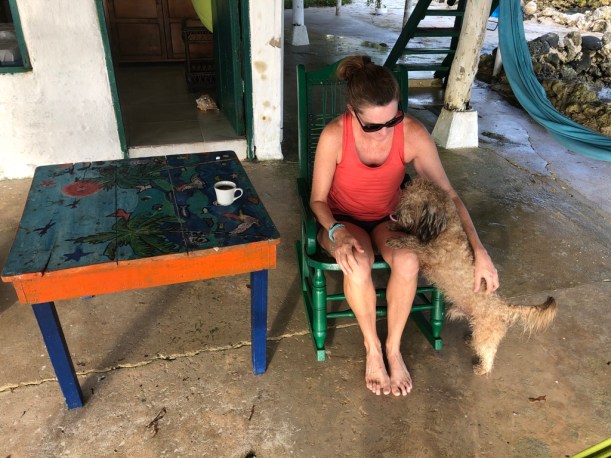
After three days of sticky heat, tourist-clogged streets and the never-ending press of touts (“Cigars? No? Cocaine?”) we were ready for some quiet island time. Fortunately, just a two hour boat ride west of Cartagena lay the San Bernardo Islands, a group of ten white sand-ringed islets basking in clear turquoise waters under the Caribbean sun. We booked a four-night stay at Hotel Punta Norte on the largest of the islands, Isla Tintipan, and set off by speedboat from Cartagena’s harbor. Upon arrival at its modest dock, Isla Tintipan seemed to be everything we had hoped for. There was a small beach, a few palm trees, a single kayak, an impressive number of hammocks and colorful rocking chairs for a five room thatch-roofed ‘hotel’, and what turned out to be, to our delight, a friendly pup named Juan, one fabulous cook and a plethora of fresh seafood on its menu. Also, no internet, or electricity for that matter, and nothing much to do besides try out each of the hammocks, devour the paperbacks we had brought along and sample just about all of the delights coming from their kitchen.

72CCE253-4C88-41E0-B308-A79F77E7B421_1_105_c

Hotel Punta Norte – everything necessary for the perfect beach break.

02364256-4BB3-42D6-B2CF-05A7B8855D00_1_105_c

Heather and Juan enjoying morning coffee outside our room. The dog was never dry and always sandy.

2823CCA2-5FEA-448F-8758-5F354D822521_1_105_c

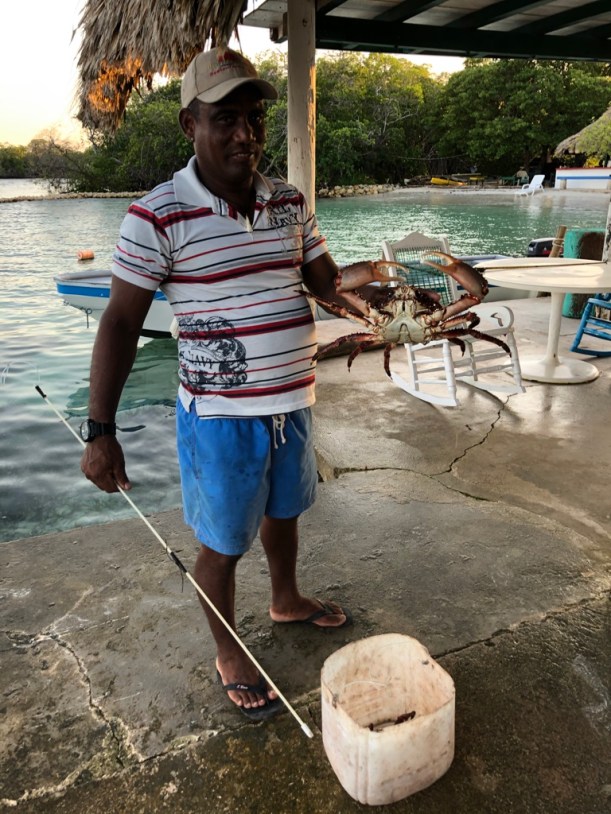
What’s the catch of the day? Doesn’t matter, we’ll take it.

It was four glorious days of sun, snoozing and seafood. One evening, Carlos, the owner, suggested we do the ‘plankton’ tour. “It’s swimming with the stars” he said. Intrigued, we accepted his invitation. About an hour after sunset we jumped into the lancha, or small outboard boat, and sped across the bay to the entrance to the island’s interior lagoon. The cloudless night sky was filled with stars and the water was pitch black. Following the lead of the boatman, we jumped into the inky water with mask and snorkel and were immediately surrounded by flashing lights trailing from our hands and feet. Each movement of our limbs ignited the bioluminescence in the water. Diving under the surface we couldn’t see through the flashing light covering our masks. After getting our fill of the light show beneath the water, we floated on our backs, gazing at the other stars above us until our boat driver roused us from our reverie and brought us back on board for the return trip to the hotel. After four days, with great reluctance, we left our little piece of paradise and returned to the big city – but just for one night. The next day we would head east from Cartagena for more Caribbean beach time.
5ED0452D-4F3A-46A9-8079-517C7942E399_1_105_c

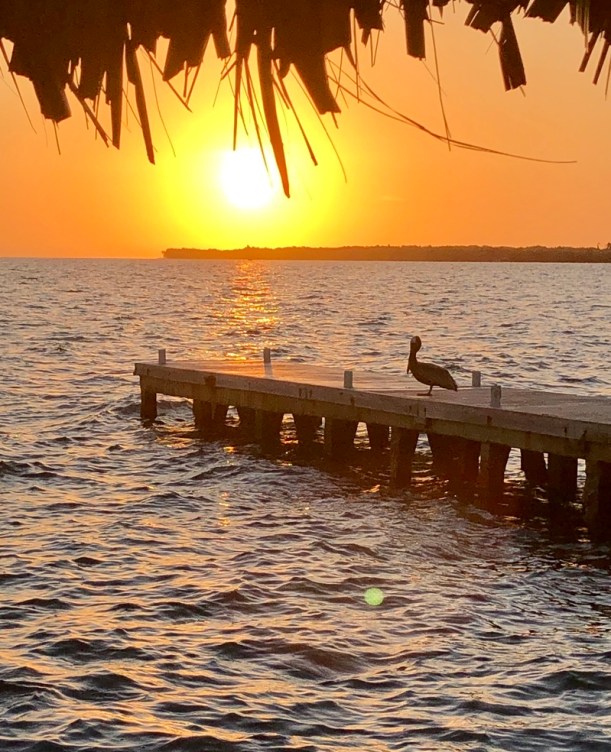
Sunset over Isla Tintipan.


Leave a comment

Jardin, Colombia

Little did we know how impactful our visit to this little Colombian mountain town would be on us. After braving the four hour bus ride through the mountains south of Medellin, over the often unpaved road that twisted through stunning landscapes, dodging landslides that covered portions of the highway in several spots, we arrived into town. Two blocks from the bus depot we found our small hotel that would be home for the next three nights (no way would Heather get back on a bus for the return trip in any less time than that). As we entered, we caught a glimpse of the bell towers that rose from atop the huge cathedral that fronted the main plaza, just half a block away. ‘Beautiful view’ I thought to myself. Later, as those bells loudly pealed the hours, starting at 3am and then erupted in a chorus of ringing announcing the first Mass of the day at 5:45am, I cursed them, and would do so each morning thereafter.

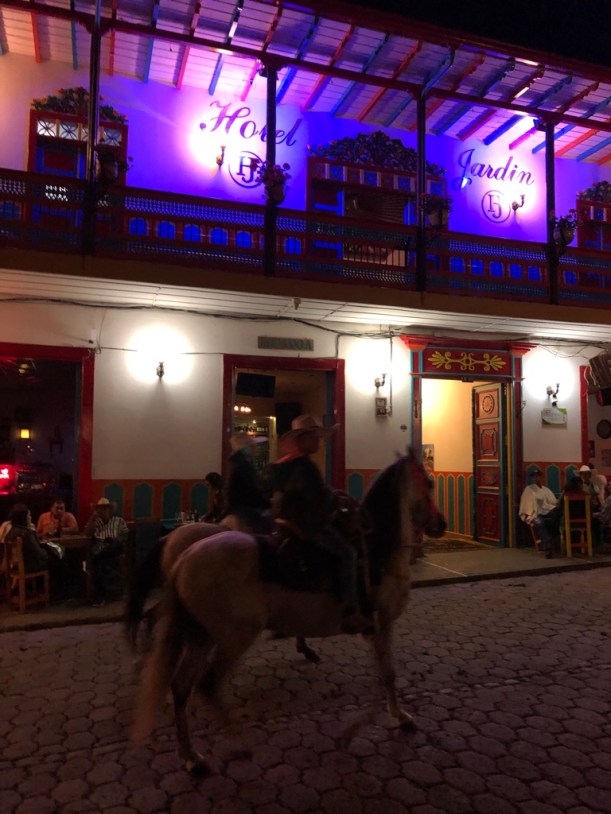
We had read how laid-back Jardin was – a place where the caballeros, the local cowboys, would come to from surrounding areas to socialize, shop and sip coffee at the numerous cafes surrounding the plaza. And it was just as we had read: this small town of 14,000 people had so many cafes and bars around the square, each with its uniquely colored tables and chairs, and each filled with men, dressed in jeans, button-down shirts, topped by a cowboy hat and their poncho folded and draped over their right shoulder, propped back in a little wooden chair, sipping tiny cups of coffee. Later in the day, the coffee cup would be replaced by a bottle of Aguila or Club Colombia, two of the popular beers, or even a small glass of aguardiente, the Colombian anise-flavored spirit. Fortunately, our first night in town happened to be a Saturday, when horsemen and -women ride into the plaza atop their paso fino horses and prance back and forth while the horses exhibit the fast short step for which they’re renowned. As we sat outside of one of the bars, we couldn’t help but marvel at our luck to partake in this small-town tradition, watching a slice of rural Colombian life in a scenic village almost completely devoid of other tourists.

AA0C75BB-38EF-4F05-B184-EE84C185AF2F_1_105_c

Caballeros parade their horses through Jardin.

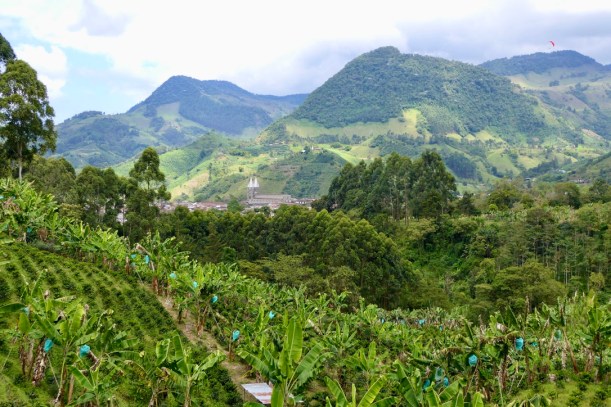
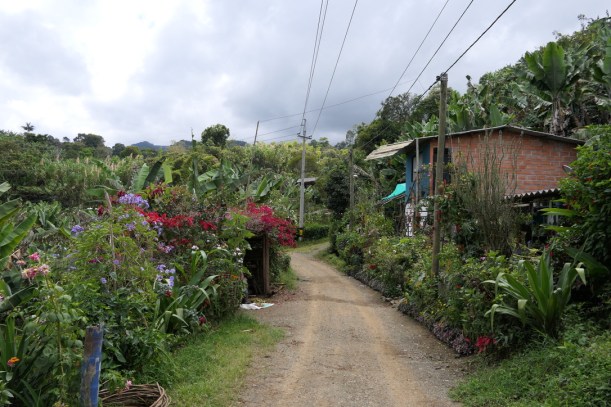
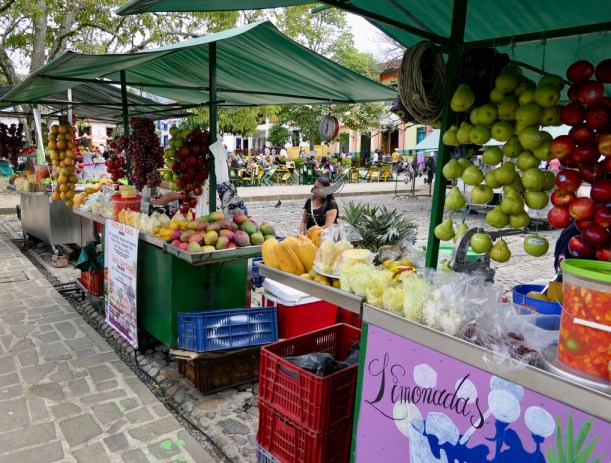
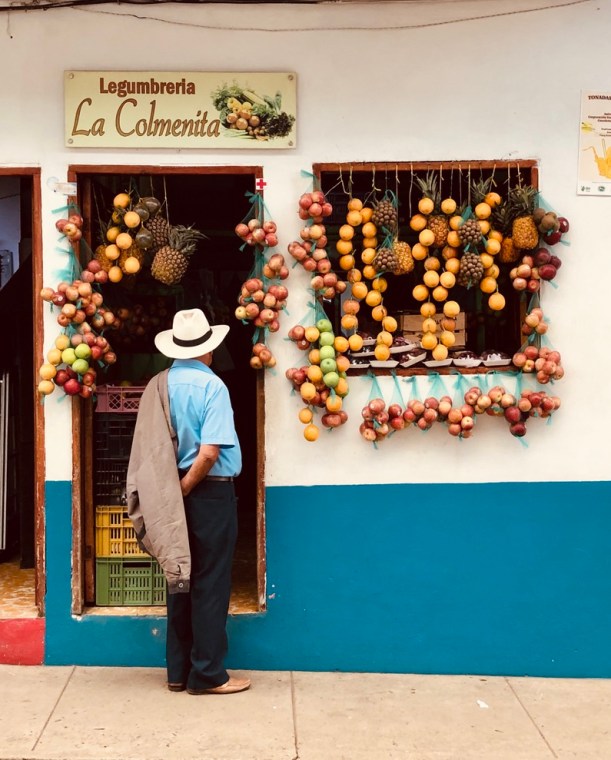
Our first full day we were keen to get in some walking and explore the countryside surrounding town. With Google Maps we were able to find our way to the starting point of the Reccorido Herrera, a walking trail along a cobbled path that took us south out of town past flowering shrubs and well-kept cottages to eventually join a dirt road that followed a river. Just past a pretty little waterfall, Cascada de Amor, we crossed the river and began to climb. The thick growth along the riverbanks eventually gave way to expansive views of the valley that held Jardin. Coffee shrubs and banana trees covered the ground, occasionally broken up by an orange or guava tree, their limbs dripping with fruit, the air scented with their perfume. When we passed a house, it would be nearly covered in potted plants, the yard a profusion of colors from the different blooms. At one, an elderly couple sat together in chairs along the roadside shucking beans together. Without exception, each resident greeted us with an “Hola!” or “Buenas dias!”. We marveled at the friendliness of the paisas, which, even back in Medellin, we had been told were the friendliest of all the Colombian people. As we passed one open field, we stopped to look for the birds we could hear, but not yet see, calling out. As we scanned the trees another walker strode up to us, camera and binoculars both hanging around his neck. An avid birder from Indiana, he enlightened us to the species we were hearing and finally caught glimpses of. “1,900 species of birds in Colombia, more than any other country on Earth!” he chirped (pun intended). Eventually we continued on our separate ways, our path winding downward and back into town. Returning to the plaza we sought out one of the fruit vendor stalls and gorged ourselves on slices of juicy-sweet papaya and mango. Other days we would sample the pineapple or indulge in a glass of fresh-squeezed orange juice. A perfect way to refresh after a sweaty hike.
55A452B0-2AFC-4961-8282-0898C5CE8264_1_105_c

First days hike outside Jardin – folks love their flowers here!

0D45DC73-E4CB-4254-AB5D-E25F4A0B2EBC_1_105_c

Views back to Jardin – coffee and banana plants in the foreground.

0F0D83B0-7B38-417F-B9DC-BA248AFF68DE_1_105_c

Flowers around the homes outside Jardin.

5B7A9BD5-1367-480D-9967-9809585CF27F_1_105_c

Fruit stalls on the plaza.

That evening we dined on roast chicken, steamed potatoes and arepas at a little local hole-in-the-wall, two of us unable to finish all the starchy sides (no way we weren’t finishing off that tasty chicken though) of our $4 meal. Then it was back to the plaza for beer and mojitos. A perfect day!

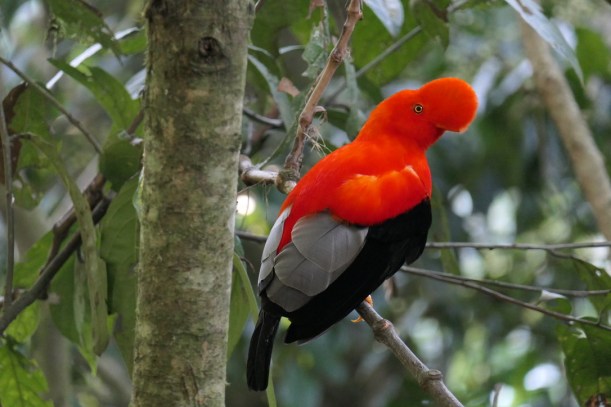
Our last day started with a morning hike up the opposite side of the valley to a lookout back over town. On the way we passed a trout farm (they offered the option to catch your own trout which they would then prepare for your lunch or dinner – too early for us though) and pastures holding cattle and horses before topping out at the abandoned upper terminal of an old cable car. After enjoying the views and fresh fruit juices from a lone cafe, we descended back to town. We strolled the streets to see more of the town’s colorful buildings before making a much-anticipated visit to a small private nature reserve on the edge of town. For some reason, a rare bird, gallitos de rocas, or cock-of-the-rock, returns to a grove of bamboo and other trees next to a woman’s home overlooking the river. At about 4:30 each afternoon she welcomes visitors (and asks for a small fee) to her property to view the birds as they screech and flutter about. Small sitting areas had been built where we, and five or so others, sat and watched as up to ten of the bright-red, fluffy-headed birds frolicked in the trees. A couple other attractive species also made appearances. It was a beautiful sight.

3C3F61DF-B139-4E5A-AB79-12E0E2FEE8DA_1_105_c

On our way out of town, past the trout farm (just below).

808D9AC8-7BA9-4FFE-BA10-6B00096897C0_1_105_c

Colorful Jardin.

2870A4BC-45CB-4FA7-B23A-AF21522F8156_1_105_c

El Balconcito, purveyor of cold beer and tasty mojitos. However, not the most comfortable chairs in the world.

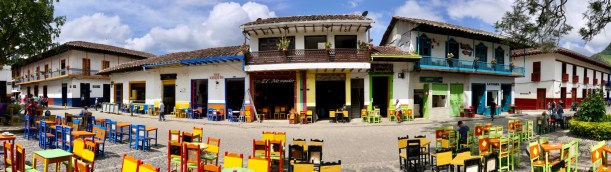
6E9914E5-BACC-45BD-A682-0266220CA9D2_1_105_c

Pano of one side of Jardin’s plaza.

CD10606A-3A57-4F19-ADBC-D97F5494DF62_1_105_c

Gallitos de Roca.


Leave a comment

Ten Days – Medellin, Guatape And Jardin Colombia

Spanish was coming at us from all sides. This was immediate and total immersion into the language. It had been five years since we had needed to speak (or attempt to speak) and understand it. But nothing had prepared us for being thrown into the middle of a crowd and trying to make heads or tails of the conversations surrounding us. Boy, we were in trouble! And we were still in the airport in Ft. Lauderdale, Florida . . .

Following the experience in our homeland, we had a smooth flight over the Caribbean Sea and across the northern stretches of the Andes into the valley that held Medellin, Colombia. We carried a bit of apprehension – we’re not city people and Medellin, Colombia’s second largest city after the capital, Bogota, has an unenviable past. It was, for a time in the 80’s and 90’s, the world’s most dangerous city and home to the notorious drug cartel leader, Pablo Escobar. But as we were to find out during our visit, Medellin is now one of the world’s most vibrant and innovative cities. Art and culture have given this city a level of excitement and energy unmatched by many others, and the paisas, the inhabitants of Antioquia province, of which Medellin is the capital, are justly proud of how they managed to bring themselves from the depths of drug violence to their present state.

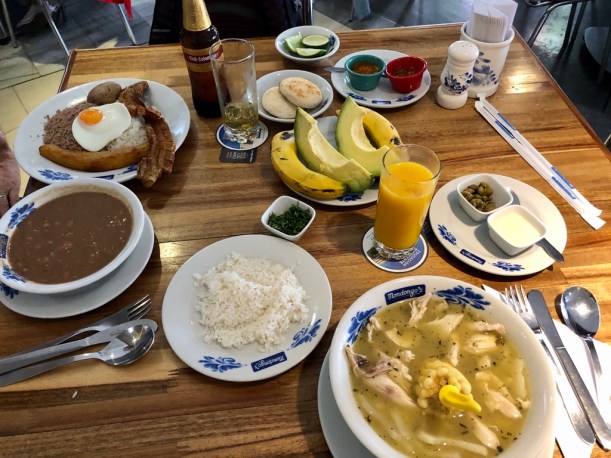
On our first night, following the recommendation of our hotel clerk, we wandered a few blocks away to Mondongo, a restaurant specializing in the provincial cuisine. As tourists, we were alone amongst the locals – families, business-types and young couples. I had heard of the local specialty called bandeja paisa and was keen to give it a try. This plate consisted of a mound of rice, ground beef, a fried plantain, a slice of double-thick deep-fried bacon all topped by a fried egg along with a soup bowl full of beans. Heather opted for the more sensible ajioca, another regional dish consisting of a large bowl of broth brimming with shredded chicken, sliced potatoes and half a corn cob. Equally impressive to us were the procession of condiments and side dishes that the waiter proceeded to lay out on our table: arepas (corn meal cakes), limes, chopped cilantro, a plate of two different salsas and another plate containing segments of what surely must have been the world’s largest avocado as well as a couple of bananas. While most everything made sense in the context of the dishes, we never could figure how we were supposed to incorporate the bananas into our meals (like some others we elected to take them home for breakfast). The food was delicious. Having not had much to eat through our travels from the US to here, we gorged ourselves and were thoroughly stuffed. The following day I did a bit more research on the local dishes only to find that bandeja paisa is typically shared by two or more people. Could explain my slow start to our second day.

56F5C26F-9334-4EEB-9D7B-989ECB4CDC7C_1_105_c

The Colombian trucker’s plate, bandeja paisa, on the left; ajiaco and the buffet of condiments on the right.

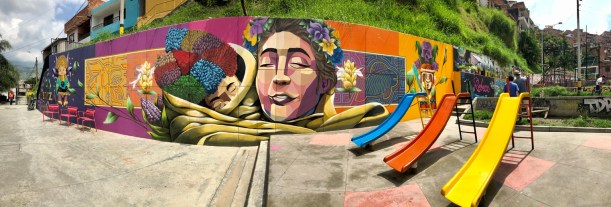
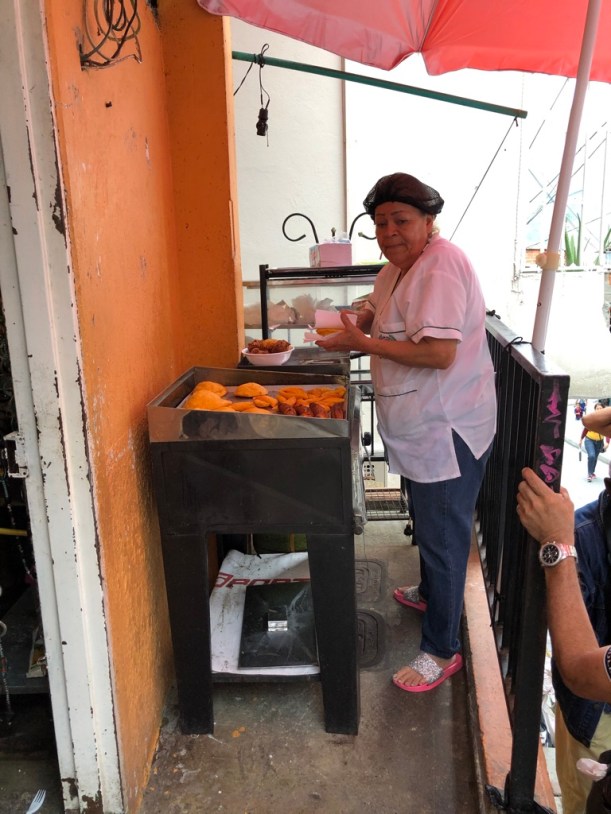
Our second and third days in Medellin took us to two extremes in the city – el centro, the heart of the city, and to Comuna 13, one of its poorest areas. El centro had the usual collection of government buildings, cathedrals and plazas. We were able to sample some street foods like empanadas (meat and potato-filled cornmeal pastries) and homemade frozen fruit pops. Also of interest was a wander through the ‘red light district’, centered around a small cathedral, where married men would absolve themselves of sin by offering a short prayer before taking up with the working girls just outside. Comuna 13, by comparison, is located on the edge of Medellin and climbs up the mountainside that borders the city. Once the most dangerous and violent of the barrios in Medellin, our guides insights to growing up during the turbulent times under the cartels left us speechless. But once the gangs were rooted out by the government, life here blossomed. The narrow alleyways of the comuna were covered in street art. People had painted their modest homes in bright colors. Vendors crowded the streets, offering ice cream, empanadas, fruit and drinks. Young men performed hip-hop moves, or sang or played guitars, hoping for a little change. It was as if life had been hibernating for two decades and now had burst forth and seen the light of day for the first time

F7E7AB55-4916-4FFA-9C11-186B8968CA37_1_105_c

Street art in Comuna 13. Seems like anything that would hold color was a canvas.

.

3C32AD85-25A2-464C-BA3D-2B6D78A29439_1_105_c

Still the best empanadas, in a country famous for them, that we ate. On the street in Comuna 13.

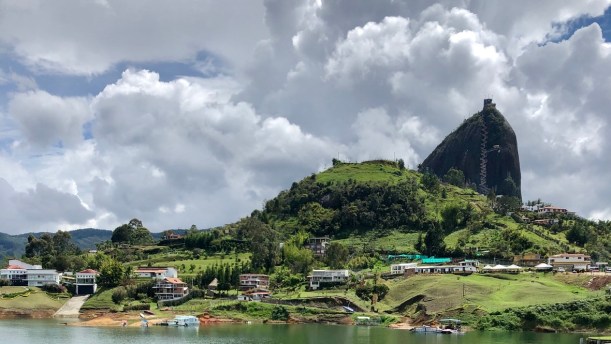
Leaving Medellin by bus, we traveled for two hours east across the mountains and into farm country (and not flat farm country). Pastures held cattle, hillsides were covered with fields of corn, strawberries and beans and small towns were filled with folks shopping. Still a half hour outside our destination of Guatape we caught our first glimpse of what brings hordes of tourists to the lake-side town – El Penol de la Piedra, simply known as ‘the rock’. Reaching a height of just over 7,000 feet in elevation, and accessed by 659 steps, ‘the rock’ towers over the lake-side and offers stunning views of the convoluted lake shore and the surrounding hills. While most folks visit Guatape as a day trip from Medellin, we opted for a two-night stay to enjoy the small-town vibe, colorful buildings lining the cobblestone streets and the fresh air, which was much appreciated after our time in the city. Besides visiting the rock, we wandered the streets, sipped cold beers in a cafe overlooking the main plaza and dined on trucha, the local farm-raised trout, for which the area is justly famous for.

5BE8D76B-9F11-4F0A-B596-40C1564E09E0_1_105_c

‘The rock’ from the bus to Guatape. Yes, those are the stairs straight up the side.

4540417B-E5BF-4C0C-8A84-7B76C1F929A4_1_105_c

View from the top.

ED030721-C6E9-476F-8977-AF36B7A9C1E5_1_105_c

Colorful, clean, uncrowded Guatape. A wonderful respite from city life.

The title of this post indicated my intention to also cover our visit to Jardin, located about three hours, by bus, south of Medellin. But Jardin so impressed us, and we so enjoyed our stay that I thought it deserves it’s own post. So stay tuned . . .