The Rhum Line

The aimless and sometimes muddled route of a traveling couple looking for their next great adventure


1 Comment

Time To Head South

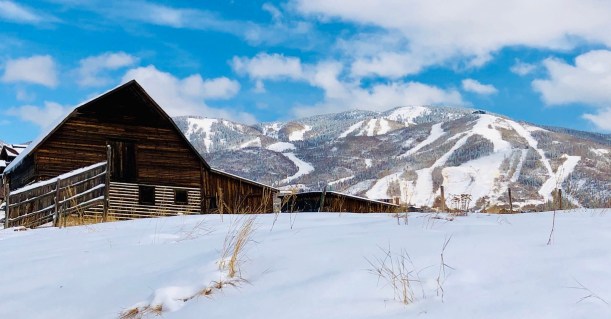
After a fantastic winter traveling through Asia and Australia, we’ve spent the last six months back in our home base of Steamboat Springs, Colorado. We returned home to spend a summer hiking wildflower-filled meadows, road-tripping through the Rockies, paddling high country lakes, catching up with friends and working a bit in order to restock the travel kitty. Mother Nature greeted our return by dropping a blanket of snow on us over the first official day of summer – our first snow day in nearly seven years. If we thought perhaps we had returned too early, we were certainly sure we had stayed too late this year. Before we were able to escape Colorado this week, over 50″ of snow had fallen on the local mountain and the ski area announced its earliest opening ever. Our remaining cold-weather gear was put to the test as freezing temperatures over the last couple weeks had us saying on more then one occasion – “we’ll never stay this late again”.


The plan is to visit Latin America this season – Colombia, Panama, Costa Rica and Belize. Some of these countries will be new destinations, some we’ll visit for the second time. We’ll dust off the basic Spanish that we haven’t used since our last trip to Mexico over five years ago. We’ll find some beaches, visit a rainforest or two, ride a couple busses into some remote corners of a banana republic and Heather will take a couple thousand pictures. We’ll probably drink a cold beer now and again. It’ll be fun.

7AE0FC77-BA87-499F-98A3-FE212DCD7E74_1_105_c

We’re going . . .

780C90AF-B384-4DF6-BF93-3426B851480A_1_105_c

from this . . .

12396C30-0312-4AD7-A1BC-FF77E1F6639E

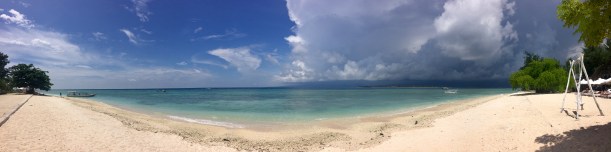
to this.


Leave a comment

An Australian Road Trip – Part One

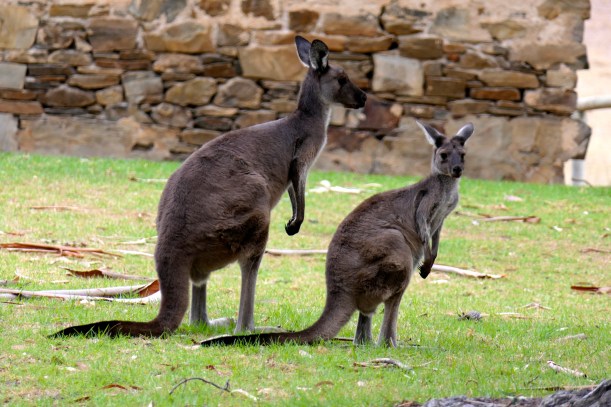
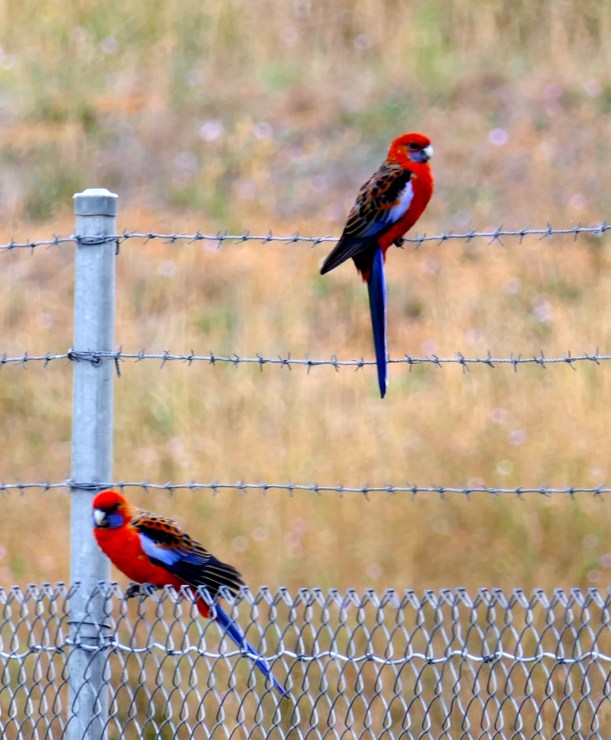
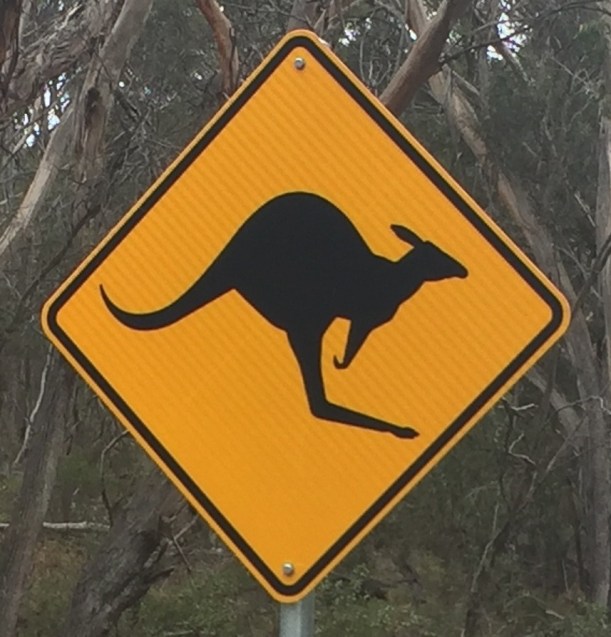
Following an overnight flight from Bali we arrived, tired, to Adelaide, the capital of South Australia. Our plan was to grab our rental car, pick up a few provisions and drive an hour south to the Fleurieu Peninsula, staging ourselves to catch a morning ferry out to Kangaroo Island the next day. We breezed through immigration and collected our car, and, heeding the written instructions on the dashboard, stayed on the left side of the road. Just outside the airport we pulled in to the deserted parking lot of a supermarket. We would have to wait a half hour for the store to open, so we relaxed and I tried to familiarize myself with the car as our eyes grew heavy. An hour later we awoke to a full parking lot. Rallying ourselves to the task at hand we moved through the store picking up some essentials – peanut butter and jam, bread, granola, yogurt, fruit, deli meat, cheese and coffee. We were set. Getting back on the highway we made good time through the light morning traffic. Passing through Adelaide’s southern ‘burbs the road narrowed and rolled through gentle hills with glimpses of the Southern Ocean off to our right. Once on the peninsula the land was a succession of cattle and sheep pastures, broken by stands of eucalyptus trees. We arrived in Second Valley by early afternoon and settled in to our motel room for a much deserved nap. Feeling refreshed we headed out in the car to explore the area, hoping to catch a glimpse of a real live kangaroo, or perhaps a koala. As the sun started to set, the nocturnal ‘roos came out in force. Groups grazed in the pastures, others hopped across the road in front of us, and all the while, coming as a complete surprise to us, parrots and cockatoos screeched in the trees overhead. Flocks of white cockatoos with pink breasts fed on the ground, while the multi-colored parrots streaked from tree to tree. A perfect first day.

P1140280

G’day mate!

P1140274

A couple parrots stay still for a moment.

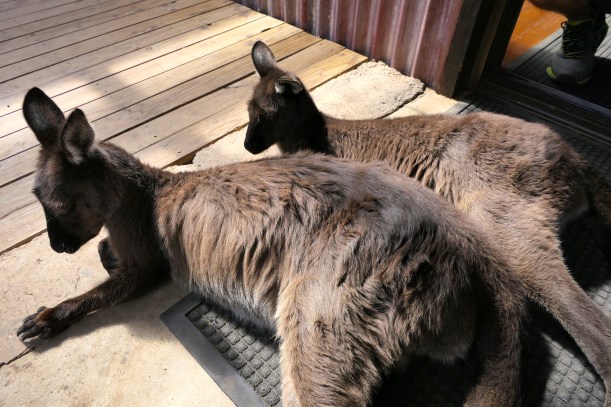
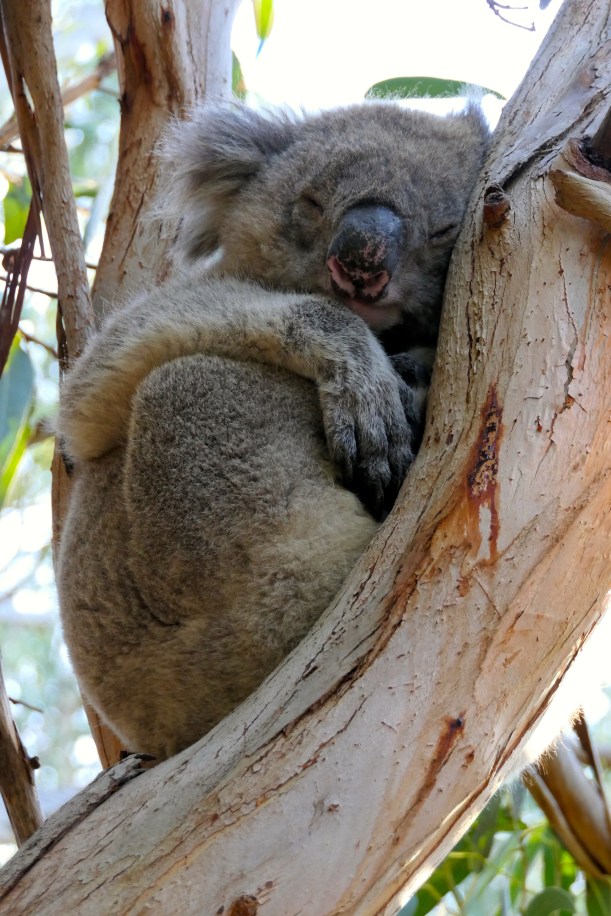
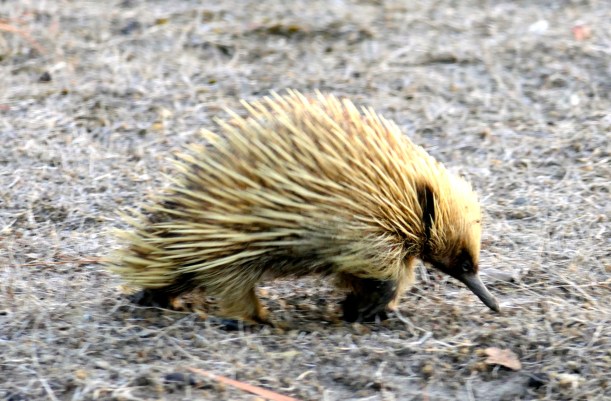
The ferry took us across the Backstairs Passage on a forty-five minute trip from Cape Jarvis to Kangaroo Island, where we hoped to see more of the namesake marsupials, as well as koalas, echidnas and wallabies. On the south shore of the island there were beaches that harbored fur seals and sea lions. Heather’s shutter finger was itching to go. We traveled westward along one of the three paved roads, taking us once again through rolling countryside until we hit the flat center of the island. Seeing a sign for a honey farm, we couldn’t resist taking a detour, and turned off onto a red-dirt side road. The honey farm was set in the middle of nowhere, and while we hadn’t seen any traffic on the road, there were several cars in the parking lot. The shop contained all sorts of honey-based goods and we took a sample of their blue gum (eucalyptus) honey, some chocolate-covered honeycomb and a dish of honey ice cream. Suitably amped up on sugar, we headed off to our next destination, but were distracted by yet another road sign for a eucalyptus distillery. With the possibility of sampling eucalyptus gin or something of the sort we turned, once again, off the main road. Alas, there would be no gin or whiskey sampling there, as they produced only eucalyptus oils and related products. However, the shop did have three resident orphaned kangaroos! So not only close-up photos of adorable animals, but the chance to pet them as well. Finally, we arrived at Seal Beach and were happy to take a short stroll to an overlook to catch a glimpse of several fur seals lazing on the beach, resting up after their exhausting time spent out at sea hunting for food. By the afternoon it was time to check in to our accommodation for the night. So far we had not seen any ‘roos or koalas. But as luck would have it, the caravan park (campground to us Yanks) bordered a eucalyptus grove, as well as a couple small ponds, which hosted an array of birdlife. “You’re guaranteed to see koalas!” the host told us. After dropping our bags in our cabin, and scaring off a wallaby lazing outside our door, we headed over to the grove. True to their word, koalas were foraging in the eucalyptus trees, feeding on the leaves (their only food source). A couple were still snoozing in the lower branches of one tree, in no rush to start their evening feed. By the ponds we viewed all kinds of birds, including the surprisingly numerous parrots, storks and egrets. Best of all, we spotted an echidna, one of the country’s most elusive animals, poking his long snout into the ground for a meal. Awesome wildlife spotting right out our door.

P1140307

Afternoon nap at the honey farm.

P1140321

Taking a breather on Seal Beach.

P1140371

Zzzzzzzz . . .

P1140418

What the . . . it’s an echidna.

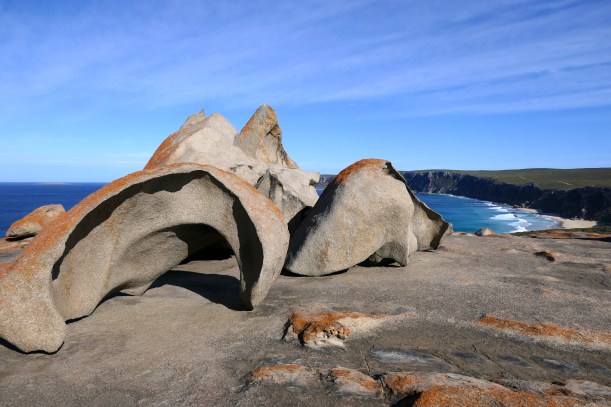
Day Three took us to the remote western side of Kangaroo Island to view amazing rock formations, such as Remarkable Rocks and Admirals Arch, along with lighthouses and rugged cliffs bearing the brunt of the Southern Ocean. By late afternoon we had circled back to the eastern end of the island for a stay just outside of Kingscote, the largest settlement. After a long driving day we treated ourselves to a traditional fish and chips dinner at the local ‘chippy’. Bringing our meal back to our cabin, we sipped wine and watched the sunset as the kangaroos started to come out for their nightly feed.

P1140481

The wildlife is cool but the scenery is remarkable – Remarkable Rocks.

IMG_0605

Rugged coastline at Robe.

Our forth day took us back across the passage to the mainland and then a loooong drive south to the beach town of Robe (Australia’s favorite beach town, according to the marketing folks). Once again, our accommodation would be a small cabin in a caravan park, which, being a Saturday and the start of the Easter school holiday, was very crowded. But the park’s location right on the beach, and within walking distance of a grocer and purveyor of adult beverages, made us forget the crowds as we ended up having the beach to ourselves at sunset. The following day we would be leaving the coast to head inland – destination Coonawarra – wine country!


Leave a comment

Bye, Bye Bali

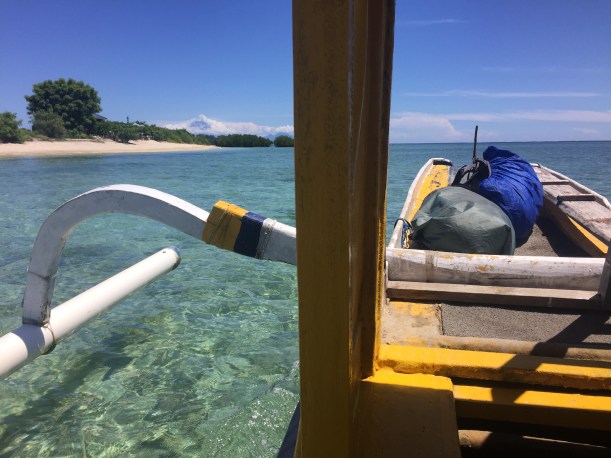
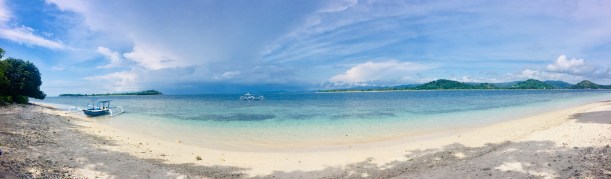
As the calendar flipped over to April, it became time for us to plan our departure from south east Asia and head back to the US. We thought it’d be a good idea to have one last snorkeling excursion before we left Indonesia, so Heather found a small island off the southern coast of Lombok boasting a fantastic reef and white sand beaches called Gili Layar. We booked three nights at the lone bungalows on the island, not wanting to commit too much time in case it didn’t live up to it’s billing. We left Bali on a small ferry to cross the Lombok Strait and disembarked at Gili Gede, the gateway to this small group of islands, then hopped aboard a smaller boat to complete the trip to little Gili Layar. At first glance it seemed to offer everything we wanted – simple bungalows; a nice beach with palm trees, loungers and hammocks; clear water and a restaurant offering cheap food and cold beer. Paradise! We dropped our bags in our bungalow, grabbed our mask and snorkel and hit the water. The reef was . . . underwhelming. Large areas of rubble, very few fish, no soft corals and quite a bit of trash floating in the water. We returned to the beach and made ourselves comfortable on a couple of lounge chairs in the shade of some palms. While the snorkeling wasn’t going to live up to it’s hype, we could still easily spend three days relaxing here, sharing this beach with just four other guests.

IMG_0416

Our bags on their way to Gili Layar.

IMG_E0423

While the views underwater weren’t that great, on the surface they were spectacular.

By the end of the day we had a new plan – we would take a ferry north to Gili Meno, another Lombok island that we’d visited just last year and thoroughly enjoyed. We knew the condition of the reef to be good, the accommodation decent and a wide variety of food on offer. For three more days, it didn’t disappoint. I spent mornings walking the circumference of the island, examining the damage from the earthquake that struck northern Lombok last September. Several guesthouses and businesses were severely damaged and had not reopened. Our days were spent in the water hunting for turtles and moray eels or lounging in the shade on the beach. A perfect way to end our time in Indonesia!

IMG_0462

Heather gets in to the swing of Gili Meno.

But wait! We just weren’t ready to fly straight back to the US. Where could we go for a week or so with decent weather so we could prolong returning to the cold and snow of Colorado. For a couple weeks we racked our brain -perhaps a South Pacific island like Fiji, which we visited last year on our way home from New Zealand; maybe a Japanese island such as Okinawa; or even American Samoa or Hawaii. Eventually we had to rule out each of our ideas due to lack of, or the extremely high cost of, accommodation and airfare. Maybe we should just fly directly back to Colorado, where Steamboat Springs had just recorded over four hundred inches of snow for the season, and our tenant had sent a photo of the huge snow piles ringing our parking area. Uh . . . I don’t think so. The decision was hastily made –  we’re off to Australia!

IMG_0572

Next stop!


Leave a comment

A New Happy Place

You know that feeling you get when you arrive somewhere and it just feels ‘right’? Despite a stressful day of travel, maybe you’re a little hungry, been in the car too long, yet you can feel all that slough off when you get into your accommodation, soak in the view, feed off the great vibe of the staff, and, even before you crack that first beer, the first thought you have is ‘we should have stayed here longer’. That’s the feeling I had arriving at my new favorite place in Bali (for the second time).

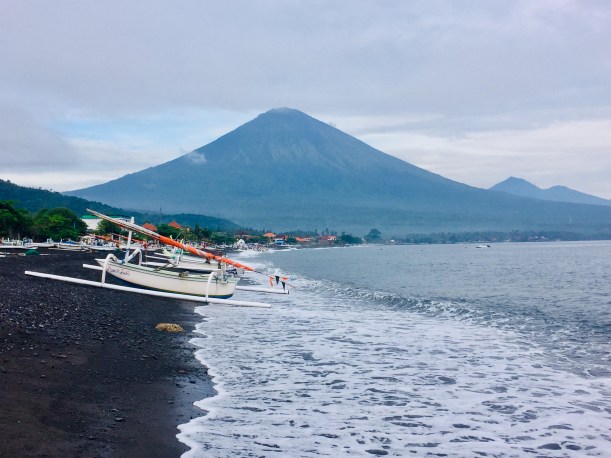
Heather and I were finally undertaking the Bali road trip we had been considering since back in January. Yes, we took a mini-trip with our friend Rene back then. But we only traveled from Ubud, in the island’s center, to Sidemen (‘Ubud twenty years ago!’ someone had said), Candidasa and Sanur over four days. It was nice. But we didn’t have time for some other spots we had hoped to see. So, this time we allotted seven days and planned on a big counter-clockwise loop around the northern part of Bali. We picked up our car in Sanur and headed north along the coast. The beach town of Amed was our first destination. Located on Bali’s northeast corner, Amed is known for diving, black sand beaches and jaw-dropping views of Mt. Agung, the island’s highest peak and an active volcano. An American friend had recently visited and exclaimed Amed to be “Hawaii twenty years ago!” (Can we stop doing that?). Despite the absence of surfers, girls in hula skirts, huli-huli chicken and a plethora of time-share condos I could kind of see his point. It had a chill vibe. The colorful fishing boats lining the black sand beaches were pretty. The views of Mt. Agung, at least in the morning, were spectacular. Heather had booked two nights in an amazing room – beachfront, huge and spacious, a massive terrace with a daybed and a breakfast buffet (included in the $25 rate) that ranks as one of the best I’ve ever seen. I had just picked up a new crime novel, we had stocked up on snacks and beverages to fill the in-room fridge and we had just enough trip planning left to do to keep us busy for a couple days. After fifteen minutes of lounging on the day bed, listening to the surf crash on the beach and feeling the perfect tropical breeze we walked back to the reception desk and booked two more nights. But Amed was not to be my new happy place. Don’t get me wrong. We loved our time there. We read. We snacked. We planned. We napped. But the best was yet to come.

IMG_0346

Fishing boats on the beach at Amed. Mt. Agung provides the backdrop.

Tearing ourselves away from Amed we took the car along the north coast for the two hour drive to sleepy little Lovina. We had come up here on our original visit back in 1998. Sleepy was being kind. Had Rip Van Winkle been here he probably would have slept for forty years! Obviously nothing stays the same over two decades. We didn’t expect the Lovina we remembered. It was, like many towns in SE Asia, hanging by a thread. High season (July to September – the dry season) brings hordes of visitors. Guesthouses sprout like mushrooms after a rain storm. Shops open, peddling the same tank-tops, sarongs and knick-knacks that everyone else is selling. Warungs (family-run restaurants) crowd into every spare space, banking on the success of their neighbors. But the rest of the year they’re empty. Struggling to stay afloat. Empty shops attest to the danger of overbuilding and fierce competition. The waters become fouled with trash and other plastic pollution. Snorkeling sites degrade. The fish disappear. The tourists find the next big thing and start to move on. Lovina wasn’t our happy place.

            NOTE: Lovina was so uninspiring, Heather didn’t take a single photo!

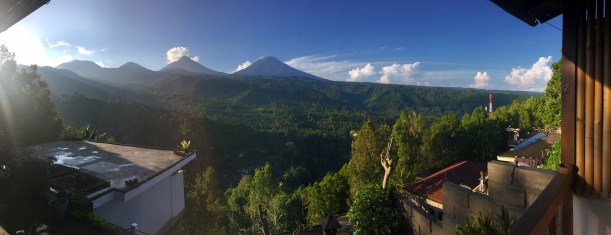
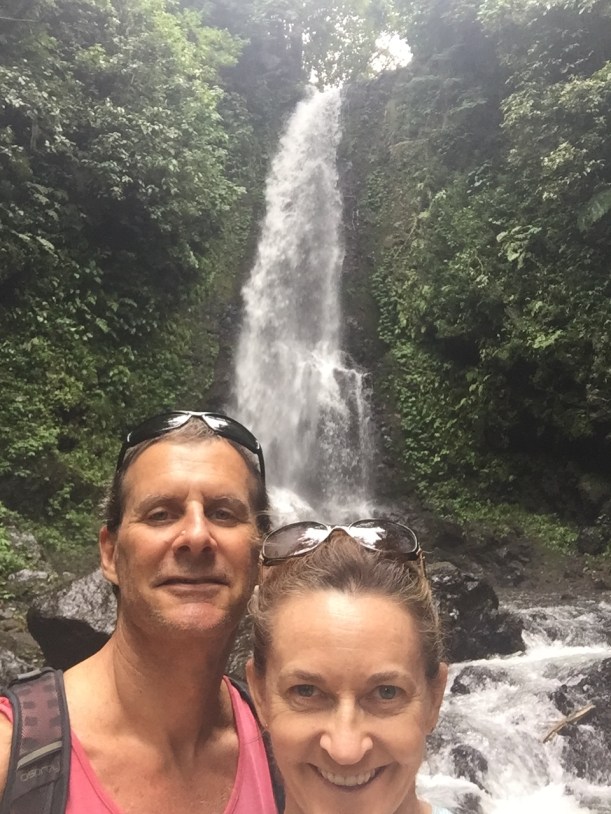
The next day we put ourselves at the mercy of Google maps and took the most direct route to Munduk, located high in the mountains of central Bali. The route is only ‘direct’ if you’ve pulled the map back far enough to encompass the whole island. As we found, leaving the northern highway and turning inland, the road twisted, turned and was either climbing or dropping (sometimes precipitously) for the hour trip. But it afforded a great view of rural Bali – rainforest, rice terraces, small farming villages and the misty peaks that cradled a series of three lakes surrounding Munduk. Our first impressions when we checked in to our room reminded us of being on the edge of the Kathmandu Valley – lush green valleys holding small villages, rice and rainforest. The peaks were still green instead of being snow-covered, but were majestic even so. We dined at an ‘eco-cafe’ and had a wonderful meal. The cafe supports local farmers and only serves cage-free Luwak coffee. What the heck is that? Turns out one of the fads coffee-crazed people are clamoring for is a cup of java made from coffee beans that have first been eaten by a civet cat (a relative of the mongoose), then pooped out, collected and roasted. Who the hell was the first person to try Luwak coffee? Anyway, we felt good about ourselves by eating locally-sourced food and opting for tea rather than coffee with our meal. The next day dawned bright and sunny and we were excited to see Munduk’s other attraction – waterfalls. The valley has several gorgeous waterfalls but a nice easy hiking trail links three of the most popular. We dropped down from the main road into the rainforest and after a ten minute hike came upon Red Coral Waterfall. Given that Bali had been receiving ample amounts of rain over the past couple weeks the falls were full and glorious. The water cascaded over a ledge to drop fifty or so feet into a small pool. Lush foliage lined the cliff walls on either side. It was beautiful (almost reminded us of Hawaii . . .  twenty years ago). We continued another few minutes down the trail to the next set of falls and they also didn’t disappoint. As the day was starting to heat up and we were already bathed in sweat, we opted to turn around and return to the car to start the drive to Sidemen, which lay three hours away.

IMG_0360

View from our Munduk guesthouse.

IMG_0375

Waterfall selfie!

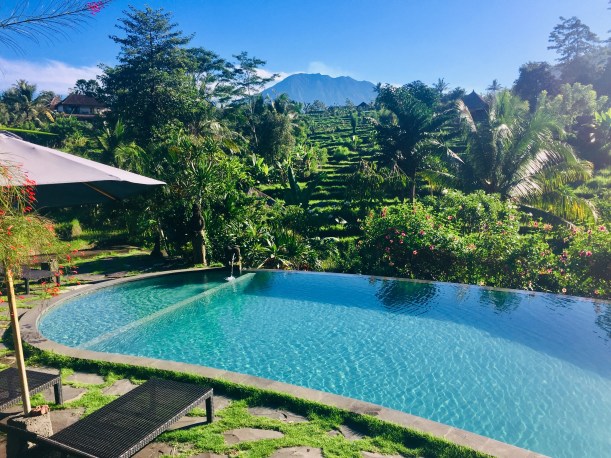
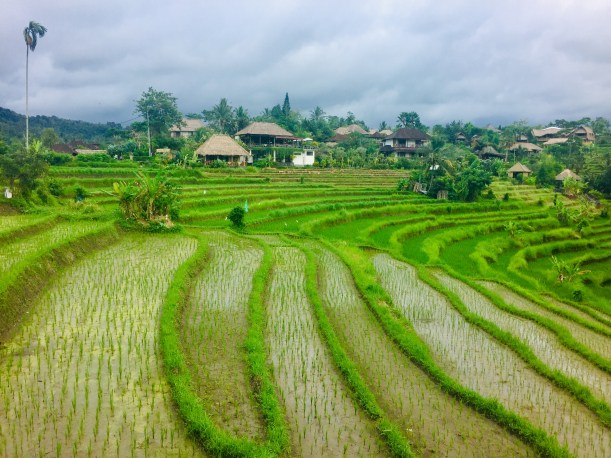
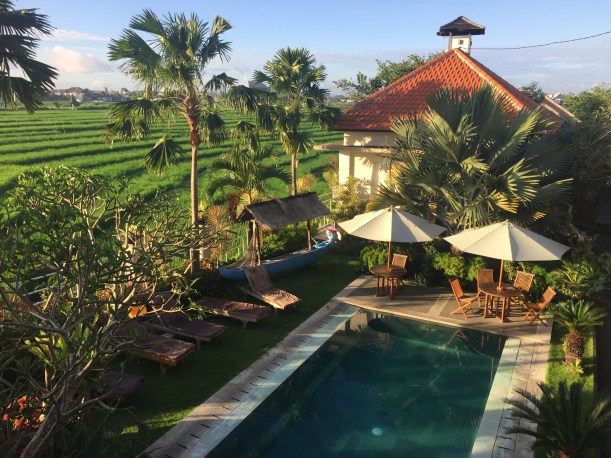
After crawling through traffic surrounding Ubud we arrived in the Sidemen valley. Having already spent two nights here earlier this year, we chose a guesthouse which was a little more remote then our first place, which suffered from quite a bit of road noise, being located right along the main road. As soon as we arrived at our guesthouse, slurped down the welcome drink of fresh fruit juices and caught sight of the surrounding rice terraces, glimmering pool steps from our door and the beautiful room featuring colorful tiles, local artwork and rustic wooden furniture, we were hooked. The shoulders, hunched from the stress of driving through the horrendous Ubud traffic, relaxed. A dip in the pool washed away the sweat from our earlier hike. There was no road noise. No buzzing motorbikes. Only green. Birds. The sound of a babbling brook running below the property. Views back to Mt. Agung. We immediately thought ‘we should have stayed longer’. We had found our happy place.

IMG_0403

Another view of Mt. Agung from our terrace in Sidemen.

IMG_0390

Sidemen – ‘Ubud twenty years ago’.


Leave a comment

A Tale Of Two Cities – Singapore and Georgetown

We’re not really city people. Small towns, mountains, beaches – that’s more our thing. But we have fallen in love with Singapore. Clean streets (the importation of chewing gum is forbidden!). Wide sidewalks. Green spaces. Colonial architecture competing with ultra-modern skyscrapers. A real melting pot of cultures and cuisines. And eating. That’s also our thing. Incredible street food served in clean and orderly “hawker centers” (the one in Little India maybe not so much). It’s really the food that brought us back this year. Last year we visited the touristy things – Riverwalk, Gardens By The Bay, Clark’s Quay, Fort Canning Park. This year we only had three locations on our list and they were all street food centers. Starting in the 70’s, the Singaporean government started moving the street food stalls off the street and into hawker centers, where they could be better regulated for hygiene and not block car and pedestrian traffic and take up valuable parking space.

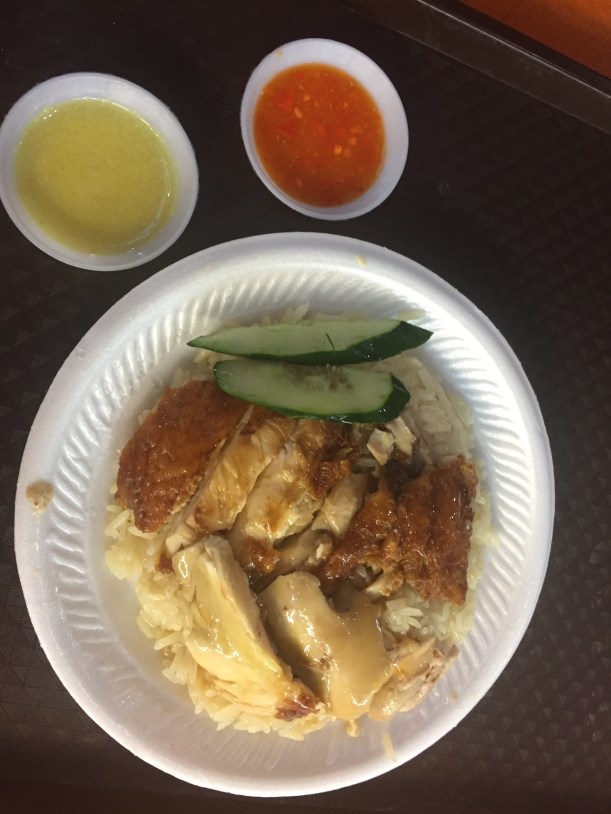
Our first stop was the Maxwell Food Center in Chinatown. There were a ton of Chinese inspired dishes on offer here, but none so famous as Hainanese Chicken Rice. This is a fairly simple dish, as it’s name implies – sliced poached chicken served over steamed rice. But the beauty of the dish, and it’s attraction, is the flavorful broth that’s ladled over the top. Even Heather, who isn’t a ‘gravy’ fan, raved about the incredible flavor of the broth. Anthony Bourdain visited the Maxwell Food Center for his show and highlighted one of the stalls for their chicken rice dish. It’s easy to find – look for the big cardboard cutout of Bourdain and the long line. But several stalls offer the dish and it would be hard to believe that any one would be any less tasty. We also tried a dish of sliced pork over noodles and steamed dumplings filled with chicken. Fresh fruit juices and a cold beer afterwards made for a perfect, and inexpensive, evening.

IMG_0177

Classic chicken and rice with ginger and chili sauces.

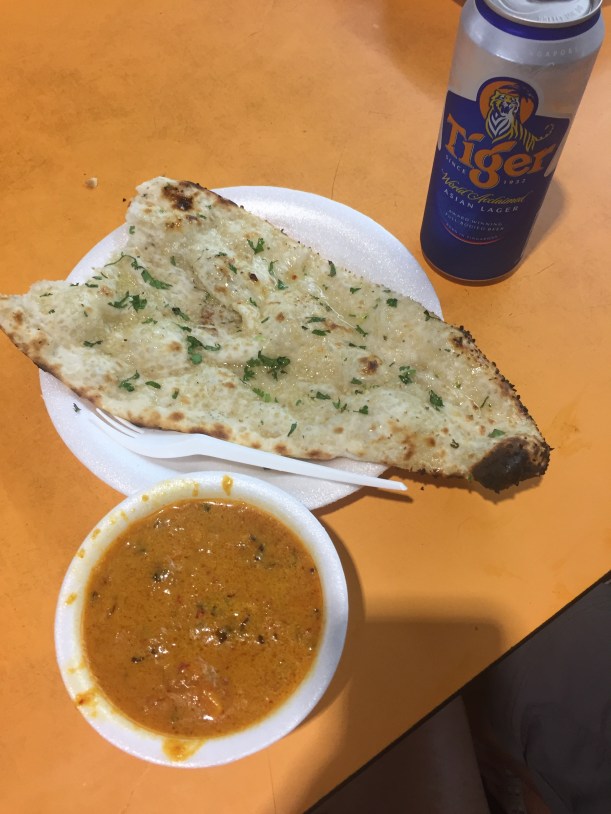
Our second day took us up to Little India, and the Tekka Center food court. It was nearly impossible, seeing all the Indians and Bangladeshi people, the smell of curry in the air, and the chaos of the place, not to think we’d been transported to Delhi or Mumbai. First up was a serving of dosa – a fermented chick pea flour pancake accompanied by several flavorful condiments. Next we shared a meal of mutter paneer, cheese cubes in a curried sauce with peas, served with naan fresh from the tandoor oven.

IMG_0195

Curry and naan in Little India.

IMG_0196

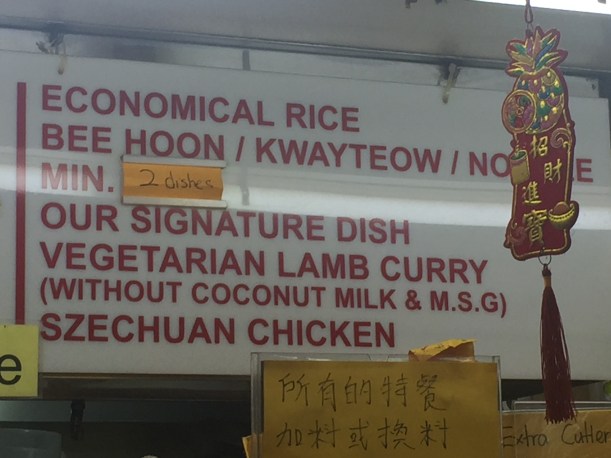
Vegetarian Lamb Curry???

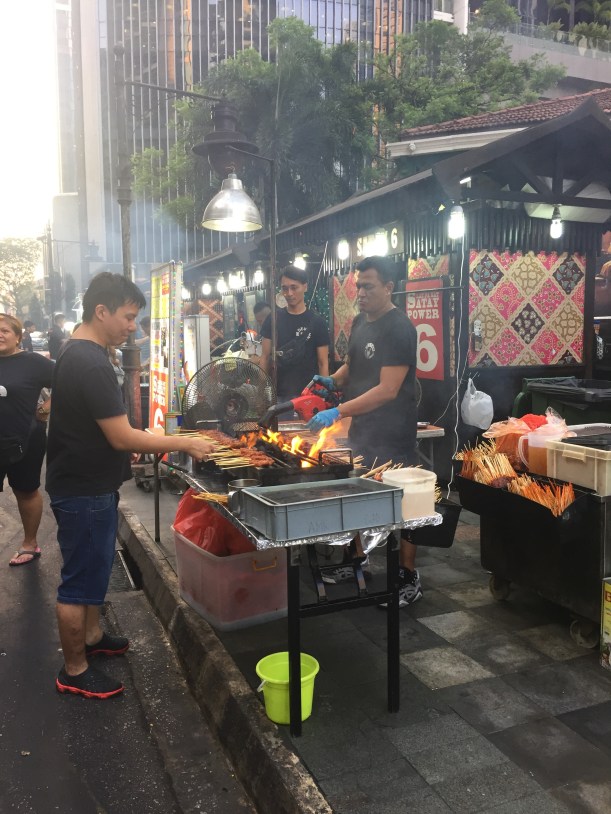
Later on day two we walked to Lau Pa Sat, smack dab in the center of the financial district. We started with fresh juices and a vegetable noodle soup with wontons before moving outside to check out the numerous satay stalls which this food center is justly famous for. Sitting down at a table to enjoy a plate of chicken skewers cooked over a charcoal fire and served with peanut sauce and a cucumber salad, we watched as the vendors transformed a four lane roadway, which only minutes before had been filled with rush-hour traffic, into another eating area, setting up long tables and folding chairs to accommodate hundreds of additional diners. After filling up on satay, we strolled back to our hotel through Chinatown, happy with another visit to Singapore.

IMG_0205

Satay stalls outside Lau Pa Sat food center.


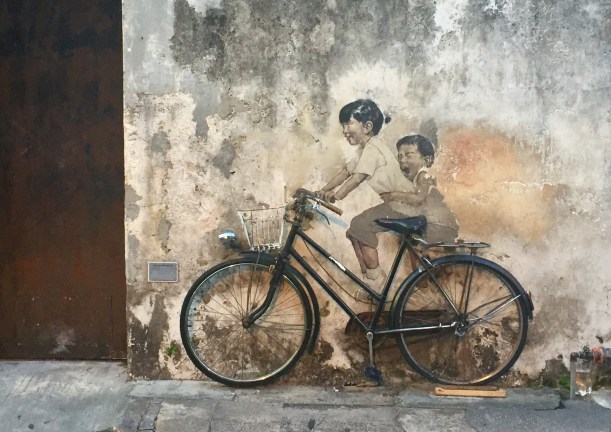
Next stop – Georgetown, Malaysia. Touted as the best street food city in all of south east Asia. Like Singapore, a melting pot of Malay, Chinese and Indian culture. Mosques, churches and Hindu temples all compete for space along it’s crowded and compact downtown streets. It’s certainly grittier than Singapore (heck – ANY city is grittier compared to Singapore). Along with street food, street art is an attraction here. Wandering along the streets and alleys, we stumble upon mixed-media murals – real swings, bikes and motorcycles incorporated into paintings of kids playing, riding or folks lined up for street food. Just blocks from our hotel, on Jalan Chulia, carts materialize starting at 6 pm. Woks are fired up and dishes of wan tan see – steaming noodles, topped with roast pork, steamed greens, wontons and a flavorful soya-based sauce are offered. Heather opted for the vegetarian char kway teow – flat noodles with egg, bean sprouts and spices similar to pad thai. Again, we ordered fresh fruit juices – papaya and guava this time. All for less then $4. Most days we walked the streets in the morning before the thermometer hit the mid-90’s. Then we would retreat to the air-conditioned comfort of our hotel during the middle of the day. As the sun dipped and the temperature retreated into the 80’s, we’d venture back out to find a comfortable cafe in an old renovated Chinese shop house for some happy hour beers and wine. When we tired of street food (how was that even possible?) we’d opt for a sit down meal. One night we strolled down the block from the hotel and found a sports bar/nightclub/Indian restaurant, where we sipped ice-cold Tiger beers and pomegranate mojitos before stuffing ourselves on delicious Indian dishes while watching retro music videos under a spinning disco ball. The final night we entered the Red Garden Food Center, just steps away from our hotel. Perusing the stalls set up around the perimeter of the indoor hall, we chose roast duck with rice and a chicken shawarma platter. Taking a seat at one of the dozens of tables filling the center of the cavernous space, a waiter quickly appeared for a drink order – fresh squeezed orange juice and Tiger beer, thank you very much. My roast duck breast was tender, juicy and flavorful, with crisp skin ($1.75). Heather’s Middle Eastern-inspired shawarma platter had shaved chicken, pita bread, fries, a creamy garlic sauce and more salad then the two of us could eat ($3.75). I love a place where duck is cheaper than chicken!

IMG_E0251

Georgetown street art.


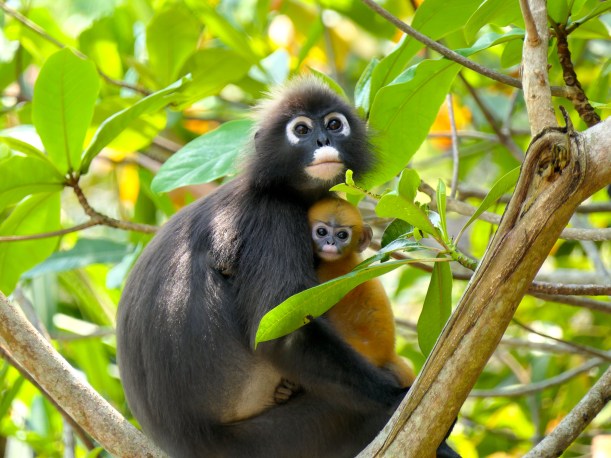
We did tear ourselves away from the delicious food in Georgetown one morning to visit Penang National Park (had to work off those extra calories). The park is home to the Dusky Leaf Monkey, a species we had never seen before. Chances of spotting them were slim, given the dry conditions and the high heat of the day. But we slogged through the three hour roundtrip hike that took us through rainforest to a secluded, and beautiful beach, and back to the park entrance station. Wouldn’t you know it –  returning to within a hundred yards of the entrance gate, we spied a troop of monkeys moving through the trees just above us. One female had a baby which is just about the cutest thing you’ve ever seen. 

P1140190

OMG! A yellow baby Dusky Leaf monkey.


Leave a comment

Nyepi – A Different Kind Of Holiday

After two incredible weeks in Raja Ampat it was time to return to Bali. After two weeks of fish and rice it was time to eat well in Bali. After two weeks with little or no internet it was time to get caught up in Bali. Heather and I had discussed and planned our first couple meals upon our return. We had a list of things to accomplish online – our tax return had to be completed and filed; travel plans for our upcoming trip to Singapore and Penang had to be researched and reservations made; a friend had written seeking travel advice for their upcoming trip to Bali; a blog post, or two, had to be written. After landing in Denpasar we arranged for a ride to our guesthouse in Canggu, dreading the rush hour traffic that would certainly slow our trip. But we made amazing time through the empty streets. Most of the shops had already closed for the day. It was weird. It was Nyepi.

The Balinese are the only folks who celebrate their new year in March. Anyway, Nyepi is a day for introspection. Families urge the evil spirits to leave their homes the night before Nyepi by banging pots and pans. Then they observe a day of silence, doing no work and using no electricity, hoping those same spirits won’t return in order to ensure the family has an entire year of good luck. And they really take this seriously! The airport shuts down for twenty-four hours. TV service is suspended. All movement outside the home is forbidden (guards patrol the streets to ensure no one ventures outside). Worst of all, for us at least, internet service is suspended. So we wouldn’t be checking any items off our to-do list this day. We wouldn’t get that meal we were craving. We would, however, read a hell of a lot. And play cards. And take naps. And pat ourselves on the back for getting out to the grocery store the night before and stocking the room with beer and wine. 

IMG_0151

Our guesthouse in Canggu during Nyepi. Not a bad place for solitary confinement.

Following the Day of Silence, we did get to our to-do list, and had a chance to explore Canggu, which is a hipster surf town. To get away from the motorcycle-riding man-buns and the emaciated-yoga-chick crowd we ventured up to Tanah Lot, a Hindu temple built on the rocky shoreline a few miles north. Even visiting before the Instagramming selfie-taking hordes who flock here at sunset, it was still really busy and, we felt, a bit overblown. So much so that Heather didn’t even take photos!

OLYMPUS DIGITAL CAMERA

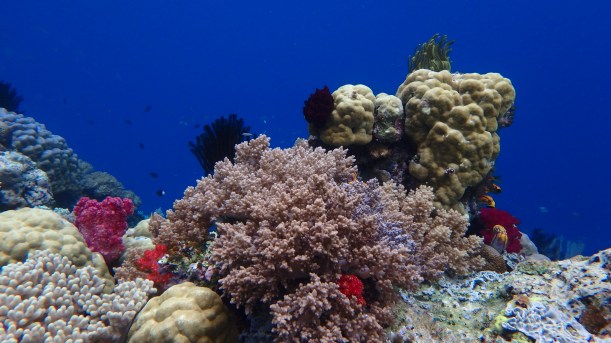
In lieu of a Tanah Lot photo, here’s an underwater scene from Raja Ampat.


Leave a comment

Raja Ampat – Part Two

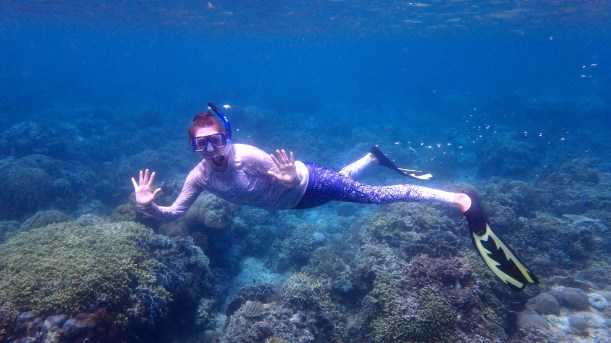
With five amazing days snorkeling in Raja Ampat already behind us, we were excited to start the second phase of our visit to this eastern Indonesian wonderland. We met our guide, Roli, on the pier in Sorong, just beside the local fish market. We chatted while we waited for the dinghy that would take us out to the Raja 4 Adventurer, an older wooden vessel that would be our home for the next ten days. As soon as we were aboard, and had greeted our fellow passengers, a group of seven Germans, we motored south from Sorong towards the large island of Misool, the centerpiece of the southern part of Raja Ampat. Crossing the Seram Sea, we didn’t see any land for hours. Eventually, in the late afternoon, the shadow of jagged islands on the horizon came into view. Just before nightfall we tied the boat to a mooring ball surrounded by small steep-sided islands covered in dense vegetation. We dined on fish (!), rice and veggies, then retired to our cabins, eager for an early start and a day in the water. Arising at sunrise, we ate fried eggs and toast, then boarded the dingy for the first of four snorkeling excursions that day. Motoring to one of the islands, we dropped in on a wall just a few feet offshore. The steep elevation above water continued down below. The wall was nearly vertical and the bottom was invisible. Immediately folks started picking their heads up out of the water to call out – ‘shark’, ‘turtle’, ‘ray’, ‘octopus’. They were all there, but for me the real stars of the show were the corals. Hard corals, soft corals, fans, whips, tube sponges in every color. I didn’t know where to look. Towards shore were the hard corals, at the top of the wall were schools of fish and soft corals, and in the deep were the larger fishes – jacks, tuna, trevalley, bump-head parrot fish and the occasional shark or turtle. Stunning stuff. And we’ve got nine days of this! Each ensuing snorkel was fantastic – more walls, a mount in the open sea teeming with big fish, shallow reefs leading to white sand beaches. Eventually, the big stuff became so commonplace we stopped boasting to each other about how many sharks or turtles we had seen (though the octopi still elicited much excitement). At the end of each day we dragged ourselves out of the water for the final time, took a quick fresh-water rinse and eagerly awaited dinner so we could eat and get to our bunks in order to rest up for the following day.

IMG_0137

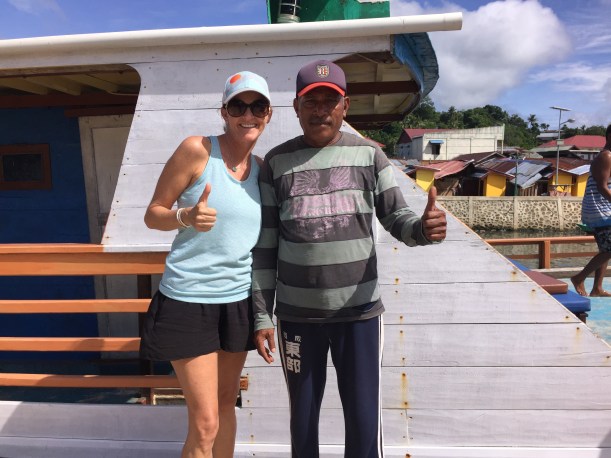
Heather and the captain, dockside, with the Raja 4 Adventurer.

IMG_9777

At anchor off one of many beautiful islands.

IMG_0020 2

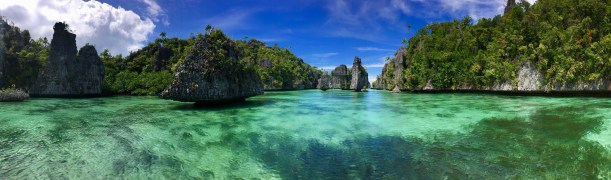
Another stunning bay. As beautiful above as below.

OLYMPUS DIGITAL CAMERA

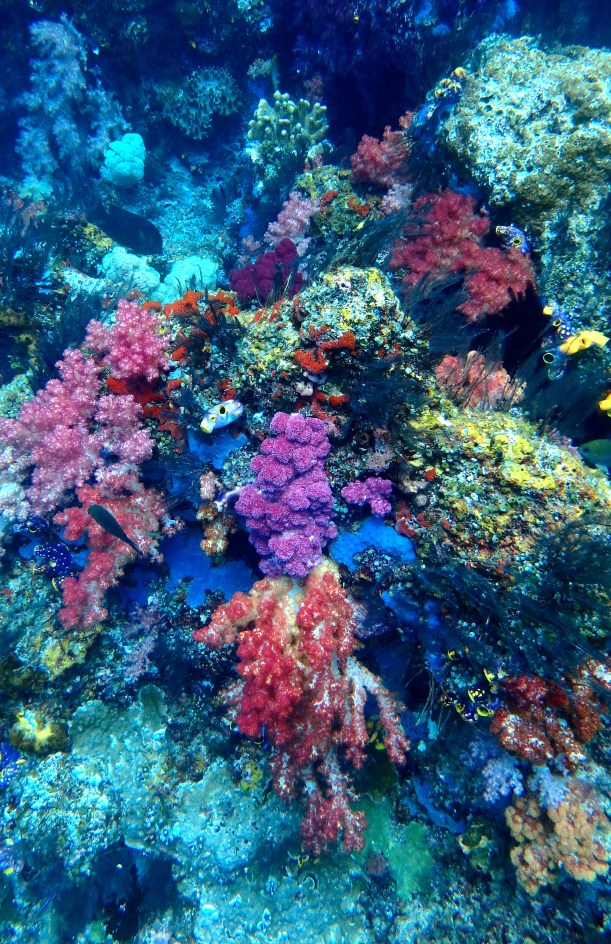
Some of the amazing color below.

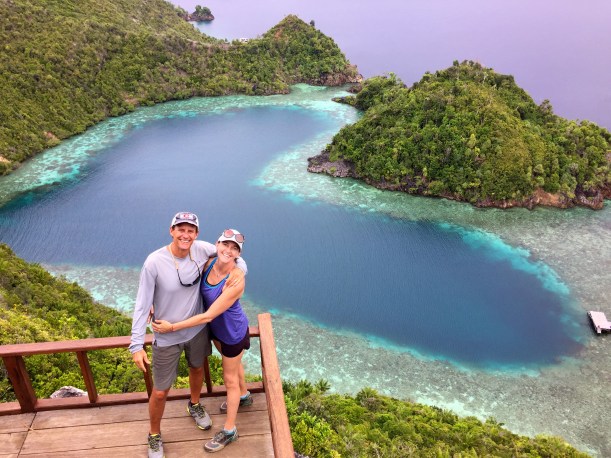
In between snorkeling excursions, we would occasionally take the dinghy to one of the islands that surrounded us for a short trek to a view point. We ‘oohed’ and ‘aahed’ at the incredible views, looking down on heart-shaped Love Lagoon, or the expanse of limestone pinnacles that filled the waters around us. Even from the tops of hills we could spot sharks, turtles and larger parrotfish swimming in the clear waters of the lagoons below.

IMG_9912

Why do they call this Love Lagoon?

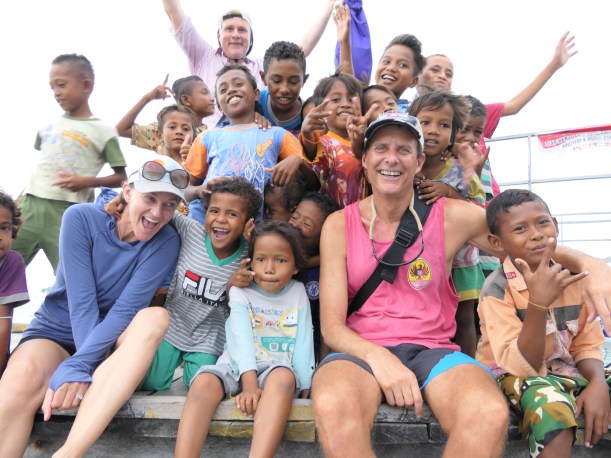
During the middle of our trip, we spent an afternoon visiting Yelen village, on a small island off the eastern point of Misool. As soon as our boat dropped anchor just off the town jetty, the kids playing there stopped and started to shout and wave. By the time our dinghy reached the jetty, more kids had come out to greet us. We felt like the pied piper, leading a horde of village children through the streets of the town, shrieking and posing for photos. There wasn’t much conversation, other then repeated shouts of “Hey!”, “Mister!” or “Hello!” from them. After we strolled through town and had seen the sights – the mosque, with it’s gang of male elders sitting outside; the soccer field, hosting a herd of grazing goats; a few shops selling essentials like cooking oil, chips, candy and laundry powder; and a few stalls offering vegetables, including eggplants, onions, chilies and sour melons, we returned to the jetty with our entourage. High-fives were exchanged with each of the boys and a final group photo was taken on the dock before we departed in the dinghy. Everyone waved, not stopping until we were back at our boat.

P1140040

It doesn’t get better then this.

With few exceptions our tour of the area was private. On two days we spied another live aboard anchored in the distance. At one snorkeling spot a dinghy was dropping divers into the water as we were getting picked up. Despite the dozens of boats that ply the waters of Raja Ampat, the fact we saw few others is a testament to the vast area here that has, so far, escaped mass tourism. The Coral Triangle, as this region is called, is a breeding ground for coral and fish species that can eventually make their way to far flung areas to repopulate other reefs that have been decimated by overfishing and other destructive environmental practices. It’s essential this breeding ground be protected and visited responsibly.

OLYMPUS DIGITAL CAMERA

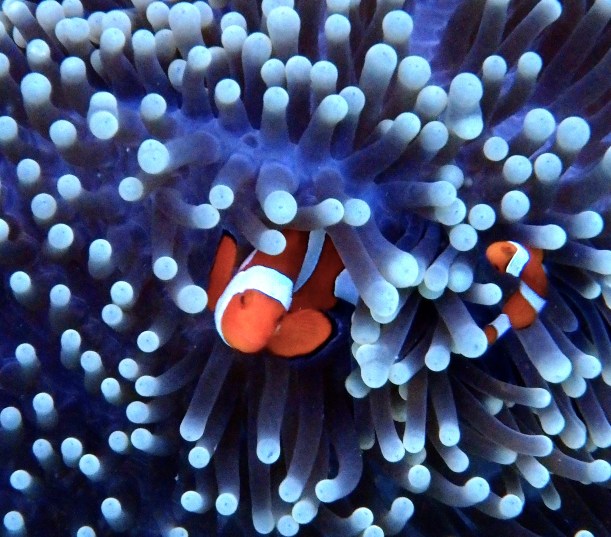
Who doesn’t love a clown (anenome fish)?


Leave a comment

Raja Ampat – Part One

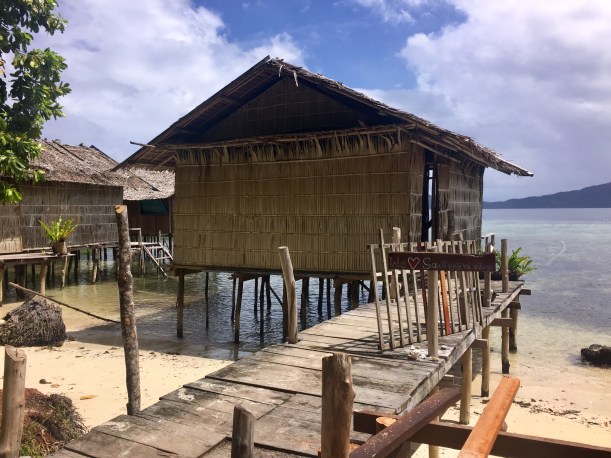
I sat on the weathered grey wood planks of our deck outside our over-water bungalow. The water lapped gently on the shore behind me. Birds trilled and whistled from the mangroves to my left. From my right, music drifted over the water, coming from the village of Sawinggrai. Heather was snorkeling out in front, getting reacquainted with the house reef. We had just arrived an hour ago at the Mandarin Homestay, on the island of Gam, in Raja Ampat. For a time, it seemed that we might never get here. This had been the centerpiece of our winter season travels. Back in the summer of 2018, we booked a ten-day live-aboard trip for snorkelers, as well as planning an additional two weeks visiting other areas of the province, including a return to Mandarin, our favorite homestay from a year ago. Due to my health issues back in Java, and the need to take it easy for a couple weeks until I got the ‘all clear’ from my follow-up doctor’s visit, we had to cut our Raja time down by a week. Getting to Sorong, the jumping off point for all things Raja, takes planning, patience and a bit of luck under the best of circumstances. The only flights to Sorong, at least from Bali, where we had been up until two days ago, go through Makassar, on Sulawesi, and don’t continue on to Sorong until 3 am, for reasons that aren’t too clear to me. Arriving in Makassar at 7 pm, we had eight hours to kill. Fortunately, there’s a decent, and cheap, hotel right in the terminal. We opted to splurge for a room for the layover, get a little sleep, wake up at midnight and return to the terminal. It went according to plan until we checked out at 12 and walked through the security checkpoint, only to find the flight was now leaving at 4 am. Okay, no big deal. We sat at the gate until 4:30 when they announced the new departure time would be 9:15 am. “Let’s go back to the hotel, see if we can get back into the room and get some more rest” Heather suggested. Unfortunately, the front desk told us the room had already been cleaned (at 4:30 in the morning!?) and wouldn’t let us back in. So, back to the terminal to sit for another five hours. Finally, at 9:30, the flight was cancelled. So we were going to miss another day in Raja Ampat. Luckily, we were rebooked on the next morning’s flight, got another room at the airport hotel, and went back to sleep. That night everything went according to plan – the flight left on time, we got a taxi from the airport to the harbor, got a ferry ticket to Waisai (the capital of Raja Ampat, on the island of Waigeo, where homestay transportation meets you), met Akes, the owner of Mandarin Homestay, and, after an hour boat ride, I was sitting on that deck. Thank God for perseverance. It sure feels good to finally return somewhere you’ve been dreaming about from the moment you left it last.
IMG_E9612

Our over-water bungalow at Mandarin Homestay. Home, sweet home!

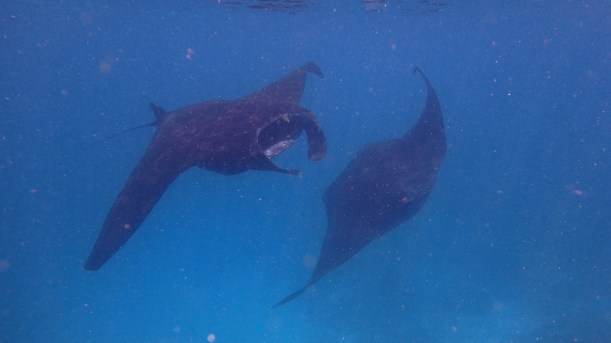
Life at Mandarin, and Raja Ampat in general, is slow-paced, to say the least, and totally focused on water activity. Waking at sunrise, I make my way to the hammocks in front of our bedroom, which occupies half of our wood-floored, bamboo-walled and thatch-roofed bungalow. The other half is a covered lounge area, with two hammocks, a drying line and a table. A few small boats pass through the channel separating Gam, where we are, and the island of Mansour, a couple miles distant. The birds make the only noise I can hear. After an hour, I stroll the path through the village, passing small groups of children, dressed in their red and white uniforms, heading to school. Most say ‘hello’, and I in turn greet them. Returning to the bungalow, Heather has stirred, so I go to the dining hut and prepare a mug of instant coffee to bring to her. After silently (she’s not much of a talker until that first coffee is downed) watching the morning unfold, it’s breakfast time. Akes’ mother has prepared pancakes for us, and a small army it seems, though we are the only guests in the five bungalows they operate. Along with the pancakes is a plate of bananas and oranges to round out our meal. Stuffed, we return to our hammocks and wait for the tide to come up so we can get out for our first snorkel of the day. This becomes the rhythm of our days. Wake, hammock time, eat, snorkel, hammock time, eat, snorkel, hammock . . . you get the picture. Other days we arrange with Akes to take us by boat to incredible snorkel sites around Gam. One day we visit Manta Point, where we snorkel with a half-dozen manta rays. The giant beasts glide effortlessly against the current, mouths agape, scooping up plankton and small jellyfish. At times we seem to be right in their path, but they always swoop away before getting too close. After a couple more times drifting with the current through a deep channel to view the mantas again, we travel further west to Arborek Island. There we snorkel around the village jetty, which is encrusted with colorful soft corals. The tube sponges in brilliant yellow, orange and purple are particularly impressive. Giant clams are also spotted here, some spanning over two feet in width. After another encounter with the mantas on the way home we happily fall into our hammocks to await Akes’ call for us to have lunch. After an afternoon snorkel on the house reef, we relax on the deck to watch sunset, devour dinner (like lunch, and all lunches and dinners, it consists of fish, a vegetable dish and steamed white rice), then retire to read for an hour before our eyes grow heavy and sleep overtakes us.
OLYMPUS DIGITAL CAMERA

A couple of the beasts from the deep.

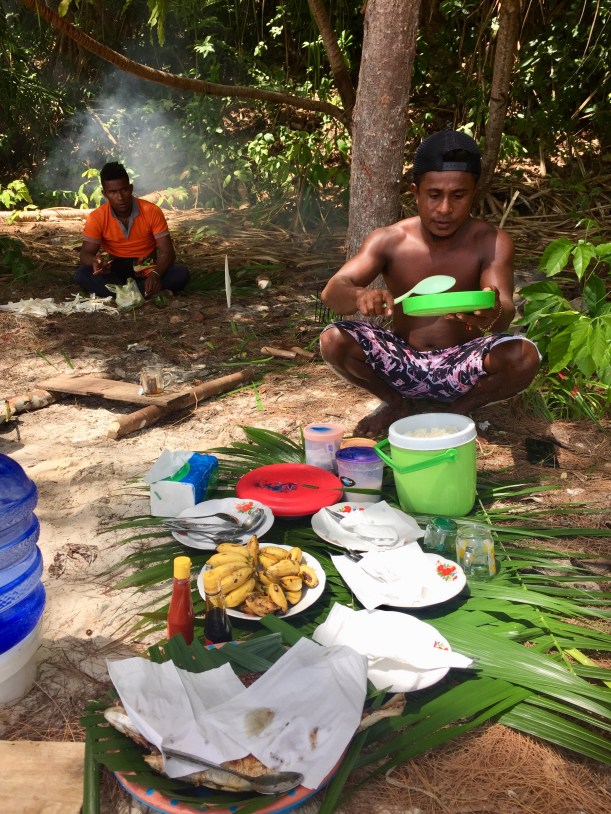
The next day we’re on the boat once again, heading to the small, uninhabited island of Yeben. But, fortunately, Manta Point is on the way, and once again, it doesn’t disappoint. Reluctantly, we wave goodbye to the remaining mantas and climb aboard the boat to make our way to the island. It’s ringed by gleaming white sand, with a shallow lagoon at it’s eastern side. We head out to snorkel the reef wall at the edge of the lagoon while Akes and his boatman cut dry branches to make a fire, over which they’ll grill whole fish for our lunch on the beach when we return. The snorkeling is, once again, spectacular. We can barely tear ourselves away to return to the beach, but are rewarded with the smell of freshly barbecued fish, along with vegetables and rice that Mama had prepared earlier.
IMG_E9650

Akes prepares our beach bbq on Yeben island.

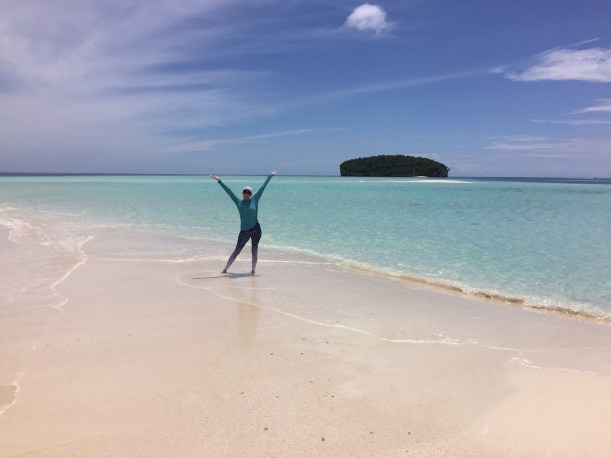
To top off a perfect day, Akes agrees to stop at Manta Point once again on the way home. This time we are stunned to see eleven magnificent mantas surround us when we enter the water. They glide, roll, flap their wings and entertain us for several minutes. Finally, when they move off, we lift our heads and hoot and holler, unable to control our excitement. We linger a bit longer, floating in deep water, waiting for more. Some of the mantas return, in ones and twos, making more passes by us. After several more minutes it seems they’ve moved on, and we climb back on board the boat and return home. Somehow, the sunset seems a little better that evening, perhaps because it’s viewed through wide eyes and with huge smiles. Our last day takes us across the channel to Cape Kri, where we drift across a deep reef, spotting black-tipped reef sharks and a large turtle. This is followed by a drift across a shallower portion of the reef, where we’re able to spot smaller fishes. We travel along the southern shore of Kri to it’s neighbor Mansour and tie up at the Yenbuba village jetty. Snorkeling the area of the jetty we see schools of large batfish, unicorn fish, three turtles and a couple reef sharks, along with the abundance of soft corals on the pilings. As a special treat, and owing to the receding tide, Akes takes us out to a white sand tidal flat just off Kri’s eastern side. We stroll the hundred feet of exposed sand, gaze at the chain of other sandy patches stretching off to Pulau Roti (Bread Island, so-called because of it’s similar profile to the beloved sweet buns the locals are so fond of)), marvel at the crystal-clear water and take so many selfies it’s like we’re a couple of Japanese schoolgirls. Once again we return home, not saying much, lost in our own thoughts of five amazing days filled with underwater wonders.
IMG_9704

Private island time. Pulau Roti in the background.

Leave a comment

Survivor: Atauro Island

Note: This leg of the trip took place in mid-January. Due to my health issue a week later I just never got around to writing this post until now.

“I think we should visit Timor Leste!” Heather exclaimed one afternoon as I swung in my hammock outside our guesthouse room in Ubud. ‘Oh God’ I thought. I was perfectly content here on Bali. Morning walks through the rice fields. A slew of great eateries available. Cooling off in the pool each afternoon. Enjoying cold Bintangs (the Indonesian beer) while watching sunsets. Why would she want to take us to one of the world’s newest, and poorest countries? No one I knew had been there. Why did we have to be the first?

World-class snorkeling. I guess that was as good a reason as any. So we packed our bags and took the two hour flight from Denpasar to Dili, Timor Leste’s capital. Dili is, as you might expect, a bit . . . rough. Three governments in the past three years haven’t been able to figure out how to use the revenue from the oil and gas found offshore, or the tourist dollars (and they’re actually dollars as the official currency is our very own greenback) to build the country up. On the ride from the airport to our guesthouse we saw crumbling sidewalks, pot-holed streets, loads of sullen-looking young men sitting around (no doubt the ladies were off working) and trash littering the shoreline. It all seemed pretty depressing. Yet, it turns out the Timorese are a pretty happy bunch. They were not about to let a little adversity get them down. Our driver, the guesthouse manager, mentioned that it was a particularly busy day. “Oh, are there many other guests?” we enquired. “No, there are no other guests. It’s just that two of my family died today. And only last month three others in my family died.” He said this rather matter-of-factly. Then he laughed and pointed out the new shopping center we were passing.

IMG_9408

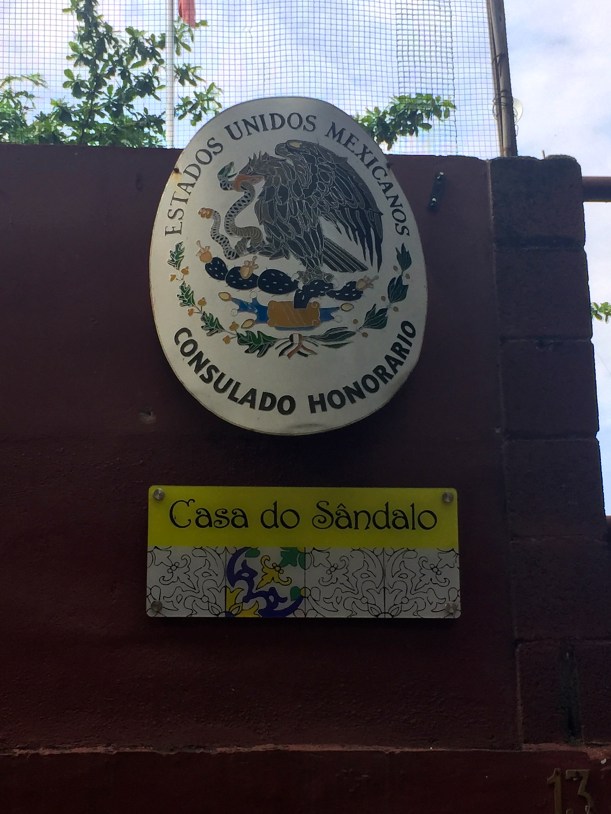
Guesthouse/consulate in Dili.

As we arrived at the Pousada Casa do Sandalo, a guard pushed back a large metal gate, allowing us access to the compound, which consisted of a cobblestone courtyard around a fountain and several trees, scattered wrought iron furniture, and a half dozen rooms facing a larger, main building. The structures were all painted a pleasant shade of yellow. A bit weird, I thought. The place reminded me of Mexico. When I went into the office to register, the same manager that drove us was sitting behind a massive wooden desk and greeted me once again. He pointed to a Mexican flag beside the desk. “Welcome to Pousada Casa do Sandalo and the honorary consulate of Mexico!” I wasn’t crazy then. I guess in Timor Leste, everyone needs a side hustle.

We would not dally in Dili. Our ultimate objective was Atauro Island, a mountainous mass on the northern horizon that we reached the next morning after a two-hour boat ride. We checked in to the Atauro Dive Resort, which overlooked the beach and boasted of an amazing house reef just offshore. Calling itself a ‘resort’ might have been a bit of a stretch. I hadn’t been to any other ‘resort’ where all the guests shared one pit toilet. The bed was comfortable and there was a huge deck facing the water, so there were pluses. What we didn’t realize at the time was how important the mosquito net on the bed would be. It would be the only safe haven, other then being in the water, from the relentless onslaught of flies and mosquitos. We could slather ourselves with DEET while sitting on the deck and lessen the biting of the mosquitos but nothing deterred the flies. Meals were eaten with one hand while waving away the flies with the other. If there was any area of the body not sprayed with repellent, it was bitten by mosquitos (imagine using that pit toilet!). After waking in the morning, the mosquitos were laying in wait outside the net as I exited our safe haven and quickly donned pants and long-sleeve shirt, then sprayed feet, hands and head with the repellent. After snorkeling, failing to immediately respray while storing gear or hanging wet clothing resulted in another round of bites.

OLYMPUS DIGITAL CAMERA

Approaching Atauro Island from Dili.

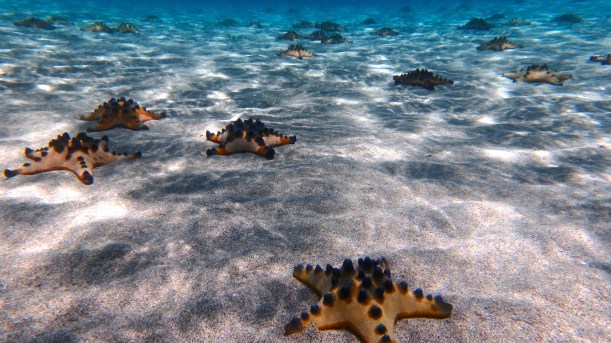
The snorkeling was, indeed, world-class. We’d never seen such a density of hard corals anywhere. The carpet of colors was mesmerizing. Large sandy areas were littered with starfish in reds, blues and orange. All the usual tropical fish species were in evidence. Blue-spotted rays, banded sea snakes and various moray eels were icing on the cake. We would spend six days on Atauro Island – snorkeling, swatting, spraying and sometimes cursing. When the time came to return to Dili for a night prior to our flight back to Bali, we were almost grateful to be leaving the bugs behind.
OLYMPUS DIGITAL CAMERA

Invasion of the starfish . . .

img_9431

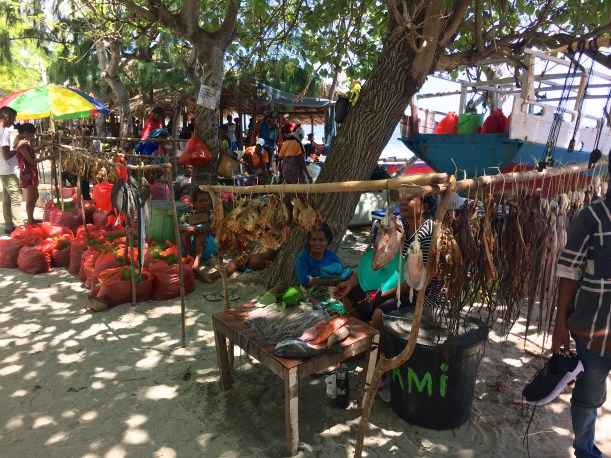
Atauro Island’s Saturday market – fresh and dried fish. The red bags contain seaweed. A pleasant diversion from all the snorkeling

OLYMPUS DIGITAL CAMERA

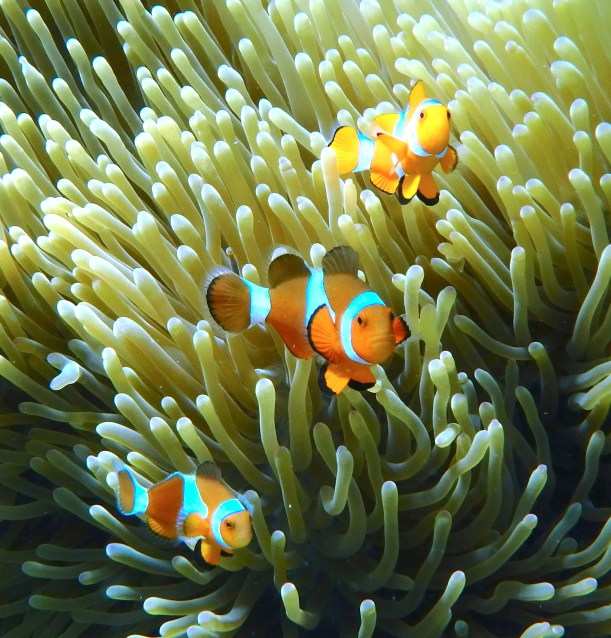
Everyone loves these little guys!

OLYMPUS DIGITAL CAMERA

Heather gives the Atauro reef a solid 10!


Leave a comment

A Java Tour With A Twist

It was 2:30 in the morning when I woke. The first thing I heard was the ticking of the wall clock, then the quiet drone of the air conditioning unit above me. I knew Heather was sleeping in the other single bed in the room. As I slowly came to full consciousness, I opened my eyes. First I noticed the hiss of oxygen coming out of the plastic tube that snaked around from behind me, under my chin and to my nose. Next, I felt the tape on the back of my left wrist that held the IV tube which disappeared under the skin there. On my right wrist was the hospital ID bracelet. I was propped up into an almost-sitting position. Moments later the drone of the first of many calls to prayer, which emanated from one of several mosques nearby, began. If I hadn’t woken up beforehand, this definitely would have roused me from my slumber. It all came back to me then. I was twenty-four hours into the worst health crisis of my life and we were stranded in the small city of Banyuwangi, in the eastern province of Muslim-dominated Java, Indonesia.
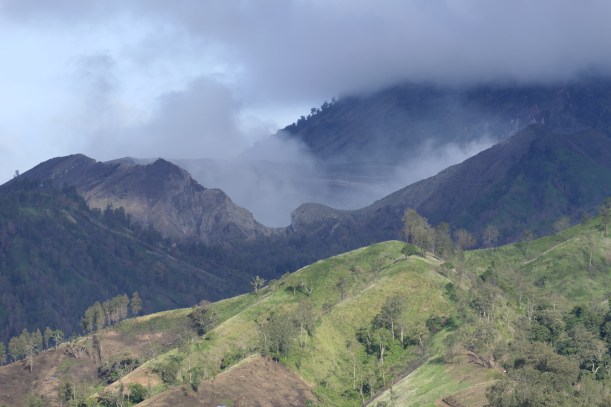
Just two days ago we had embarked on the start of a seven-day road trip with our guide and driver, Ade. The plan was to drive through western Bali, take a car ferry across to Java and visit several sites in the eastern province of the island. Ade, originally from Java, now living on Bali, was highly recommended by some friends. He had access to places there no one else did. He wanted his clients to see the “real Java” and we were totally onboard. Our first two days, after departing the ferry in Banyuwangi, were to head to Baluran National Park. It was an incredibly diverse area, ecologically, and encompassed rainforest, savanna, mangrove swamps, volcanic black sand beaches and, towering over everything, Mount Baluran. Ade had led the first Western tourist, only back in October of 2018, to the summit. He promised some unique experiences. The first afternoon we drove to Kawah Wurung, or ‘Failed Crater’, which, after a short hike, offered 360-degree views of the surrounding mountains and of Ijen, which contained a sulphur-spewing, blue-flame fire in it’s crater.

P1130678

A view of Ijen from Kawah Wurung.

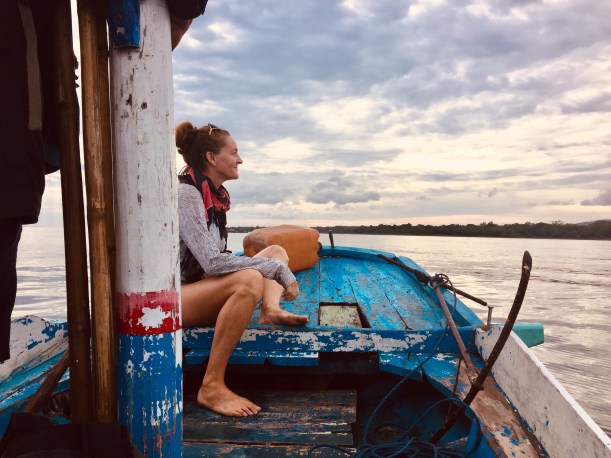
The following day we rose early to catch sunrise from the beach along the northern part of the park. We boarded a small wooden boat that would take us along the shore to the only village located within the park’s boundaries, known for grazing it’s large herd of cattle along the shoreline. Chugging along on the boat, marveling at the unwinding scenery in front of us, we, along with Ade, were joined by Hendrick, the park’s head ranger and the three crewmen of the boat. The calm water of the Java Sea lapped at the volcanic black sand beach, which was backed by mangroves and forest. The green canopy stretched back to, and up the slopes of Mount Baluran. Ijen and other volcanic peaks dotted the horizon from east to west.

IMG_E9564

A sunrise boat ride along the northern shore of Baluran Nat’l. Park.

We arrived at the village in time to see the last part of the cattle herd (nearly two hundred strong) being driven along the black sand to the sparse grasslands behind the mangroves. After landing on the beach, we walked about twenty minutes to one of Hendrick’s ranger stations where we settled down to have our packed breakfast. Then we boarded motorbikes, with drivers, to take us most of the way back west, along muddy trails, to our waiting boat for the short ride to the starting point, and Ade’s waiting car. The afternoon was spent driving park roads through the savanna, spotting deer, water buffalo and long-tailed macaque monkeys. A pair of hornbills screeched in the trees above us as we walked a short trail from the parking area at Bama Beach on the park’s east side. By evening we were back at our homestay in Sitabondo. Heather needed some rest, as she had been battling a cold for the past two days, and that morning’s 4:30 am start was taking it’s toll. Later that evening was when everything started to go south.

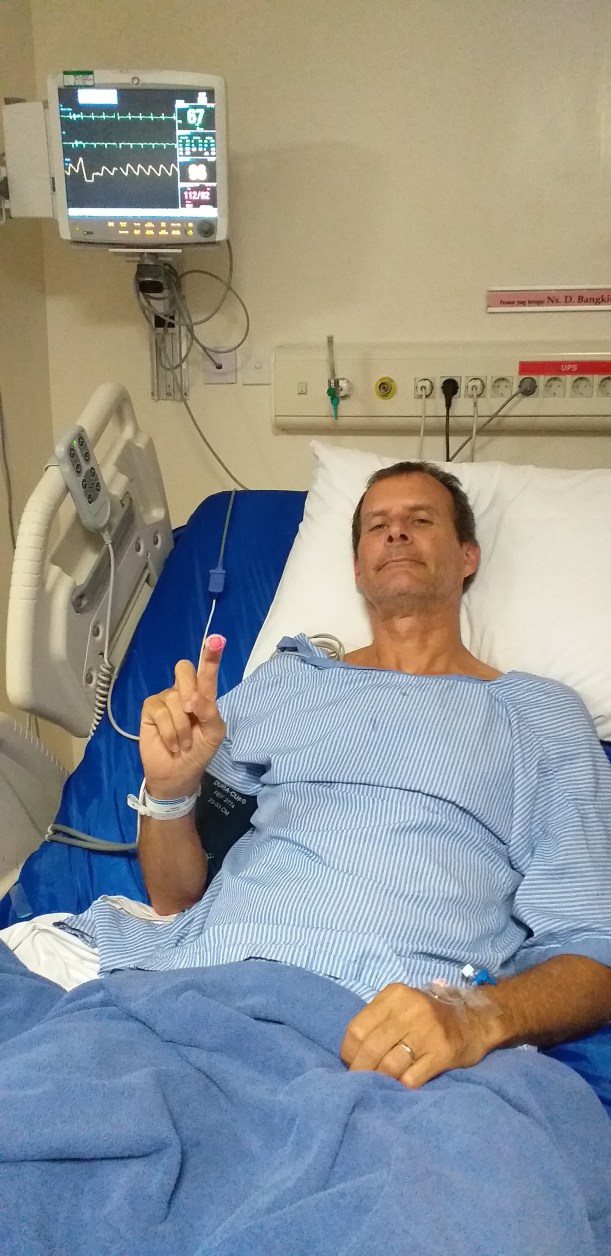
After dinner, I retired to bed around nine, Heather fast asleep in the bed beside mine. I had noticed a slight twinge in my chest as I tried to get comfortable. Waking at 2 am, the twinge had turned to a dull pain. I couldn’t lay on my right side. By 3 I couldn’t lay down at all. Propped up by a pillow I tried to reason out my predicament. Stabbing pain in the right-side of my chest. But no radiating pain to my shoulders or arms. No tingling in my fingers. No shortness of breath or feelings of nausea. I was not having a heart attack. I could wait this out. The pain grew. When Heather woke at just after six I told her my predicament. Googling symptoms on her phone she came back with two possibilities: a viral infection of the lung or a blood clot. Sitting up the symptoms subsided a little. Maybe I could ride this out and it would go away. The problem was that our plan for the coming day involved traveling south for two hours by car. Then we would transfer to a jeep for the three hour journey to Meru Bethiri National Park along the southern coast of Java, where we would spend the night at a back-country ranger station to view sea turtles laying their eggs along the beach and joining in on the release of new hatchlings to the sea the next morning. If things went downhill, we would be about as far-removed from care as we could get. The decision was made to return to Banyuwangi, the closest hospital to our location. As we started the hour drive, Heather was texting with our friend, Kristi, back in Colorado. She’s an operating room nurse and our go-to source for health questions while traveling. Throughout the ride Kristi passed along suggestions and gave advice. Given the specific pain in the right-side chest area, she was convinced of a pulmonary issue. We arrived at the hospital and sat while Ade went to the reception desk to arrange for a doctor to see me. On a whim, Kristi texted one more question to Heather – ‘had I experienced any pain in my calf recently?’ I turned to her in surprise. In fact, I had been having unexplained tightness in my right calf over the past four days. But what could that have to do with pain in my chest? We anxiously hovered over the phone waiting for the reply. When it came we were speechless. Kristi stated unequivocally “I am 100% certain. A blood clot from your leg has detached and lodged in your lung. There can be no delay in treatment.” She then listed a series of drug injections, blood tests and other monitoring that needed to be started ASAP. Heather sprung to action. She demanded access to the ER and we were promptly taken in. While walking to a curtained area, she was reading off Kristi’s recommendations to anyone who would listen. Nurses started an IV drip, took my blood pressure and performed an EKG. The doctor arrived and Heather repeated her action list. Heather became increasingly frustrated as the doctors seemed to focus on my right leg. After all, she had mentioned the calf pain and they wanted to investigate that as well, even rolling me along to X-ray to rule out any fractures. Only then convinced that the leg was healthy would they proceed to determining the cause of my chest pain. When an injection was ordered, Ade would take the prescription and run to the pharmacy department to purchase the drug, hand it to the nurse, who in turn would administer it. A bit crazy. The decision to admit me was made and I thought perhaps Ade would leave us, assuming our tour was finished. But he never left our side. And I mean that literally – he slept outside our private hospital room (on a mat on the tile floor of the terrace) for two nights; fetched meals for Heather (I suffered through the hospital food); was always present when doctors and nurses came to the room in order to interpret; and supplied us with bottled water. 

20190125_093442

This stop wasn’t on our Java itinerary.

I’m lucky. I had two blood clots lodge in my lungs. No permanent damage done. I have a wife who fought tooth and nail for me to get the proper course of care. She spent the first two days at my side, sleeping in my room, then keeping me company during the day throughout my eight-day stay, despite suffering through a cold.  I had a friend, over 9,000 miles away, who correctly diagnosed my condition, when the local doctors couldn’t. I had someone who was a perfect stranger just two days earlier refuse to abandon us and supported us throughout my hospital stay. After a week I felt good – other than the cold I caught, and was released. I’ll have to take it easy for a couple weeks, until a follow-up exam hopefully shows that the DVT in my leg has completely dissolved. Then it’ll be time to head out to Raja Ampat. The reefs are calling!